10-K: Annual report [Section 13 and 15(d), not S-K Item 405]
Published on February 27, 2026
UNITED STATES
SECURITIES AND EXCHANGE COMMISSION
Washington, D.C. 20549
________________________
FORM 10-K
________________________
(Mark One)
| ANNUAL REPORT PURSUANT TO SECTION 13 OR 15(d) OF THE SECURITIES EXCHANGE ACT OF 1934 | |||||
For the fiscal year ended | |||||
| or | |||||
| TRANSITION REPORT PURSUANT TO SECTION 13 OR 15(d) OF THE SECURITIES EXCHANGE ACT OF 1934 For the transition period from ____________ to ____________ | |||||
Commission File Number: | |||||
(Exact name of registrant as specified in its charter)
| (State or other jurisdiction of incorporation or organization) | (I.R.S. Employer Identification No.) | |||||||
(Address of principal executive offices) (Zip Code)
Registrant’s telephone number, including area code: (832 ) 308-4999
Securities registered pursuant to Section 12(b) of the Act:
| Title of each class | Trading Symbol(s) | Name of each exchange on which registered | ||||||
Securities registered pursuant to Section 12(g) of the Act: None
________________________
Indicate by check mark if the registrant is a well-known seasoned issuer, as defined in Rule 405 of the Securities Act. Yes þ No o
Indicate by check mark if the registrant is not required to file reports pursuant to Section 13 or Section 15(d) of the Act. Yes o No þ
Indicate by check mark whether the registrant (1) has filed all reports required to be filed by Section 13 or 15(d) of the Securities Exchange Act of 1934 during the preceding 12 months (or for such shorter period that the registrant was required to file such reports), and (2) has been subject to such filing requirements for the past 90 days. Yes þ No o
Indicate by check mark whether the registrant has submitted electronically every Interactive Data File required to be submitted pursuant to Rule 405 of Regulation S-T (§ 232.405 of this chapter) during the preceding 12 months (or for such shorter period that the registrant was required to submit such files). Yes þ No o
Indicate by check mark whether the registrant is a large accelerated filer, an accelerated filer, a non-accelerated filer, a smaller reporting company, or an emerging growth company. See the definitions of “large accelerated filer,” “accelerated filer,” “smaller reporting company,” and “emerging growth company” in Rule 12b-2 of the Exchange Act.
þ | Accelerated filer | o | |||||||||||||||
Non-accelerated filer | o | Smaller reporting company | |||||||||||||||
Emerging growth company | |||||||||||||||||
If an emerging growth company, indicate by check mark if the registrant has elected not to use the extended transition period for complying with any new or revised financial accounting standards provided pursuant to Section 13(a) of the Exchange Act. o
Indicate by check mark whether the registrant has filed a report on and attestation to its management’s assessment of the effectiveness of its internal control over financial reporting under Section 404(b) of the Sarbanes-Oxley Act (15 U.S.C. 7262(b)) by the registered public accounting firm that prepared or issued its audit report. þ
If securities are registered pursuant to Section 12(b) of the Act, indicate by check mark whether the financial statements of the registrant included in the filing reflect the correction of an error to previously issued financial statements. o
Indicate by check mark whether any of those error corrections are restatements that required a recovery analysis of incentive-based compensation received by any of the registrant’s executive officers during the relevant recovery period pursuant to §240.10D-1(b). o
Indicate by check mark whether the registrant is a shell company (as defined in Rule 12b-2 of the Act). Yes ☐ No þ
The aggregate market value of voting and non-voting common equity held by non-affiliates of the registrant as of June 30, 2025, the last business day of NCR Atleos Corporation’s most recently completed second fiscal quarter, was approximately $2.08 billion.
As of February 20, 2026, there were 73,561,203 shares of common stock issued and outstanding.
DOCUMENTS INCORPORATED BY REFERENCE
| Part III: | Portions of the Registrant’s Definitive Proxy Statement for its Annual Meeting of Stockholders to be filed pursuant to Regulation 14A within 120 days after the Registrant’s fiscal year end of December 31, 2025 are incorporated by reference into Part III of this Report. | ||||
TABLE OF CONTENTS
| Item | Description | Page | ||||||
| PART I | ||||||||
| 1 | ||||||||
| 1A. | ||||||||
| 1B. | ||||||||
| 1C. | ||||||||
| 2 | ||||||||
| 3 | ||||||||
| 4 | ||||||||
| PART II | ||||||||
| 5 | ||||||||
| 6 | ||||||||
| 7 | ||||||||
| 7A. | ||||||||
| 8 | ||||||||
| 9 | ||||||||
| 9A. | ||||||||
| 9B. | ||||||||
| 9C. | ||||||||
| PART III | ||||||||
| 10 | ||||||||
| 11 | ||||||||
| 12 | ||||||||
| 13 | ||||||||
| 14 | ||||||||
| PART IV | ||||||||
| 15 | ||||||||
| 16 | ||||||||
This Report contains trademarks, service marks and registered marks of NCR Atleos Corporation and its subsidiaries, and of other companies, as indicated. Unless otherwise indicated, the terms “Atleos,” the “Company,” “we,” “us,” and “our” refer to NCR Atleos Corporation and its subsidiaries.
FORWARD LOOKING STATEMENTS
This Annual Report on Form 10-K and other materials Atleos has filed or will file with the SEC contain, or will contain, “forward-looking statements” within the meaning of Section 27A of the Securities Act of 1933, as amended, and Section 21E of the Securities Exchange Act of 1934, as amended, pursuant to the safe harbor provisions of the Private Securities Litigation Reform Act of 1995 (the “Act”). Forward-looking statements use words such as “expect,” “anticipate,” “outlook,” “intend,” “plan,” “confident,” “believe,” “will,” “should,” “would,” “potential,” “positioning,” “proposed,” “planned,” “objective,” “likely,” “could,” “may,” and words of similar meaning, as well as other words or expressions referencing future events, conditions or circumstances. We intend these forward-looking statements to be covered by the safe harbor provisions for forward-looking statements contained in the Act. Statements that describe or relate to Atleos’ plans, goals, intentions, strategies, or financial outlook, and statements that do not relate to historical or current fact, are examples of forward-looking statements. Examples of forward-looking statements in this Annual Report on Form 10-K include, without limitation, statements regarding: Atleos’ business and financial strategy; Atleos’ future plans relating to its workforce talent; expectations regarding Atleos’ cash flow generation and liquidity; our expectations of demand for our solutions and execution and the impact thereof on our financial results; Atleos’ focus on advancing our strategic growth initiatives and transforming Atleos into a software-led as a service company with a higher mix of recurring revenue streams; and our expectations of Atleos’ ability to deliver increased value to customers and stockholders. Forward-looking statements are based on Atleos’ current beliefs, expectations and assumptions, which may not prove to be accurate, and involve a number of known and unknown risks and uncertainties, many of which are out of Atleos’ control. Forward-looking statements are not guarantees of future performance, and there are a number of important factors that could cause actual outcomes and results to differ materially from the results contemplated by such forward-looking statements, including those factors listed under the sections entitled “Risk Factors,” “Management’s Discussion and Analysis of Financial Condition and Results of Operations,” and “Business,” including factors relating to:
•Strategy and Technology: transforming our business model; development and introduction of new solutions; competition in the technology industry; integration of acquisitions and management of alliance activities; and our multinational operations;
•Business Operations: domestic and global economic and credit conditions; tariffs and other trade measures; risks and uncertainties from the payments-related business and industry; maintenance of a significant amount of vault cash, which involves risk of loss and is subject to cost fluctuations based on interest rate movements; retention and attraction of key employees; defects, errors, installation difficulties or development delays; failure of third-party suppliers; a major natural disaster or catastrophic event, including the impact of pandemics and geopolitical and macroeconomic challenges; environmental exposures from historical and ongoing manufacturing activities and climate change; and the impact of data protection, cybersecurity and data privacy including any related issues;
•Finance and Accounting: our level of indebtedness; the terms governing our indebtedness; incurrence of additional debt or similar liabilities or obligations; access or renewal of financing sources; our cash flow sufficiency to service our indebtedness; interest rate risks; the terms governing our trade receivables facility; any lowering or withdrawal of the ratings assigned to our debt securities by rating agencies; our pension liabilities; and the write down of the value of certain significant assets;
•Law and Compliance: allegations or claims by third parties that our products or services infringe on intellectual property rights of others, including claims against our customers and claims by our customers to defend and indemnify them with respect to such claims; changes to our tax rates and additional income tax liabilities; uncertainties regarding regulations, lawsuits and other related matters; and changes to cryptocurrency regulations;
•Separation: the perceived reliability of Atleos’ financial statements if Atleos is unable to satisfy the requirements of Section 404 of the Sarbanes-Oxley Act; that Atleos may incur material costs and expenses as a result of the spin-off; Atleos’ obligation to indemnify NCR Voyix Corporation (“Voyix”) pursuant to the agreements entered into in connection with the spin-off (including with respect to material taxes) and the risk Voyix may not fulfill any obligations to indemnify Atleos under such agreements; that under applicable tax law, Atleos may be liable for certain tax liabilities of Voyix following the spin-off if Voyix were to fail to pay such taxes; that agreements binding on Atleos restrict it from taking certain actions after the distribution that could adversely impact the intended U.S. federal income tax treatment of the distribution and related transactions; potential liabilities arising out of state and federal fraudulent conveyance laws; the fact that Atleos may receive worse commercial terms from third parties for services it previously received from Voyix; and that after the spin-off, certain of Atleos’ executive officers and directors may have actual or potential conflicts of interest because of their previous positions at NCR; and
•Our Common Stock: Atleos’ stock price may fluctuate significantly; substantial sales in the public market may cause the price of Atleos’ common stock to decline; timing, amount or payment of dividends; dilution of ownership percentages; timing and impact of Atleos’ share repurchase program; certain provisions in Atleos’ governing documents may prevent or delay an acquisition; the exclusive forum provision in Atleos’ bylaws could limit a stockholder’s ability to bring a claim against Atleos; and actions or proposals from stockholders that do not align with our business strategies or the interests of our other stockholders.
i
Should one or more of these risks or uncertainties materialize, or should underlying assumptions prove incorrect, actual results may vary materially from those set forth in the forward-looking statements. Atleos may not be able to realize any of the potential strategic benefits, synergies or opportunities as a result of these actions, nor may stockholders achieve any particular level of stockholder returns. The separation may not enhance value for stockholders, nor may Atleos be commercially successful in the future, nor achieve any particular credit rating or financial results. Any forward-looking statement speaks only as of the date on which it is made. Atleos does not undertake any obligation to publicly update or revise any forward-looking statements, whether as a result of new information, future events or otherwise, except as required by law.
ii
PART I
Item 1. BUSINESS
General
General Development of the Business
NCR Atleos Corporation (“Atleos,” the “Company,” “we,” “us,” and “our”) is an industry-leading financial technology company providing self-directed banking solutions to a global customer base including financial institutions, merchants, manufacturers, retailers and consumers. Self-directed banking is a rapidly growing, secular trend that allows banking customers to transact seamlessly between various channels all for the same transaction. Our comprehensive solutions enable the acceleration of self-directed banking through automated teller machine (“ATM”) and interactive teller machine (“ITM”) technology, including software, services, hardware and our proprietary Allpoint network. While we provide all our solutions on a modular basis, we have also assembled these capabilities into a turnkey, end-to-end platform which we have branded “ATM as a Service.” On October 16, 2023, we completed our separation from NCR Corporation (now known as NCR Voyix Corporation or “Voyix” and referred to as “NCR” prior to the Separation) and launched as an independent publicly-traded company (the “Separation” or “Spin-off”). Additional information about the Separation can be found in Note 1, “Basis of Presentation and Significant Accounting Policies”, in Part II, Item 8 of this Annual Report on Form 10-K.
As ATM technology has evolved in recent years, the substantial majority of banking transactions can now be completed at the ATM, including cash deposits, withdrawals and other account services, as well as the origination of payments transactions such as bill payments and money transfer. In addition, the development of ITMs, which utilize remote bank employees to provide customer support and servicing via interactive video, enable customers to complete more complex transactions such as account opening, card issuance and replacement, and loan applications. We believe that ATMs and ITMs are increasingly the delivery channel of choice where transactions cannot be completed digitally, and for this reason, are critical to a broader strategy to provide convenient access for consumers.
The secular nature of the growth in self-directed banking is in large part responsive to how financial institutions interact with their customers and the ensuing implications to the traditional branch banking operational model. With retail banking customers increasingly receptive to engagement outside the traditional branch banking environment, financial institutions are investing in non-branch channels to foster enhanced engagement with their customers. As such, ATMs and ITMs represent an increasing share of transactions relative to the legacy branch infrastructure.
These shifts in engagement have meaningful operating implications, particularly in the face of sustained margin pressure across the banking industry. We believe that self-service banking capabilities, and self-directed banking more broadly, represent an opportunity for financial institutions to rationalize legacy branch networks and instead invest in omni-channel engagement models, often in partnership with third party providers as part of a comprehensive and more cost-effective solution.
Our solutions are designed to enable the acceleration of digital transformation through software, services, and hardware, creating meaningful operating efficiencies while offering differentiated user experiences to end consumers. ATM and ITM channels allow financial institutions to transform the traditional branch banking model and offer a more robust, efficient, and convenient banking experience to their customers.
Our solutions also offer distinct and powerful advantages to retailers and consumers. Through our ATMs and ITMs, retailers can create everyday banking destinations within their store footprints, driving new and repeat foot traffic and increased in-store spending while reducing the high labor costs associated with maintaining in-store financial services desks. Consumers benefit from increased convenience and connectivity through proximity to our network of approximately 78,000 self-service banking terminal locations, including the Allpoint network, which we believe is the largest retail surcharge-free independent network of ATMs in the U.S.
We believe our comprehensive capabilities differentiate us in the marketplace for self-directed banking technology. Historically, banks and retailers would negotiate with a wide array of third-party technology and service providers, pairing disparate systems with internally developed technologies to assemble a disjointed self-directed banking offering. Our customers, in contrast, benefit from a comprehensive outsourced solution to a single vendor, improving the functionality and availability of a self-directed banking network and the predictability of the cost to operate.
1
Given the demands of our customers, we are continuing our transition to software-led solutions. Today, our software platform, which runs in the cloud and includes microservices and application programming interfaces (“APIs”) that integrate with our customers’ systems, and our ATM as a Service solutions, bring together all our capabilities and competencies to power the technology to run our customers’ self-directed banking networks, at the same time allowing us to earn a greater proportion of recurring revenues.
We have grown organically, as well as through acquisitions, to add software, services and other capabilities that complement or enhance our existing portfolio. We intend to continue pursuing opportunities to win new customers, expand our footprint and drive more transactions and foot traffic for our customers.
By delivering mission-critical solutions to a durable customer base under long term contracts, we generate diversified and largely recurring revenues across contracted software, services and predictable transactional revenue streams. We believe our global scale, operational expertise and efficient use of capital, as a percentage of revenues, position us to deliver meaningful free cash flow, with opportunities for further expansion as we pursue our growth objectives, undertake strategic acquisitions and return capital to our stockholders.
NCR Atleos Corporation’s common stock is listed on the New York Stock Exchange (“NYSE”) and trades under the symbol “NATL.”
Operating Segments
We manage our operations in the following segments: Self-Service Banking, Network, and Telecommunications & Technology (“T&T”).
•Self-Service Banking - Offers solutions to enable customers in the financial services industry to reduce costs, generate new revenue streams and enhance customer loyalty. These solutions include a comprehensive line of ATM hardware and software, and related installation, maintenance, and managed and professional services. We also offer an ATM as a service (“ATMaaS”) solution to manage and run the ATM channel end-to-end for financial institutions that include back office, cash management, software management and ATM deployment, among other services.
•Network - Provides a cost-effective way for financial institutions, financial technology companies (“fintechs”), neobanks, and retailers to reach and serve their customers through our network of ATMs and multi-functioning financial services kiosks. We offer credit unions, banks, digital banks, fintechs, stored-value debit card issuers, and other consumer financial services providers access to our ATM network, including our proprietary Allpoint network, providing convenient and fee-free cash withdrawal and deposit access to their customers and cardholders as well as the ability to convert a digital value to cash, or vice versa, via ReadyCode. We also provide ATM branding solutions to financial institutions, ATM management and services to retailers and other businesses, and our LibertyX solution gives consumers the ability to buy and sell Bitcoin.
•T&T - Offers managed network and infrastructure services to enterprise clients across all industries via direct relationships with communications service providers and technology manufacturers. Our customers rely on us as a strategic partner to help them reduce complexity, improve cost efficiency, and enable global geographical reach. We deliver expert professional, field, and remote services for modern network technologies including Software-Defined Wide Area Networking, Network Functions Virtualization, Wireless Local Area Networks, Optical Networking, and Edge Networks.
Our Strategy
Our business strategy and growth roadmap are defined by the following:
•Increase transaction levels at existing locations: We believe there are opportunities to increase the number of transactions that occur at our existing ATM locations. In addition to our current initiatives that tend to drive additional transaction volumes to our ATMs, such as bank-branding, we have developed and are continuing to develop new initiatives to drive incremental transactions to our existing ATM locations. These initiatives may include incentives to cardholders, such as coupons and rewards, which incentivize customers to visit our ATMs. We also continue to invest in data analytics to identify high cash usage areas allowing us to better serve our financial institution partners and customers.
•Win more customers and expand our footprint in target markets: We have a long history and association with branch transformation through generations of products and thousands of customers, many of whom we have served for decades. We will continue to invest in the sales and customer success teams required to win and retain new customers and expand our ATM footprint with both retailers and banks. Our targeted customer acquisition strategy varies by customer type:
2
◦Retail: We believe the retail channel is substantially underpenetrated and an actionable opportunity to grow our network. The value proposition through retail partnerships is multi-faceted, most importantly driving increased foot traffic and sales velocity. We are investing in initiatives to more proactively help drive traffic and marketing for our retail partners, by for instance drawing cardholders to retail ATM locations in exchange for incentives and other retail offers.
◦Bank: We will continue to invest in winning more banks and credit unions, primarily seeking to deploy our ATMaaS model but also traditional company- and bank-owned models. Critically, we will continue to invest in our value proposition, ensuring that we allow our financial institution customers to offer a premier end-consumer experience at a material savings as compared to an internally developed ATM network.
•Invest in the FinTech channel: We intend to invest to expand relationships with fintechs and card issuers, such as reloadable stored-value debit card issuers, digital-only balances held by consumers, and alternative payment networks, which are seeking an extensive and convenient ATM network to complement their card offerings and electronic-based accounts. Many leading fintechs and challenger digital banks and providers of consumer financial services that lack a physical branch or ATM network of their own have partnered with us to provide their customers with convenient and surcharge-free access to ATM services. We have seen strong transaction growth with this customer type, as many of these businesses promote the convenience of our Allpoint network as a value point to their customers and an integral part of their solution.
•Shift traditional ATM business to recurring ATM as a Service model: We intend to continue investing to win new ATMaaS customers as well as convert existing customers operating under a traditional model. We estimate that the contractual ATMaaS model doubles recurring revenue as compared to a traditional ATM hardware and maintenance contract of comparable size, expanding our total addressable market. This is because historically certain of our customers would purchase some of the components that make up our ATMaaS offering from third parties. By combining all of these components into one ATMaaS offering, the Company strengthens its service offering for customers and increases our ability to capture additional revenues. With our comprehensive as a service model, we have an opportunity to win incremental market share by improving the utility of new and existing customers’ self-directed banking solutions, driving retention.
•Grow the Allpoint network: As banks reduce physical footprints and digitize existing branches, and credit unions seek to expand with limited physical points of presence, our value proposition is only magnified, and our sales pipeline reflects this secular trend. We will continue to invest in bringing financial institutions and retailers to the Allpoint network to drive high margin incremental transaction volumes while allowing us to continue to re-invest in expanding and improving the network, reinforcing our competitive advantage. We believe the addition of deposit accepting functionality in the Allpoint network significantly expands the value proposition to our customers, allowing them to offer near branch functionality in secure convenient retail locations that their customers are in every day.
•Expand Total Addressable Market through product development: We see an opportunity to expand our addressable market by extending the breadth of our capabilities. For example, we are investing to introduce cashless card access and Bitcoin capabilities, extending ATM capabilities beyond traditional uses, such as cash access and balance inquiries. As another example, we are introducing cash deposit functionality specifically targeting retailers executing prepaid reloads, billpay and other cash-to-card consumer transactions which generate substantial daily cash balances.
•International Expansion: We intend to continue investing in international expansion. As of December 31, 2025, we have ATM networks in 13 countries and service ATMs in 65 countries and, in 2025, we generated 55% of our revenue outside of the United States. We will focus our expansion and investment on high cash jurisdictions, such as European Union countries and beyond, where we believe we have an opportunity to build Allpoint-like networks in partnership with broader, country-level banking systems.
•Select M&A: We intend to continue to complement and accelerate our organic growth strategies through acquisitions. As historical operating businesses within NCR, we have a successful record of identifying, executing, and integrating acquisitions, and we intend to continue to pursue acquisitions where they can accelerate our growth objectives and are strategically and financially accretive.
Our business strategy and growth roadmap allow us to remain on the leading edge of secular trends driving self-directed banking, be efficient and have widespread availability of financial services and financial inclusion more broadly.
3
Products and Services
The comprehensive set of products and capabilities we deliver can be flexibly constructed into a solution to meet the needs of the customer. The flexibility of our model is well suited both for customers who are interested in a completely outsourced, turnkey solution and for those customers who prefer to integrate our products into their existing infrastructure. Our solutions consist of self-service software, self-service hardware, our global services network, ATM network, and managed services:
•Software: We develop, install, support and run software, which we brand as AMP (ATM Management Platform), to power a modern user experience for our proprietary and third-party hardware units. Select functionality includes device management, endpoint security, ATM marketing, cash management, transaction processing, personalization and application software. We have developed our software expressly to foster the digital first strategies of customers, including the requisite flexibility to enable seamless add-ons, upgrades, maintenance and security. We earn revenue on a recurring, subscription basis based on multi-year contracts. Our combined software and services strategy is the driving factor behind the evolution of our financial profile to a more recurring, lower capital model.
•Hardware: We develop, assemble, distribute and maintain a variety of ATM hardware units. We can assemble and sell an ATM or ITM with or without embedding our own hardware-agnostic software. Our hardware products include multi-function ATMs, ITMs, cash dispensers and cash recycling ATMs. The breadth of our hardware offerings ensures that we can address the increasingly diverse use cases that financial services kiosks serve today, offering a valuable on-ramp to broader software and managed services offerings.
•Global Services Network: Underlaying our self-service software and hardware solutions is our global service network that enables us to install, maintain, and repair our own units or third-party units. Hardware and software service support is offered on a stand-alone basis, as part of self-service solutions, or bundled with other managed services. The scale, expertise and global reach of our service network differentiate us from our competitors.
•ATM Network: The ATMs and ITMs we deploy are operated under either Company-owned, customer-owned, or partner-owned models, depending on the customer need and delivery model selected. The majority of the kiosks we serve are ATMs, however financial institutions and retailers are increasingly looking to video teller solutions to offer more self-service options to their customers, and we are well positioned to serve these needs.
In a Company-owned arrangement, we place ATMs generally at well-known retailers such as Circle K, Costco, CVS, Kroger, Target, and Walgreens. We also service and operate ATM networks on behalf of financial institutions, independent operators (ISOs) or program managers in either a Company-owned or customer-owned model, with services directed by the customer. We are typically responsible for the majority of the aspects of the ATM’s operations. Services can include transaction processing, managing cash and cash delivery, supplies, and telecommunications, as well as routine and technical maintenance. We typically earn revenue on a per transaction basis from the surcharge fees accepted by cardholders for the convenience of using our ATMs and from interchange fees paid by cardholders’ financial institutions when processing the transactions conducted on our ATMs, or on a fixed monthly recurring fee. In a customer-owned or partner-owned model, the bank, retail merchant or independent distributor owns the ATM and is usually responsible for providing cash and performing simple maintenance tasks, while we generally provide processing only services or various managed services solutions.
With Company-owned ATMs we have an opportunity to augment revenue streams through branding arrangements, specifically by attaching customer logos to our ATMs and transactions both physically and digitally. These bank-branding arrangements allow a financial institution or fintech to expand geographically for less than the cost of building a branch location or placing a stand-alone ATM or advertising through costly media channels. Under these arrangements, the financial institution’s or fintech’s customers have surcharge-free access to do everyday banking at the branded ATMs. In return, we may receive branding fees from the financial institution or fintech while increasing our volumes driven by surcharge-free access and retaining our base revenue for non-branded cardholders using the branded ATMs. When the brand of a financial services provider is placed on an ATM, volumes typically increase which contributes to base revenue production through interchange and other applicable fees.
We offer credit unions, banks, digital banks, fintechs, stored-value debit card issuers, and other consumer financial services providers access to Allpoint, our retail-based ATM network, providing convenient and surcharge-free cash withdrawal and deposit access to end consumers and cardholders as well as the ability to convert a digital value to cash, or vice versa, via ReadyCode. Additionally, our LibertyX platform gives enrolled LibertyX users the ability to buy and sell Bitcoin.
4
•Managed Services: Our managed services, including ATMaaS solutions, help retailers, financial institutions, and ATM distributors run their end-to-end ATM channel by relying on us to handle some or all of the operational aspects associated with operating and maintaining ATMs, typically in exchange for a monthly service fee, a fee per transaction, or a fee per service provided. As part of this suite of services, we offer a full line of software such as multi-vendor ATM management systems software application suite and related hardware including multi-function ATMs, ITMs, thin-client ATMs, cash dispensers, and cash recycling ATMs. Additionally, we offer back office, cash management and delivery, software management, transaction management, ATM deployment, and routine and technical maintenance, among other related services. Each managed service arrangement is a customized ATM management solution that can include any combination of the services we offer.
Sales and Marketing
We have a sales and marketing team around the globe focused on developing and managing our relationships with financial institutions and retail customers. We typically organize our sales and marketing teams by customer type across retail and financial customers. Our sales and marketing teams focus on understanding customer needs and market or competitor dynamics, product development planning and market sizing, project lifecycle management and development, and analysis to evaluate if our services are meeting customer needs. Our product lifecycle approach ensures we have high-quality products that are launched consistently in a customer-centric manner. In addition to targeting new business opportunities, our sales and marketing teams support our customer retention and growth initiatives by building and maintaining relationships with our existing customers. We maintain sales teams for each of the geographic markets in which we currently operate.
We seek to identify growth opportunities and have also worked to simplify and streamline our sales and marketing processes, maintaining our high quality and consistent experience for customers, while delivering on a timely basis.
Customers
We have built a global network and serve banks and credit unions of varying sizes in over 140 countries.
In our retail channel, we operate under long-term contracts with major national and regional merchants including convenience stores, gas stations, grocery stores, pharmacies, and other high-traffic locations. Our merchant-owned ATMs are typically deployed under arrangements with smaller independent merchants.
Competition
We believe that we are well-positioned to offer a comprehensive self-directed banking solution with our breadth of services, in-house expertise, and network of existing locations, that can leverage the economies of the physical services required to operate an ATM portfolio. However, there are several large financial services companies, equipment manufacturers, and service providers that currently offer some of the services we provide, with whom we compete directly in this area. Our competition consists of global ATM software, services and hardware companies including Fiserv, Euronet, Brink’s Company, Hyosung, and Diebold Nixdorf. Within our Allpoint network, historically, we have competed with financial institutions and other independent ATM deployers (commonly referred to as “IADs”) for additional ATM placements, new merchant accounts, branding, and acquisitions.
Research and Development
We remain focused on designing and developing solutions that anticipate our customers’ changing technological needs, as well as consumer preferences for convenience and accessibility. Our expenses for research and development were $70 million in 2025, $62 million in 2024, and $80 million in 2023. We anticipate that we will continue to have significant research and development expenditures in the future in order to provide a continuing flow of innovative, high-quality products and services and to help maintain and enhance our competitive position. Information regarding the accounting and costs included in research and development activities is included in Note 1, “Basis of Presentation and Significant Accounting Policies”, of the Notes to Consolidated Financial Statements in Item 8 of Part II of this Report under “Research and Development Costs,” and is incorporated herein by reference. We also continue to evaluate emerging technologies, such as machine learning and generative artificial intelligence (“AI”), for incorporation into our business to augment our products and services.
Intellectual Property, including Patents and Trademarks
Intellectual property is of significant importance to us. We maintain a broad portfolio of intellectual property rights, including patents, copyrights, trademarks and trade secret rights. We use intellectual property rights, nondisclosure agreements, assignment agreements and other measures to protect and establish our intellectual property rights and ownership of our intellectual property. In
5
many cases, we own the intellectual property relevant to or used by our business, but in other cases, we obtain licenses, including in supply arrangements, to access and use other parties’ intellectual property, including that of Voyix. Although in the aggregate our intellectual property is materially important to Atleos and our business, we do not consider any single piece of technology, patent, copyright, trade secret or license to it to be of material importance to our business as a whole.
We believe we have and will continue to take reasonable measures to protect our intellectual property and build our portfolio of intellectual property rights, but we cannot be assured that any of our intellectual property rights or other intellectual property may not be challenged, found unenforceable or invalid, or used, copied, otherwise infringed or misappropriated by others. From time to time, we take actions to protect our business by asserting our intellectual property rights against third-party infringers or those who misappropriate our trade secrets.
We seek patent protection for our innovations, creations and developments, and other technology (including software) along with improvements to them, our hardware, products, services and solutions, especially where such protection is likely to provide strategic value to us. Atleos owns approximately 500 patents in the United States and various other patents in foreign countries. The foreign patents are generally counterparts of our United States patents. Many of the patents owned by Atleos are licensed to others, and Atleos is licensed under certain patents owned by others. We also have numerous patent applications pending in the United States and in foreign countries. Our portfolio of patents and patent applications is of significant value and importance to us. As appropriate, we may look to monetize our patents and certain technology and other intellectual property rights to drive additional value from our intellectual property portfolio.
We have registered, and most likely will continue to register, certain trademarks in the United States and foreign countries. We consider the “NCR Atleos” and NCR Atleos logo marks, as well as our certain other trademarks to have significant value to us. Our right to use NCR in our name and associated trademarks is licensed to us by Voyix. We expect to maintain our rights in and to the trademark NCR Atleos, and other trademarks including NCR, for years to come.
Seasonality
Our sales have been historically seasonal, with lower revenue in the first quarter of each year. Transaction volumes at ATMs in regions affected by strong winter weather patterns typically experience declines in volume during winter months as a result of decreases in the amount of consumer traffic through such locations. We usually see an increase in transactions in the warmer summer months, which are also aided by increased vacation and holiday travel. We expect these fluctuations in transaction volumes to continue in the future. In addition, other factors, such as a recessionary economic environment or real, or potential health emergencies such as the widespread outbreak of contagious diseases, could hinder travel, reduce the use of cash and may have a negative impact on transaction levels. Such seasonality also causes our working capital cash flow requirements to vary from quarter to quarter depending on variability in the volume, timing and mix of sales. However, with the transition of our revenue mix to comprise a higher mix of recurring software and services revenue, we expect that our sales will continue to become more linear over time.
Manufacturing and Raw Materials
In most cases, there are a number of vendors providing the services and producing the parts and components that we utilize. However, there are some services and components that are purchased from single sources due to price, quality, technology or other reasons. In the past, we have been able to obtain an adequate supply of raw materials and components for virtually all materials used in the production process. We currently believe we have adequate resources of raw materials and components and that our portfolio of vendors providing services and producing parts has the resources and facilities to overcome most unforeseen interruptions of supply.
Atleos leverages a global network of internal and third-party partner facilities to manufacture its products. As of December 31, 2025, our primary internal manufacturing facility is in Chennai, India and we leverage additional partner facilities located in Budapest, Hungary.
Further information regarding the potential impact of these relationships on our business operations, and regarding sources and availability of raw materials, is also included in Item 1A of this Report under the caption “Business Operations,” and is incorporated herein by reference.
Backlog
Backlog includes orders confirmed for products scheduled to be shipped as well as certain professional and transaction services to be provided. Although we believe that the orders included in the backlog are firm, we may allow some orders to be canceled by the
6
customer without penalty. Even when penalties for cancellation are provided for in a customer contract, we may elect to permit cancellation of orders without penalty where management believes it is in our best interests to do so. Further, we have a significant portion of product revenue derived from term-based software license arrangements that include customer termination rights and services revenue that is recurring or transaction-based business, for which backlog information has not historically been measured. Therefore, we do not believe that our backlog, as of any particular date, is necessarily indicative of revenue for any future period. However, backlog is included as a component of our remaining performance obligation to the extent we determine that the orders are non-cancellable. Refer to Note 1, “Basis of Presentation and Significant Accounting Policies”, of the Notes to Consolidated Financial Statements in Item 8 of Part II of this Report for additional information on remaining performance obligations.
Risk Management
Oversight. Atleos is committed to a strong oversight mechanism of material risks. The Atleos Board of Directors (the “Board”) has oversight of executive management’s responsibilities to design, implement and maintain an effective enterprise risk management (“ERM”) framework for our overall operational, information security, strategic, reputational, technology, sustainability, and other risks, including matters relating to, environment, health and safety, business continuity planning (“BCP”), third-party risk management (“TPRM”), and the security of our personnel and physical assets. Atleos’ management is responsible for developing and managing formal programs designed to identify, assess and respond to material and emerging risks and opportunities that may impact the achievement of Atleos’ strategic objectives. In particular, the Audit Committee of the Board (the “Audit Committee”) assists the Board in its oversight of risk management.
Our Chief Risk Officer has primary oversight for the Company’s ERM programs, including BCP and TPRM, details of which are reported to the Audit Committee. Atleos’ ERM programs support the Company’s strategic objectives and corporate governance responsibilities. The ERM programs include the following primary objectives:
•Establish a standard risk framework and supporting policies and processes to identify, assess, respond to, and report on business risks and opportunities;
•Establish clear roles and responsibilities in support of the Company’s risk management activities;
•Ensure appropriate independent oversight of business risks and opportunities and the impacts of related business decisions on the Company’s risk profiles and tolerances;
•Ensure appropriate communication and reporting of business risks and opportunities including related response strategies and controls to Atleos’ executive leadership and Board; and
•Provide relevant training to executives, managers and employees.
In addition to the Chief Risk Officer, our Chief Compliance Officer has a direct channel to the Board. Our Chief Compliance Officer is responsible for oversight of compliance with local regulatory and business-specific requirements including those related to anti-money laundering (“AML”) and anti-bribery/anti-corruption (“ABAC”) laws globally. Further, our Chief Compliance Officer oversees investigations pertaining to fraud, conflicts of interest, violations of laws, and other similar matters, and reports on those activities to one or more Committees of the Board. All of these channels to the Board are designed to prevent risks and initiatives from being siloed into one channel and provide a clear and accurate picture of the Company’s evolving risk landscape.
Business Ethics and Integrity. Our Code of Conduct sets forth standards designed to uphold our values and foster integrity in our relationships with one another and our valued stakeholders. Our Code of Conduct is available at https://www.ncratleos.com/corporate-governance-docs/ncr-atleos_atleos-code-of-conduct.pdf.
Everyone at Atleos is required to annually take our Code of Conduct training, available in 16 languages. Training is updated annually, taking into account the recent compliance matters and the Company’s compliance risk profile. Our Ethics and Compliance Team is responsible for managing the Company’s adherence to the Code of Conduct. In 2025, 100% of active Atleos employees and contractors and each member of the Board completed our annual Code of Conduct training.
Data Protection, Privacy and Security. Atleos’ data protection, cybersecurity, and privacy program initiatives receive oversight from the Audit Committee, as well as from several members of our Executive Leadership Team including the Chief Operating Officer, General Counsel, and Chief Information & Technology Officer. Atleos’ Chief Information & Technology Officer, Chief Information Security Officer (“CISO”) and Chief Privacy Officer are responsible for management of these programs. Additional support is provided by our Chief Risk Officer and our Chief Compliance Officer.
Atleos supports certain privacy protections for those with whom we interact. Under the direction of Atleos’ Chief Privacy Officer, Atleos’ privacy professionals offer advice and guidance on practices, such as: complying with privacy laws and regulations; designing solutions with privacy in mind; implementing contracts governing intracompany activities; minimizing the collection of data; providing meaningful notice and choice; and safeguarding information. The privacy program is supported by dedicated privacy
7
attorneys, privacy program managers within the business, and data protection officers in various locations internationally. Many of these privacy professionals have industry recognized privacy certifications from the International Association of Privacy Professionals.
Under the direction of Atleos’ CISO, the Global Information Security organization is responsible for implementing and maintaining an information security program designed to protect information technology resources and the confidentiality and integrity of data gathered relating to our people, partners, customers, and business assets. Also, we employ various information technology and protection methods designed to promote data security, including firewalls, intrusion prevention systems, denial of service detection, anomaly-based detection, anti-virus/anti-malware, endpoint encryption and detection and response software, Security Information and Event Management system, identity management technology, security analytics, multi-factor authentication and encryption.
To further our commitment to data privacy and cybersecurity:
•Atleos maintains the ISO 27001 certification for certain locations throughout the United States, Europe, and India;
•Third-party audits for PCI-DSS, PA-DSS and SSAE-18 SOC2 are conducted for certain service offerings;
•Atleos maintains an information security awareness and training program. Employees and contingent workers are required to complete training within 30 days of hire, as well as an annual refresher course. Additionally, Atleos performs regular testing designed to educate employees to identify email “phishing” attacks;
•Atleos’ corporate insurance policies include certain information security risk policies that cover network security, privacy and cyber events; and
•Our Atleos Privacy Policy can be found on the Company website for further viewing at https://www.ncratleos.com/privacy.
Environmental Management. We are committed to managing our environmental footprint and protecting the global communities in which we operate. We strive to minimize the environmental impact of our products and operations while also delivering innovative technologies and solutions designed to support businesses and consumers in their efforts to operate responsibly. For example, Atleos uses remote sensing technology to solve customer equipment issues, which reduces the number of maintenance visits and reduces our carbon footprint. We complete the annual CDP climate change questionnaire and have been recognized with a score of “B” for our most recent submission. We continue to evaluate our environmental management progress annually to better understand our areas of opportunity to make a true impact.
Product Innovation and Management. Delivering solutions and services that provide value to our customers in an environmentally responsible way is critical to Atleos’ ongoing success. As such, we strive to develop and recycle our products in a responsible way. A few examples of how we are already doing this include our Intelligent Deposit, Self-Service Diagnostic Gateway (SSDG) and our cash recycler solutions that enable our SelfServ ATM customers to better manage an increasing volume of transactions and related maintenance activities – cutting down on costs, fuel and materials required to operate and maintain their ATMs throughout the lifecycle.
Supplier Responsibility. We believe in creating positive change responsibly, and our supplier partners play a critical role in bringing that vision to life. We not only expect high quality products and services from our suppliers, we also expect them to conduct their businesses consistent with our Supplier Code of Conduct. Our Supplier Code of Conduct, available at https://www.ncratleos.com/suppliers/manuals-forms-and-templates, sets forth our expectation that our suppliers will meet ethical standards consistent with Atleos’ Code of Conduct and policies.
As part of our overall ERM approach, our TPRM program is designed to enable proper risk identification and oversight of Atleos’ vendors and includes the following objectives:
•Perform risk-based segmentation and prioritization of all existing and new Atleos vendors
•Perform sanctions screenings on all vendors and ABAC screenings on applicable vendors
•Perform extended due diligence on identified high risk vendors to include responsible sourcing, business continuity, information security, data privacy, and other reviews as applicable
•Perform Financial Risk Assessment on identified high risk vendors
Additionally, we take a risk-based approach to supply chain due diligence. We engage with the majority of our largest suppliers on a quarterly basis to identify potential risk exposure. As part of our supplier partner onboarding process, supplier partners are required to certify compliance with International Electrotechnical Commission 62474 standards. Atleos requires its supplier partners to maintain compliance with the Restriction of Hazardous Substances (RoHS) Directive, Registration, Evaluation, Authorization and Restriction of Chemicals (REACH) Regulation, and other applicable regulations.
Human Capital Resources
On December 31, 2025, Atleos had approximately 20,000 employees worldwide. Given the multinational nature of our business, we monitor our global employment footprint. As of December 31, 2025, our employees by geographic region included approximately:
8
28% in the Asia Pacific region; 40% in the Europe, Middle East and Africa region; 14% in the Americas, excluding the United States; and 18% in the United States.
Atleos has taken the opportunity to review, revamp and establish the programs necessary to drive a successful future for our employees and our company. Atleos continues to prioritize investment and focus on its human capital resources.
Our progress to date includes:
•Successfully implemented ‘Service First’ initiative, which keeps service at the core of our strategy and everyday actions (91% employee awareness and alignment in the first year);
•Expanded development programs across leadership, process improvement, and other areas that are key to employee engagement and ongoing company success;
•Implemented monthly manager toolkits, keeping our leaders informed on key initiatives and empowering them in communicating and engaging with their teams;
•Launched global well-being program and resources, encompassing four key pillars: Physical, Financial, Family, and Mental well-being;
•Invested in our people, platforms and processes by incorporating automation, increasing efficiency and improving employee experience; and
•Enhanced and expanded upon initiatives that continue to reinforce our company culture, employee engagement, employee value proposition, and retention.
Our current roadmap for future programs to invest in our people includes:
•Further embedding our ‘Service First’ mindset, its benefits, and application opportunities across internal and external customers;
•Harnessing the power of AI to work smarter and expand capabilities, empowering an AI-enabled, future-ready workforce;
•Enhancing our global employee engagement survey to expand upon an already-valuable feedback cycle and create meaningful action planning around areas of opportunity; and
•Creating further transparency and understanding of career path opportunities and expanding our portfolio of development opportunities, fostering employee growth and satisfaction.
Government Regulations
We are subject to a variety of evolving government laws and regulations, including those related to environmental protection, in the various jurisdictions in which we operate or our products are sold, or where our offerings are used, including, for example, privacy and data protection laws, regulations and directives, and anti-corruption laws such as the United States Foreign Corrupt Practices Act and the United Kingdom Bribery Act. In addition, though not material to our business taken as a whole, certain parts of our operating segments are subject to industry-specific laws and regulations. For example, the ATM business is subject to the Electronic Fund Transfer Act which governs the rights, obligations and liabilities of participants in Electronic Fund Transfer Systems (including ATMs); portions of our payments-related business are subject to or contractually obligated to comply with certain anti-money laundering laws and regulations such as the Bank Secrecy Act and their international counterparts; portions of certain businesses are customer-facing and may be subject to certain consumer protection requirements such as oversight by the Consumer Financial Protection Bureau (“CFPB”) and Federal Trade Commission (“FTC”) and similar state or foreign agencies in the jurisdictions where they operate; and portions of certain businesses are subject to a number of foreign, federal and state licensing requirements including money transmission, money services and virtual currency, which may be subject to regulatory changes in the future in the jurisdictions where they operate.
Our LibertyX business is subject to specific government laws and regulations. As a Bitcoin reseller, the LibertyX business must obtain money transmitter licenses in those states that have deemed the direct sale of Bitcoin to be “money transmission” in their state money transmitter regulations. Additionally, we must obtain a virtual currency license in New York and Louisiana because those states have developed a specific license requirement for companies that engage in virtual currency business activity. While we have wound down the LibertyPay business operations, we continue to maintain its associated money transmitter licenses. These licenses are now actively used to support our ReadyCode product. While we believe that the Company has obtained the licenses necessary for its businesses to operate lawfully in the jurisdictions in which it operates, it is possible that jurisdictions may require new or modified licenses due to evolving regulation in this space. As a money service business, LibertyX and ReadyCode must register with Financial Crimes Enforcement Network and comply with AML regulations, including the Bank Secrecy Act, the USA Patriot Act, and Office of Foreign Assets Control (“OFAC”) regulations. The businesses are required to maintain customer identification and transaction monitoring programs, including, but not limited to, collection and verification of know your customer information, OFAC and politically exposed person screening, customer due diligence/enhanced due diligence processes, and currency transaction records and suspicious activity filings. They must also comply with the consumer protection regulations under 12 CFR Part 1005 (Regulation E). We monitor the evolving regulatory environment closely, because it could result in changes to our businesses. For example, states may enact legislation relating to virtual currency kiosks that could limit our ability to operate.
9
Although we do not currently expect that compliance with government laws and regulations, including environmental regulations and those designated to address climate risk, will have a material effect on the capital expenditures, cash flow, financial condition, earnings and competitive position of the Company or its segments, it is possible that such compliance could have a material adverse impact on our capital expenditures, cash flow, financial condition, earnings or competitive position, including, but, not limited to, as our Self-Service Banking, Network or T&T businesses grow or change. Further, while we do not currently expect to incur material capital expenditures related to compliance with such laws and regulations, it is possible that environmental matters will lead to a material adverse impact on our capital expenditures, earnings or competitive position. A detailed discussion of the current estimated impacts of compliance relating to environmental regulations, particularly the Kalamazoo River matter, is reported in Item 8 of Part II of this Report as part of Note 9, “Commitments and Contingencies”, of the Notes to Consolidated Financial Statements and is incorporated here by reference. Further information regarding the potential impact of compliance with governmental laws and regulations is also included in Item 1A of this Report and is also incorporated here by reference.
Information about our Executive Officers
The Executive Officers of Atleos (as of February 27, 2026) are as follows:
| Name | Age | Position and Offices Held | ||||||||||||
| Timothy C. Oliver | 57 | President and Chief Executive Officer | ||||||||||||
| Andrew Wamser | 52 | Executive Vice President and Chief Financial Officer | ||||||||||||
| Stuart Mackinnon | 54 | Executive Vice President and Chief Operating Officer | ||||||||||||
| Andrea Burson | 47 | Executive Vice President and Chief Human Resources Officer | ||||||||||||
| Ricardo J. Nuñez | 61 | Executive Vice President, General Counsel, Secretary and Chief Compliance Officer | ||||||||||||
| Traci Hornfeck | 47 | Chief Accounting Officer | ||||||||||||
Set forth below is a description of the background of each of the Executive Officers.
Timothy (Tim) C. Oliver is the President and Chief Executive Officer of Atleos, a position he has held since October 16, 2023. Most recently, Tim served as Chief Financial Officer for NCR, from July 13, 2020 to October 16, 2023, and was responsible for all aspects of its financial stewardship, compliance and balance sheet management, working with the investor community and partnering with the business units to ensure customer success and profitability. Mr. Oliver served as President and Chief Financial Officer of Spring Window Fashions, LLC, a consumer goods company, and a member of the company’s leadership team from 2019 to July of 2020. In this role he focused on, among other things, aligning the company’s business portfolio and growth initiatives with its finance strategy. From 2011 to 2019, he served as Chief Financial Officer of the Goldstein Group Inc. (GGI), a privately held conglomerate, and President and Chief Financial Officer of its subsidiary, Alter Trading Corporation (Alter), a privately held metal recycler and broker company. Mr. Oliver also served as President during the last three months in his role at Alter. Before joining GGI and Alter, he was the Senior Vice President and Chief Financial Officer of MEMC Electronic Materials, Inc., a publicly held technology company (now SunEdison, Inc.), from 2009 to 2011, and Senior Executive Vice President and Chief Financial Officer of Metavante Technologies, Inc., a publicly held bank technology processing company, from 2007 to 2009. He also previously served as Vice President and Treasurer of Rockwell Automation, Inc. (Rockwell Automation), an industrial automation and digital transformation company, from 2005 to 2007. Before joining Rockwell Automation, he was Vice President for Investor Relations and Financial Planning at Raytheon Company. Mr. Oliver became a director of Atleos on October 16, 2023.
Andrew Wamser is the Executive Vice President and Chief Financial Officer for Atleos, a position he has held since January 27, 2025. Prior to joining Atleos, Mr. Wamser served as Senior Vice President and Chief Financial Officer of BlueLinx Holdings Inc., a wholesale distributor of building and industrial products, from July 2023 to January 2025. From February 2018 to April 2023, Mr. Wamser served as Executive Vice President and Chief Financial Officer of Mativ Holdings, Inc. (formerly SWM International, Inc.), a global specialty materials company, where he was responsible for financial planning and analysis, tax, treasury, accounting, investor relations, and strategy / M&A. From August 2014 to January 2018, Mr. Wamser served as Vice President, Finance, Treasurer and Investor Relations, at AutoNation, Inc. Earlier in his career, Mr. Wamser held investment banking roles at Barclays Capital and at UBS, where he was a Managing Director that supported clients in the Global Industrials Group. Mr. Wamser has a Master of Business Administration from Washington University in St. Louis and Bachelor of Arts from Miami University (Ohio).
Stuart Mackinnon is the Executive Vice President and Chief Operating Officer of Atleos, a position he has held since October 16, 2023. Most recently, Mr. Mackinnon served as the Executive Vice President of Network Global Technology of NCR, a role he held from August 2021 to October 16, 2023. As Executive Vice President of Network Global Technology of NCR, Mr. Mackinnon was responsible for the strategy and implementation of NCR’s global ATM technology and operations, including ensuring around-the-clock operational status, performance monitoring, cash management, technical and call center support, and field operations. He was directly responsible for developing innovative technology solutions with a focus on efficiency and service. Before joining NCR in
10
June 2021 in connection with the acquisition of Cardtronics plc (“Cardtronics”), Mr. Mackinnon served as Executive Vice President of Technology and Chief Information Officer at Cardtronics, in which position he continued to serve through August 2021. He joined Cardtronics after the company acquired Columbus Data Services, the largest ATM processor in North America, where he held the position of President for five years. Mr. Mackinnon has also held senior technology roles at Threshold Financial Technologies and Choice Hotels in Canada.
Andrea Burson is the Executive Vice President and Chief Human Resources Officer of Atleos, a position she has held since January 27, 2025. Previously, she was the acting Chief Human Resources Officer from July 2024 to January 2025. In her position, Ms. Burson oversees all aspects of human resources, including talent acquisition and development, compensation and benefits programs, and employee and labor relations. Ms. Burson has held several HR leadership roles at Atleos and NCR, including Vice President of Global Talent Acquisition and Global Executive HR Business Partner for various functions, including sales, product, professional services, and customer support. She joined NCR in June 2021 following its acquisition of Cardtronics, where she was Vice President of Human Resources. During her 10 years in progressive leadership roles at Cardtronics, she was instrumental in driving HR strategy in alignment with corporate objectives. Her experience extends to positions at Dassault Systèmes and Maersk Inc. Ms. Burson holds a Bachelor of Science degree from the University of Florida and is industry-certified as a Professional in Human Resources (PHR) and SHRM-Certified Professional (SHRM-CP).
Ricardo J. Nuñez is the Executive Vice President, General Counsel, Secretary and Chief Compliance Officer of Atleos, a position he has held since October 16, 2023. Mr. Nunez was hired by NCR pre-separation on September 18, 2023. From 2016 to 2023, Mr. Nuñez served as Chief Legal Officer, Chief Compliance Officer and Corporate Secretary of Mativ Holdings, Inc. (formerly SWM International, Inc.), a global specialty materials company where he was responsible for the legal, risk and internal audit functions. From 2007 to 2015, Mr. Nunez served as General Counsel, Corporate Secretary and Chief Compliance Officer of HD Supply, Inc., a spin-off from The Home Depot, where he co-led the subsequent initial public offering. From 2005 to 2007, Mr. Nunez served as Vice President, Legal of The Home Depot. From 1996 to 2005, Mr. Nunez served in positions of increasing responsibility at General Electric Company and began his legal career in private practice at Steel Hector & Davis (now Squire Patton & Boggs). Mr. Nunez received a Bachelor of Science in Economics from The Wharton School of Business and his Juris Doctor from Columbia University School of Law.
Traci Hornfeck is the Chief Accounting Officer of Atleos, a position she has held since March 31, 2025. Ms. Hornfeck joined the Company from Rollins, Inc. (NYSE: ROL), where she served as Chief Accounting Officer from 2021 to 2025. Previous to this, Ms. Hornfeck held several Accounting leadership roles at Equifax Inc. (NYSE: EFX) from 2014 to 2021, including the U.S. Controller and the VP of External Reporting. She began her career at PricewaterhouseCoopers where she worked with leading multinational and U.S.-based accounting clients. She completed her undergraduate studies at Miami University and is a registered Certified Public Accountant (CPA) in the State of Georgia and the State of Virginia.
Available Information
Atleos makes available through its website at http://investor.ncratleos.com, free of charge, the reports it files with the Securities and Exchange Commission (the “SEC”), including its Annual Report on Form 10-K, Quarterly Reports on Form 10-Q, definitive proxy statements on Schedule 14A and Current Reports on Form 8-K, and all amendments to such reports and schedules, as soon as reasonably practicable after these reports are electronically filed or furnished to the SEC pursuant to Section 13(a) or 15(d) of the Securities Exchange Act of 1934, as amended (the “Exchange Act”). The SEC also maintains a website (http://www.sec.gov) that contains the reports, proxy statements and information statements, and other information regarding issuers that file or furnish electronically with the SEC. Atleos will furnish, without charge to a security holder upon written request, the Notice of Meeting and Proxy Statement for the 2026 Annual Meeting of Stockholders (the 2026 Proxy Statement), portions of which are incorporated herein by reference. Atleos also will furnish its Code of Conduct at no cost and any other exhibit at cost. Document requests are available by calling or writing to:
NCR Atleos—Investor Relations
864 Spring Street NW
Atlanta, GA 30308
Phone: 832-308-4999
E-Mail: investor.relations@ncratleos.com
Website: http://investor.ncratleos.com
Atleos’ website, www.ncratleos.com, contains a significant amount of information about Atleos, including financial and other information for investors. Atleos encourages investors to visit its website regularly, as information may be updated and new information may be posted at any time. The contents of Atleos’ website are not incorporated by reference into this Form 10-K and shall not be deemed “filed” under the Exchange Act.
11
Item 1A. RISK FACTORS
The risks and uncertainties described below could materially and adversely impact our business, financial condition, results of operations, could cause actual results to differ materially from our expectations and projections, and could cause the market value of our stock to decline. You should consider these risk factors when evaluating us and our common stock and when reading the rest of this Annual Report on Form 10-K, including the sections entitled “Business” and “Management’s Discussion and Analysis of Financial Condition and Results of Operations” and our financial statements and related notes included elsewhere in this document. These risk factors may not include all of the important factors that could affect our business or our industry or that could cause our future financial results to differ materially from historic or expected results or cause the market price of our common stock to fluctuate or decline. Additional risks and uncertainties not currently known to us or that we currently believe are immaterial also may impair our business, including our results of operations, liquidity and financial condition.
RISK FACTOR SUMMARY
The following is a summary of the risks and uncertainties that could materially and adversely affect our business, financial condition, and results of operations. You should read this summary together with the more detailed description of each risk factor contained below.
Risks Associated with our Strategy & Technology
•If we are unsuccessful in growing our business, our results could be negatively impacted.
•If we do not develop and introduce new solutions in the competitive, rapidly changing environment in which we do business, our business results may be impacted.
•If we do not compete effectively within the technology industry, we will not be successful.
•If we do not successfully integrate acquisitions or effectively manage alliance activities, we may not drive future growth.
•Our multinational operations, including in new and emerging markets, expose us to business and legal risks.
Risks Associated with our Business Operations
•Our business may be adversely impacted by domestic and global economic and credit conditions.
•Tariffs and other trade measures could adversely affect our results of operations, financial position and cash flows.
•We are subject to significant risks and uncertainties from the payments-related business and industry.
•We maintain a significant amount of vault cash, which is necessary to operate our business, involves risk of loss and is subject to cost fluctuations based on interest rate movements.
•If we do not retain key employees, or attract quality new and replacement employees, we may not meet our business objectives.
•Defects, errors, installation difficulties or development delays could negatively impact our business.
•If third party suppliers upon which we rely are not able to fulfill our needs, our ability to timely bring products to market could be affected.
•A major natural disaster or catastrophic event could have a materially adverse effect on our business.
•Our historical and ongoing manufacturing activities subject us to environmental exposures.
•Climate change could negatively impact our business long-term.
•Data protection, cybersecurity and data privacy issues could adversely impact our business.
Risks Associated with our Finance & Accounting
•The degree to which we are leveraged may materially and adversely impact our business, financial condition and results of operations.
•The terms of the documents governing our indebtedness include financial and other covenants that could restrict or limit our financial and business operations.
•Despite our current levels of debt, we may still incur substantially more debt, including secured debt, and similar liabilities, which would increase the risks described in these risk factors relating to indebtedness.
•If we are unable to continue to access or renew financing sources and obtain capital, our ability to maintain and grow our business may be adversely impaired.
•Our cash flows may be insufficient to service our indebtedness, and if we are unable to satisfy our obligations, we may be required to seek other financing alternatives, which may not be successful.
•The agreements governing certain of our indebtedness provide that our borrowings will bear interest at a variable rate which subjects us to interest rate risk.
•The terms governing our trade receivables facility, and obligations to remit collections on the sold receivables, could restrict or otherwise limit our financial and business operations.
•A lowering or withdrawal of the ratings assigned to our debt securities by rating agencies may increase our future capital costs and reduce our access to capital.
•Our pension liabilities could adversely impact our liquidity and financial condition.
•We may be required to write down the value of certain significant assets, adversely impacting our operating results.
12
Risks Associated with Law & Compliance
•Failure to protect intellectual property may have an adverse effect on our business.
•Changes to our tax rates and additional income tax liabilities could impact profitability.
•We face uncertainties with regard to regulations, lawsuits and other related matters.
•Changes to cryptocurrency regulations could impact profitability.
Risks Associated with the Spin-Off
•If Atleos is unable to satisfy the requirements of Section 404 of the Sarbanes-Oxley Act, or its internal control over financial reporting is not effective, the reliability of Atleos’ financial statements may be questioned and Atleos’ stock price may suffer.
•Voyix may fail to perform under various transaction agreements that were executed as part of the spin-off or Atleos may fail to have necessary systems and services in place when Voyix is no longer obligated to provide services under the various agreements.
•Under applicable tax law, Atleos may be liable for certain tax liabilities of Voyix following the spin-off if Voyix were to fail to pay such taxes.
•In connection with the spin-off, Voyix has and will indemnify Atleos for certain liabilities. However, there can be no assurance that the indemnity will be sufficient to insure Atleos against the full amount of such liabilities, or that Voyix’s ability to satisfy its indemnification obligation will not be impaired in the future.
•In connection with our separation, Atleos has and will assume, and indemnify Voyix for, certain liabilities. If we are required to make payments pursuant to these indemnities to Voyix, we would need to meet those obligations and our financial results could be adversely impacted.
•If the distribution of shares of Atleos, together with certain related transactions, does not qualify as a reorganization within the meaning of sections 368(a)(1)(D) and 355 of the IRS Code that is generally tax-free for U.S. federal income tax purposes, you and Voyix could be subject to significant U.S. federal income tax liability and, in certain circumstances, Atleos could be required to indemnify Voyix for material taxes pursuant to indemnification obligations under the tax matters agreement.
•To preserve the tax-free treatment to Voyix and its stockholders of the distribution and certain related transactions, under the tax matters agreement, Atleos is restricted from taking certain actions after the distribution that could adversely impact the intended U.S. federal income tax treatment of the distribution and such related transactions.
•The spin-off and related internal restructuring transactions may expose Atleos to potential liabilities arising out of state and federal fraudulent conveyance laws and legal dividend requirements.
•Certain of Atleos’ executive officers and directors may have actual or potential conflicts of interest because of their previous positions at NCR.
Risks Associated with Atleos Common Stock
•Atleos’ stock price may fluctuate significantly.
•Any sales of substantial amounts of shares of Atleos common stock in the public market or the perception that such sales might occur, may cause the market price of Atleos common stock to decline.
•Atleos cannot guarantee the timing, amount or payment of dividends on its common stock.
•Your percentage of ownership in Atleos may be diluted in the future.
•While we have instituted a share repurchase program, Atleos may not continue to repurchase our common stock pursuant to our share repurchase program, and any such repurchases could diminish our cash reserves and may not enhance long-term stockholder value.
•Certain provisions in Atleos’ charter and bylaws, and of Maryland law, may prevent or delay an acquisition of Atleos, which could decrease the trading price of the common stock.
•Atleos’ bylaws contains an exclusive forum provision that could limit a stockholder’s ability to bring a claim in a judicial forum that the stockholder believes is favorable for such disputes and may discourage lawsuits against Atleos and any of our directors, officers or other employees.
•We may be subject to actions or proposals from stockholders that do not align with our business strategies or the interests of our other stockholders.
STRATEGY AND TECHNOLOGY
If we are unsuccessful in growing our business, our operating results could be adversely impacted.
In recent years, we have shifted our business model to become a software- and services-led enterprise provider, focusing on increased software and services revenue, as well as recurring revenue, to enable Atleos to become an as-a-Service company. Activating our strategy to create ATM as a Service could adversely impact our revenue and margin as we shift toward increasing recurring revenue. We expect to continue to spend and may increase our capital expenditures to support our shift to ATM as a Service with the focus on our strategic growth platforms, which are the offerings with the highest growth potential to accelerate the shift. Our success depends on the return on investment generated from the capital expenditures and our ability to continue to execute
13
these strategies, while improving the Company’s cost structure. Successful execution of our strategy and the businesses associated with the strategic growth platforms depends on a number of different factors including, among others, developing, deploying and supporting the next generation of digital first software and cloud solutions for the industries we serve; market acceptance of our new and existing software and cloud solutions; successfully expanding the payment processing market; enabling our sales force to use a consultative selling model that better incorporates our comprehensive and new solutions; improving our service performance, capabilities and coverage to improve efficiency, incorporate remote diagnostic and other technologies and align with and support our new solutions; managing professional services and other costs associated with large solution roll-outs; and integrating, developing and supporting software gained through acquisitions. In addition, we continue to pursue initiatives to expand our customer base by increasing our use of indirect sales channels, and by developing, marketing and selling solutions aimed at the small- to medium-business market. It is not yet certain whether these initiatives will yield the anticipated benefits, or whether our solutions will be compelling and attractive to small- and medium-sized businesses. If we are not successful in growing software and services and expanding our customer base at the rate that we anticipate, implementing and managing these various initiatives and minimizing any resulting loss in productivity, or if the costs to complete these initiatives is higher than anticipated, we may not meet our growth and gross margin projections or expectations, and operating results could be adversely impacted.
If we do not develop and introduce new solutions in the competitive, rapidly changing environment in which we do business, our business results may be impacted.
The development process for our solutions requires high levels of innovation from our product development teams and suppliers of the components embedded or incorporated in our solutions. We expect to continue to spend and may increase our capital expenditures and allocate these expenditures primarily to our strategic growth platforms. In addition, certain of our solutions, including our cloud solutions, may require us to build, lease or expand, and maintain, infrastructure (such as hosting centers) to support them. The development process can be lengthy and costly, and requires us to commit a significant amount of resources to bring our business solutions to market. In addition, our success may be impacted by safety and security technology and industry standards. We may not be able to anticipate our customers’ needs and technological and industry trends accurately, or to complete development of new solutions efficiently, including with respect to rapid technological developments and innovations in artificial intelligence. In addition, contract terms, market conditions or customer preferences may affect our ability to limit, sunset or end-of-life our older products in a timely or cost-effective fashion. New regulations could also negatively impact our ability to develop and introduce new solutions. The global regulatory landscape is constantly evolving, with numerous new regulations issued annually. New regulations, including those related to artificial intelligence, could lead to longer new product development cycle times or cause rework which would delay product launches and lead to increased product development and manufacturing costs. If any of these risks materialize, we may be unable to introduce new solutions into the market on a timely basis, if at all, and our business and operating results could be materially impacted. Likewise, we sometimes make assurances to customers regarding the operability and specifications of new technologies, and our results could be impacted if we are unable to deliver such technologies, or if such technologies do not perform as planned. Once we have developed new solutions, if we cannot successfully market and sell those solutions, our business and operating results could be adversely impacted.
If we do not compete effectively within the technology industry, we will not be successful.
We operate in the intensely competitive technology industry. This industry is characterized by rapidly changing technology, disruptive technological innovation, evolving industry standards, frequent new product introductions, price and cost reductions, and increasingly greater commoditization of products making differentiation difficult. Our competitors include other large companies in the information technology industry, as well as, independent ATM companies and financial institutions, such as Fidelity National Information Services Inc., Fiserv, Inc., Visa Inc., Mastercard Inc., Infosys Ltd., Diebold Nixdorf, Inc., Hyosung TNS Inc., and ACI Worldwide, Inc., many of which have more financial and technical resources, or more widespread distribution and market penetration for their platforms and service offerings, than we do.
Our competitors could prevent us from obtaining or maintaining desirable locations for our ATMs, cause us to reduce the revenue generated by transactions at our ATMs, or cause us to pay higher merchant fees, thereby reducing our profits. In addition to our current competitors, new and less traditional competitors may enter the market. Vertically integrated competitors, such as expanded product and service offerings by cash-in-transit providers, may offer comprehensive bundled product and service offerings, or we may face additional competition associated with the creation, integration, and consolidation of competitors through transactions as well as the introduction of alternative payment mechanisms, such as Venmo, Zelle, Square’s Cash App, Facebook Messenger Payments, Apple Pay, virtual currencies such as Bitcoin and other emerging payment technology. Increased competition could result in reduced usage of our ATMs, transaction fee reductions, reduced gross margins, and loss of market share. In addition, our customers sometimes finance our product sales through third-party financing companies, and in the case of customer default, these financing companies may be forced to resell the equipment at discounted prices, competing with us and impacting our ability to sell incremental units. As a result, the failure to effectively adapt our organization, products, and services to the market, the entrance of new competitors into the market, or the innovation or growth of existing competitors could significantly reduce market share of our offerings, decrease demand for our solutions, significantly reduce our revenue, increase our operating costs, or otherwise adversely impact our business, operations, cash flows, operating profits and financial conditions.
14
Our future competitive performance and market position depend on a number of factors, including our ability to:
•execute our ATM as a Service strategy to grow our software and services revenue, as well as our recurring revenue;
•improve margin expansion while successfully reacting to competitive product and pricing pressures;
•mitigate increases in labor costs, component parts, freight, services and interest rates with price increases;
•penetrate and meet the changing competitive requirements and deliverables in developing and emerging markets;
•retain our existing key customers and add new customer relationships;
•cross-sell additional products and service to our existing customer base;
•rapidly and continually design, develop and market, to otherwise maintain and introduce innovative solutions and related products and services for our customers that are competitive in the marketplace;
•react on a timely basis to shifts in market demands and technological innovations, including shifts toward the desire of banks to provide digital-first experience to their customers in transactions and payments.
•reduce costs, including the capital costs of financing ATM deployments and the cash costs of filling them with bailment cash, without creating operating inefficiencies or impairing product or service quality;
•maintain competitive operating margins;
•improve product and service delivery quality; and
•effectively market and sell all of our solutions.
If we do not successfully integrate acquisitions or effectively manage alliance activities, we may not drive future growth.
As part of our overall solutions strategy, we have made, and intend to continue to make, investments in companies, solutions, services and technologies, either through acquisitions, investments, joint ventures or strategic alliances. These activities allow us to further our company strategy and provide us access to new technology or solutions that expand our offerings. Acquisitions and alliance activities inherently involve risks. The risks we may encounter include those associated with:
•disruption to our business and the continued successful execution of our company strategy, goals and responsibilities, including but not limited to disruption of the Company’s growth, its ongoing shift to software and services, the work to increase recurring revenue and Adjusted free cash flow-unrestricted, and growth of our ATM as a Service model;
•increased capital and research and development expenses and resource allocation;
•assimilation and integration of different business operations, corporate cultures, personnel, infrastructures (such as data centers) and technologies or solutions acquired or licensed, while maintaining quality, and designing and implementing appropriate risk management measures;
•retention of key employees and talent associated with the acquired or combined business;
•the incurrence of significant transaction fees and costs;
•the potential for unknown liabilities within the acquired or combined business that we may not become aware of until after the completion of the acquisition; and
•the possibility of conflict with joint venture or alliance partners regarding strategic direction, prioritization of objectives and goals, governance matters or operations.
There is risk that the integration, new technology or solutions, including, but not limited to expanded payment processing and entry into ATM as a Service, may not perform as anticipated, may take longer than anticipated and may not meet estimated growth projections or expectations, or investment recipients may not successfully execute their business plans. Further, we may not achieve the projected efficiencies and synergies once we have integrated the business into our operations, which may lead to the impairment or write down of assets, and other additional costs not anticipated at the time of acquisition. In the event that these risks materialize, we may not be able to fully realize the benefit of our investments, and our operating results could be adversely impacted.
Our multinational operations, including in new and emerging markets, expose us to business and legal risks.
For the years ended December 31, 2025, 2024, and 2023, the percentage of our revenue from outside of the United States was 55%, and we expect our percentage of revenue generated outside the United States to continue to be significant. In addition, we continue to seek to further penetrate existing international markets, and to identify opportunities to enter into or expand our presence in developing and emerging markets. While we believe that our geographic diversity may help to mitigate some risks associated with geographic concentrations of operations, our ability to sell our solutions and manufacture internationally, including in new and emerging markets, is subject to risks, which include, among others:
•the impact of ongoing and future economic and credit conditions on the stability of national and regional economies and industries within those economies;
•political conditions and local regulations that could adversely impact demand for our solutions, our ability to access funds and resources, or our ability to sell products in these markets;
•disruptions in transportation and shipping infrastructure;
15
•the impact of natural disasters, catastrophic events, civil unrest, war and terrorist activity on supply chains, the economy or markets in general, or on our ability, or that of our suppliers, to meet commitments and, otherwise, continue to conduct our business in certain countries;
•the impact of a downturn in the global economy, or in regional economies, on demand for our products;
•competitive labor markets and increasing wages in markets that we operate in;
•currency exchange rate fluctuations that could result in lower demand for our products as well as generate currency translation losses;
•limited availability of local currencies to pay vendors, employees and third parties and to distribute funds outside of the country;
•changes to global or regional trade agreements that could limit our ability to sell products in these markets;
•the imposition of import or export tariffs, taxes, trade policies or import and export controls that could increase the expense of, or limit demand for our products;
•changes to and compliance with a variety of laws and regulations that may increase our cost of doing business or otherwise prevent us from effectively competing internationally;
•government uncertainty or limitations on the ability to enforce legal rights and remedies, including as a result of new, or changes to, laws and regulations;
•intellectual property rights of third parties, and our intellectual property rights and scope of protection afforded by it in different countries;
•implementing and managing systems, procedures and controls to monitor our operations in foreign markets;
•changing competitive requirements and deliverables in developing and emerging markets;
•longer collection cycles and the financial viability and reliability of contracting partners and customers; and
•managing a geographically dispersed workforce, work stoppages and other labor conditions or issues.
In addition, as a result of our revenue generated outside of the United States, the amount of cash and cash equivalents that is held by our foreign subsidiaries continues to be significant and we may also be subject to foreign withholding taxes, which could be significant.
BUSINESS OPERATIONS
Our business may be adversely impacted by domestic and global economic and credit conditions.
Our business is sensitive to the strength of domestic and global economic and credit conditions, particularly as they affect, either directly or indirectly, the financial sector of the economy. Economic and credit conditions are influenced by a number of factors, including political conditions, consumer confidence, unemployment levels, interest rates, tax rates, commodity prices and government actions to stimulate economic growth. The imposition or threat of protectionist trade policies or import or export tariffs, global and regional market conditions and spending trends in the financial and payment industries, new tax legislation across multiple jurisdictions, modified or new global or regional trade agreements, uncertainty over further potential changes in Eurozone participation and fluctuations in oil and commodity prices, among other things, have created a challenging and unpredictable environment in which to market the products and services of our various businesses across our different geographies and industries. A negative or unpredictable economic climate could create uncertainty or financial pressures that impact the ability or willingness of our customers to make capital expenditures, thereby affecting their decision to purchase or roll out our products or services or, especially with respect to smaller customers, to pay accounts receivable owed to Atleos. Additionally, if customers respond to a negative or unpredictable economic climate by consolidation, it could reduce our base of potential customers. Negative or unpredictable global economic conditions also may have an adverse effect on our customers’ ability to obtain financing for the purchase of our products and services from third-party financing companies or on the number of payment processing transactions which could adversely impact our operating results.
Bank failures, such as those in 2023 and 2024, in addition to other global macroeconomic conditions, have from time to time caused a degree of uncertainty in the investor community and among bank customers, and could significantly impact the national, regional and local banking industry and the global business environment in which Atleos operates. If there is a severe or prolonged economic downturn, it could result in a variety of risks to our business, including driving banking customers to tighten budgets and curtail spending, which would negatively impact our sales and business.
Tariffs and other trade measures could adversely affect our results of operations, financial position and cash flows.
Our material input costs are adversely affected by tariffs imposed by the U.S. government on products imported into the United States and by trade restrictions imposed on business dealings with particular entities and/or individuals. Further trade restrictions, retaliatory trade measures and additional tariffs could result in higher input costs for our products, disrupt our supply chain and logistics, cause adverse financial impacts due to volatility in foreign exchange rates and interest rates, inflationary pressures on raw materials and energy, and heighten cybersecurity threats and other restrictions. We may not be able to fully mitigate the impact of these increased costs or pass price increases on to our customers. In addition, in response to tariffs, other countries have
16
implemented retaliatory tariffs on U.S. goods. Political tensions as a result of trade policies could reduce trade volume, investment, technological exchange, and other economic activities between major international economies, resulting in a material adverse effect on global economic conditions and the stability of global financial markets. We cannot predict future developments, and such existing or future tariffs could have a material adverse effect on our results of operations, financial position and cash flows.
We are subject to certain significant risks and uncertainties from the payments-related business and industry, including the loss of revenue from decreased usage of our ATMs by users for their financial transactions or changes in the fees charged in connection with such transactions.
As a part of our overall strategy related to our payments-related business we may be subject to the following risks:
The proliferation of payment options and increasingly frictionless methods of payment other than cash, including credit cards, debit cards, stored-value debit cards, contactless, and mobile payments options, could result in a reduced need for cash in the marketplace and a resulting decline in the usage of our ATMs. The continued growth in electronic payment methods, such as mobile phone payments, contactless payments and card only self-service order and payment terminals could result in a reduced need for cash in the marketplace and ultimately, a decline in the usage of ATMs. Payment technologies, such as Venmo, Zelle, Square’s Cash App, Facebook Messenger Payments, Apple Pay, virtual currencies such as Bitcoin or other new payment method preferences by consumers could reduce the general population’s need or demand for cash and adversely impact our ATM transaction volumes in the future.
Atleos derives a significant portion of its revenues from ATM and financial services transaction fees, which could be reduced by a decline in the usage of ATMs, the ability to charge cardholders fees to use ATMs and the level of transaction fees received, or a decline in the number of ATMs that are operated by us, whether as a result of changes in consumer spending preferences, global economic conditions, or otherwise. Additionally, should banks or other ATM operators decrease or eliminate the fees they charge to users of their ATMs or otherwise offer free access to their networks, such action would make transactions at our ATMs comparatively more expensive to consumers and could adversely impact transaction volumes and revenue.
The majority of the electronic debit networks over which transactions are conducted require sponsorship by a bank, and the loss of any sponsors and/or the inability to find a replacement may cause disruptions to our operations. In each of the geographic markets, bank sponsorship is required in order to process transactions over certain networks. In all of the markets we serve, ATMs are connected to financial transaction switching networks operated by organizations such as Visa and MasterCard. The rules governing these switching networks require any company sending transactions through these networks to be a bank or a technical service processor that is approved and monitored by a bank. As a result, the operation of the ATM network in all of the markets we serve depends on the ability to secure these “sponsor” arrangements with financial institutions.
Non-compliance with established Electronic Funds Transfer (“EFT”) network rules and regulations could expose Atleos to fines, penalties or other liabilities and could adversely impact results of operations. Additionally, new EFT network rules and regulations could require significant amounts of capital to remain in compliance with such rules and regulations. Transactions are routed over various EFT networks to obtain authorization for cash disbursements and to provide account balances. These networks primarily include Star, Pulse, NYCE, Cirrus (MasterCard), and Plus (Visa) in the United States, and LINK in the United Kingdom, among other networks. EFT networks set the interchange fees that they charge to the financial institutions, as well as the amounts paid to Atleos. Interchange fees may be lowered in some cases at the discretion of the various EFT networks through which transactions are routed, or through potential regulatory changes, thus reducing future revenues and operating profits. Future changes in interchange rates, some of which we have minimal or no control over, could have a material adverse impact on business operations, cash flows and financial conditions. Additionally, EFT networks, including MasterCard and Visa, establish rules and regulations that ATM providers must comply with in order for member cardholders to use those ATMs. Failure to comply with such rules and regulations could result in penalties and/or fines, which could adversely impact our financial results.
The election by our merchant customers not to participate in the surcharge-free network offerings could impact the effectiveness of those offerings, which would adversely impact our financial results. Financial institutions that are members of the Allpoint network pay a fee in exchange for allowing their cardholders to use selected Atleos-owned, managed and/or participating ATMs on a surcharge-free basis. The success of the Allpoint network is dependent upon the participation by our merchant customers in that network. In the event a significant number of our merchants elect not to participate in the Allpoint network, the benefits and effectiveness of the network would be diminished, thus potentially causing some of the participating financial institutions to not renew their agreements, terminate early, and/or trigger financial penalties, thereby having a negative impact on our business.
Errors or omissions in the settlement of merchant funds or in the vault cash reconciliations could damage relationships with customers and vault cash providers, respectively, and expose Atleos to liability. Atleos is responsible for maintaining accurate bank account information for certain merchant customers, financial institution customers and vault cash providers and accurate settlements of funds into these accounts based on the underlying transaction activity.
17
We maintain a significant amount of vault cash, which is necessary to operate our business, involves risk of loss and is subject to cost fluctuations based on interest rate movements.
There is a significant amount of vault cash within our ATMs, which is subject to potential loss due to theft, civil unrest or other events, including natural disasters. Any loss of vault cash from our ATMs is generally our responsibility. Third parties are also relied upon in the various regions to provide Atleos with the cash required to operate many of the ATMs. If these third parties were unable or unwilling to provide the necessary cash to operate the ATMs, there would be a need to identify alternative sources of cash to operate the ATMs or we would not be able to operate this business. The willingness of financial institutions to provide vault cash to us depends, in part, on the capital classification given to such cash by regulators, any change to which may increase the cost of the vault cash or disincentivize financial institutions from cash rental products. Our existing vault cash rental agreements expire at various times, however, each provider has the right to demand the return of all or any portion of its cash at any time upon the occurrence of certain events. If our vault cash providers were to demand return of their cash or terminate their arrangements with us and remove their cash from our ATMs, or if they fail to provide us with cash as and when we need it for our operations, our ability to operate our ATMs would be jeopardized, and we would need to locate alternative sources of vault cash or potentially suffer significant downtime of our ATMs or significantly increased costs as a result of more frequent replenishments. In the event this was to happen, the terms and conditions of the new or renewed agreements could potentially be less favorable to us, which would adversely impact our results of operations. Furthermore, restrictions on access to cash to fill our ATMs could severely restrict our ability to keep our ATMs operating and could subject us to performance penalties under our contracts with our customers. A significant reduction in access to the necessary cash to operate our ATMs could have a material adverse impact on our business operations, cash flows and financial conditions.
Our vault cash rental expense is based primarily on floating interest rates. As a result, our vault cash rental costs are sensitive to changes in interest rates. Although we currently hedge a portion of our vault cash interest exposure by using interest rate swaps, we may not be able to enter into similar arrangements for similar amounts in the future. Our currently high rental cash expense and any significant increases in interest rates could have a negative impact on our earnings and cash flow by increasing our operating costs and expenses.
In addition, the cash-in-transit business exposes Atleos to risks beyond those experienced from the ownership and operation of ATMs. The cash-in-transit operation in the United Kingdom delivers cash to and collects residual cash from ATMs in that market. The cash-in-transit business exposes Atleos to significant risks, including the potential for cash-in-transit losses, employee theft, as well as claims for personal injury, wrongful death, worker’s compensation, punitive damages, and general liability. While we maintain insurance coverage, there can be no assurance that our insurance coverage will be adequate to cover potential liabilities related to our cash-in-transit business or that insurance coverage will remain available at costs that are acceptable to us. The availability of quality and reliable insurance coverage is an important factor in our ability to successfully operate this aspect of our operations. A loss claim for which insurance coverage is denied or that is in excess of our insurance coverage could have a material adverse effect on our business, financial condition and results of operations and cash flows.
If we do not retain key employees, or attract quality new and replacement employees, we may not be able to meet our business objectives.
Our employees are vital to our success, including the successful transformation of the Company into a software- and services-led business. Therefore, our ability to retain our key business leaders and our highly skilled software development, technical, sales, consulting and other key personnel, including key personnel of acquired businesses, is critical. Maintaining an inclusive culture and work environment is an important factor in attracting employees and retention. The market for highly skilled workers and leaders in our industry is extremely competitive, and we may need to invest significant amounts of cash and equity to attract and retain new employees. We may never realize returns on these investments. Key employees may decide to leave Atleos for other opportunities or may be unavailable for health or other reasons. Changes of key business leaders could be disruptive to our business or delay the execution of our strategy, and as a result could cause fluctuation in our stock price. In addition, as our business model evolves, we may need to attract employees with different skill sets, experience and attributes to support that evolution. If we are unable to retain our key personnel, or we are unable to attract highly qualified new and replacement employees by offering competitive compensation, secure work environments, and leadership opportunities now and in the future, our business and operating results could be adversely impacted.
Defects, errors, installation difficulties or development delays could expose us to potential liability, harm our reputation and adversely impact our business.
Many of our products are sophisticated and complex and may incorporate third-party hardware and software. Despite testing and quality control, we cannot be certain that defects or errors will not be found in our products. If our products contain undetected defects or errors, or otherwise fail to meet our customers’ expectations, we could face the loss of customers, liability exposure and additional development costs. If defects or errors delay product installation or make it more difficult, we could experience delays in customer acceptance, or if our products require significant amounts of customer support, it could result in incremental costs to us. In addition, our customers who license and deploy our software may do so in both standard and non-standard configurations in
18
different environments with different computer platforms, system management software and equipment and networking configurations, which may increase the likelihood of technical difficulties. Our products may be integrated with other components or software, and, in the event that there are defects or errors, it may be difficult to determine the origin of such defects or errors. Additionally, damage to, or failure or unavailability of, any significant aspect of our cloud hosting facilities could interrupt the availability of our cloud offerings, which could cause disruption for our customers, and, in turn, their customers, and expose us to liability. If any of these risks materialize, they could result in additional costs and expenses, exposure to liability claims, diversion of technical and other resources to engage in remediation efforts, loss of customers or negative publicity, each of which could adversely impact our business operations, cash flows and financial conditions.
If third-party suppliers upon which we rely are not able to fulfill our needs, our ability to timely bring our products to market could be affected.
There are a number of vendors providing the services and producing the parts and components that we utilize in or in connection with our products. However, there are some services and components that are licensed or purchased from single sources due to price, quality, technology, functionality or other reasons. For example, we depend on transaction processing services from Accenture, computer chips and microprocessors from Intel and operating systems from Microsoft. Certain parts and components used in the manufacturing of our ATMs and the manufacturing process of ATMs themselves are supplied by single sources. In addition, there are a number of key suppliers for our businesses that provide us with critical products for our solutions. If we were unable to secure the necessary services or maintain current demand, including contract manufacturing, parts, software, components or products from a particular vendor, and we had to find an alternative supplier, our new and existing product shipments and solution deliveries, or the provision of contracted services, could be delayed, adversely impacting our business and operating results.
We have, from time to time, formed alliances with third parties that have complementary products, software, services and skills. These alliances represent many different types of relationships, such as outsourcing arrangements to manufacture hardware and subcontract agreements with third parties to perform services and provide products and software to our customers in connection with our solutions. For example, we rely on third parties for cash replenishment services for our ATM products. These alliances introduce risks that we cannot control, such as nonperformance by third parties and difficulties with or delays in integrating elements provided by third parties into our solutions. Lack of information technology infrastructure, shortages in business capitalization, and manual processes and data integrity issues, particularly with smaller suppliers can also create product time delays, inventory and invoicing problems, and staging delays, as well as other operating issues. The failure of third parties to provide high-quality products or services that conform to required specifications or contractual arrangements could impair the delivery of our solutions on a timely basis, create exposure for non-compliance with our contractual commitments to our customers and impact our business and operating results. Also, some of these third parties have access to confidential Atleos and customer data, personal data, and sensitive data, the integrity and security of which are of significant importance to the Company.
A major natural disaster or catastrophic event could have a materially adverse effect on our business, financial condition and results of operations, or have other adverse consequences.
Our business, financial condition, results of operations, access to capital markets and borrowing costs may be adversely impacted by technical or labor difficulties, labor shortages, transportation-related shortages, supply chain constraints, a major natural disaster or catastrophic event, including civil unrest, geopolitical instability, war, terrorist attack, pandemics or other (actual or threatened) public health emergencies, and the conflicts in Ukraine and Middle East and the related global response, or other events beyond our control, and measures taken in response thereto. Our Company and many of our suppliers have faced challenges with workforce safety and availability, labor and wage inflation, a changing workforce, and component availability and supply cost escalations, including materials, labor and freight.
Our historical and ongoing manufacturing activities subject us to environmental exposures.
Our facilities and operations are subject to a wide range of environmental protection laws, and we have investigatory and remedial activities underway at a number of facilities that we currently own or operate, or formerly owned or operated, to comply, or to determine compliance, with such laws. In addition, our products are subject to environmental laws in a number of jurisdictions. Given the uncertainties inherent in such activities, there can be no assurances that the costs required to comply with applicable environmental laws will not impact future operating results. Voyix has also been identified as a potentially responsible party in connection with certain environmental matters, including the Kalamazoo River matter, as discussed further in Note 9, “Commitments and Contingencies”, of Part II, Item 8 of this Form 10-K. Pursuant to the separation and distribution agreement, a portion of the liabilities for these and other environmental matters will be shared between Voyix and Atleos. A potential increase in the liabilities of Voyix with respect to such matters, or any separate finding of liability of Atleos with respect to environmental protection laws, could adversely impact our cash flows and results of operations, and such impacts may be material.
19
Climate change could adversely impact our business long-term.
Global climate change may have an increasingly adverse impact on Atleos’ business continuity and our ability to keep our employees safe and provide for our customers. Atleos considers potential risks related to weather as part of its operations strategy and has business continuity and disaster recovery plans in place.
However, they may not adequately protect us from serious disasters and adverse impacts. In addition, climate change events could have an impact on critical infrastructure in the United States and internationally, which has the potential to disrupt our business, our third-party suppliers, or the business of our customers and partners. They may also cause us to experience higher losses, attrition and additional costs to maintain or resume operations.
We have operations all over the world and our sites in California, Texas, Florida, and India are particularly vulnerable to climate change effects. In recent years, west coast of the United States, and Los Angeles in particular, experienced historic wildfires; hurricanes in Texas and Florida led to massive power outages; multiple hurricanes formed over the gulf coast as well as a typhoon in the Philippines; and the Appalachian region suffered historic floods—all of which caused significant destruction to the affected regions. We anticipate that similar weather events will continue to bring significant annual destruction in vulnerable areas. In India, extreme temperatures and increased cyclones’ frequency could interrupt our business continuity arrangements. The long-term effects of climate change could have significant repercussions for the global economy and cause significant financial and physical damages to Atleos.
Climate change is also driving new regulations and customer requirements. Our vehicle fleet is a significant contributor to our overall carbon footprint. Several jurisdictions have set sunset dates for combustion engine vehicles and some customers are asking us to transition our fleet to Electric Vehicles (“EVs”). However, due to technology and infrastructure constraints, an EV is not suitable for all applications. Additionally, we project that increased use of EVs is likely to lead to increased capital expenditures and higher leasing and insurance costs, or in some cases an inability to obtain insurance due to flood risk from hurricanes and other natural disasters in certain regions.
Heightened demand for low-carbon technology may lead to an insufficient supply of critical minerals, such as copper and lithium which are essential for ATM manufacturing, leading to increased costs, longer production timeline and reduced profitability. Because there is concern about future availability of these materials - due to the transition to a lower carbon economy and potentially reduced availability due to geopolitical tensions - certain jurisdictions are enacting legislation to increase capture and recycling rates. This may result in higher product development costs to redesign components for increase recyclability, as well as end-of-life costs as some jurisdictions prohibit passing on recycling and waste disposal costs to customers.
Europe has implemented a Cross Border Adjustment Mechanism (CBAM) for embodied carbon for certain categories of materials, with the intent to add additional materials in the future. Regulations like CBAM and governmental goals may drive the development of new low-carbon steel and aluminum production processes, like electrolytic hydrogen, which may cause cascading price increases for ATM components, leading to higher supply chain costs and lower profit margins.
Data protection, cybersecurity and data privacy issues could adversely impact our business.
Our products and services, including our cloud and hosted solutions as well as our payments and networking solutions, facilitate financial and other transactions for the customers in the industries we serve. As a result, we collect, use, transmit and store certain of the transaction, Bitcoin, cardholder information, private keys, and personal data of our customers and end-users. We also have access to transaction and personal data of our customers and their customers through or in the course of servicing our products or third-party products. Additionally, we collect, use and store personal data of our employees and the personnel of our business partners, such as resellers, suppliers and contractors, in the ordinary course of business. While we have programs and measures in place designed to protect and safeguard this data, and while we have implemented access controls designed to limit the risk of unauthorized use or disclosure by employees and contractors, we cannot provide assurances that those programs and measures will prevent cyber attacks and/or unauthorized access. The techniques used to obtain unauthorized access to this data are complex and changing, as are the underlying objectives of the attacker, like targeted business disruption, financial impact, intellectual property theft and unauthorized use, political motives, or sophisticated nation-state sponsored and organized cyber-criminal activity, and may be difficult to detect for long periods of time. An attack, disruption, intrusion, denial of service, theft or other breach, or an inadvertent act by an employee or contractor, could result in unauthorized access to, or disclosure of, this data, resulting in claims, costs and reputational harm that could adversely impact our operating results. We may also detect, or may receive notice from third parties (including governmental agencies) regarding, potential vulnerabilities in our information technology systems, our products, or third-party products used in conjunction with our products or our business. In the course of our business activities, Atleos contracts with numerous suppliers, vendors and resellers who may experience a cybersecurity, data protection or privacy issue that could adversely impact our operating results. Even if these potential vulnerabilities do not result in a data breach, their existence can adversely impact marketplace confidence and reputation. To the extent such vulnerabilities require remediation, such remedial measures could require significant resources and may not be implemented before such vulnerabilities are exploited. As the landscape evolves, we may also find it necessary to make significant further investments to protect information and infrastructure.
20
Like most companies, Atleos is regularly the subject of attempted cyberattacks, which may involve personal data. Most such attacks are detected and prevented by the Company’s various information technology and data protections, including but not limited to firewalls, intrusion prevention systems, denial of service detection, anomaly-based detection, anti-virus/anti-malware, endpoint encryption and detection and response software, Security Information and Event Management system, identity management technology, security analytics, and multi-factor authentication and encryption. There can be no assurance that our protections will always be successful and any failure could result in loss, disclosure, theft, destruction or misappropriation of, or access to, our confidential information and cause disruption of our business, damage to our reputation, legal exposure and financial losses. Further, cyberattacks are becoming more frequent and sophisticated, including through emerging artificial intelligence technologies, which may intensify or exacerbate cybersecurity risks or introduce new risks.
The Company has established relationships with cybersecurity firms and internal cybersecurity experts, which it engages in connection with certain suspected incidents. The costs arising from those engagements, which depending on the incident may include both investigatory and remedial efforts, have not to date been material to the Company. The Company also periodically undergoes evaluation of its protections against incidents, including both self-assessments and expert third-party assessments, and it periodically enhances those protections, both in response to specific threats and as part of the Company’s efforts to stay current with advances in cybersecurity defense. When the Company experiences a confirmed cybersecurity incident it generally performs root cause analyses and in appropriate instances will implement additional controls based on those analyses. There can be no assurance that the Company or its cybersecurity consultants will be able to prevent or remediate all future incidents or that the cost associated with responding to any such incident will not be significant.
The personal information and other data that we process and store also are subject to data security and data privacy obligations and laws of many jurisdictions, which are growing in complexity and sophistication as data becomes more enriched and technology and the global data protection landscape evolves. These laws may provide a private right of action for individuals alleging a breach of privacy rights, including, for example, the Illinois Biometric Information Privacy Act (“BIPA”). These laws may also conflict with one another, and many of them are subject to frequent modification and differing interpretations. The laws impose a significant compliance burden and include, for example, the European Union’s (“EU”) General Data Protection Regulation (“GDPR”), the California Consumer Privacy Act and the Brazilian General Data Protection Law. Complying with these evolving and varying standards could require significant expense and effort and could require us to change our business practices or the functionality of our products and services in a manner adverse to our customers and our business. In addition, violations of these laws can result in significant fines, penalties, claims by regulators or other third-party lawsuits alleging significant damages, and damage to our brand and business. The GDPR, for example, includes fines of up to €20 million or up to 4% of the annual global revenues of the infringer for failure to comply, and grants corrective powers to supervisory authorities including the ability to impose a limit on processing of personal data. The laws also cover the transfer of personal, financial and business information, including transfers of employee information between us and our subsidiaries, across international borders. As another example, the Illinois BIPA provides aggrieved plaintiffs the ability to recover $1,000 for each unauthorized scan of biometric data, and $5,000 for each scan found to be in willful disregard of the statute.
FINANCE & ACCOUNTING
The degree to which we are leveraged may materially and adversely impact our business, financial condition and results of operations.
Atleos has approximately $2,798 million of indebtedness outstanding with an additional $447 million of borrowings available under a senior secured revolving credit facility. Atleos may also incur additional indebtedness in the future. This significant amount of debt could:
•require us to dedicate a substantial portion of our cash flow to the payment of principal and interest, thereby reducing the funds available for operations and future business opportunities;
•make it more difficult for us to satisfy our obligations with respect to our outstanding debt, including any obligations to repurchase such debt under any indentures following the occurrence of certain changes in control;
•limit our ability to borrow money or otherwise enter into financing arrangements that would provide us with additional capital if needed for other purposes, including working capital, capital expenditures, debt service requirements, acquisitions and general corporate purposes, on satisfactory or favorable terms or at all;
•limit our ability to adjust to changing economic, business and competitive conditions;
•place us at a competitive disadvantage with competitors who may have less indebtedness or greater access to financing or access to financing on preferential terms;
•make us more vulnerable to an increase in interest rates, a downturn in our operating performance or a decline in the credit and financial markets, general economic, business and other conditions; and
•make us more susceptible to adverse changes in our credit ratings, which could impact our ability to obtain financing in the future and increase the cost of such financing.
21
If compliance with our obligations under our debt and other financing agreements materially limits our financial or operating activities, or hinders our ability to adapt to changing industry conditions, we may lose market share, our revenue may decline and our operating results may be adversely impacted.
In addition, Atleos’ actual cash requirements in the future may be greater than expected, requiring it to incur additional debt or raise additional funds. However, debt or equity financing may not be available to Atleos on terms acceptable or favorable to Atleos, if at all, and will depend on a number of factors, many of which are beyond Atleos’ control, such as the state of the credit and financial markets and other economic, financial and geopolitical factors.
Atleos’ ability to make payments on and to refinance any indebtedness, if applicable, will depend on its ability to generate cash in the future from operations, financings or asset sales. Atleos’ ability to generate cash is subject to general economic, financial, competitive, legislative, regulatory and other factors that are beyond Atleos’ control. The capital markets have experienced a period of increased volatility, which could impact any refinancing efforts or the terms thereof. If Atleos is not able to repay or refinance its debt as it becomes due, Atleos may be forced to sell assets or take other actions. In addition, Atleos’ ability to withstand competitive pressures and react to changes in Atleos’ industry could be impaired by its debt service obligations. Upon the occurrence of certain events of default under any agreements governing Atleos’ indebtedness, the holders of such debt may, in some cases, elect to accelerate amounts due thereunder, which could potentially trigger a default or acceleration of Atleos’ other debt.
The terms of the documents governing our indebtedness include financial and other covenants that could restrict or limit our financial and business operations.
Our credit agreement governing the senior secured facilities and the indentures for our senior secured notes include restrictive covenants that, subject to certain exceptions and qualifications, restrict or otherwise limit our ability and the ability of our subsidiaries to, among other things:
•incur additional indebtedness;
•create liens on, sell or otherwise dispose of, our assets;
•engage in certain fundamental corporate changes or changes to our business activities;
•make certain investments or material acquisitions;
•engage in sale-leaseback or hedging transactions;
•repurchase our common stock, pay dividends or make similar distributions on our capital stock;
•repay certain indebtedness;
•engage in certain affiliate transactions; and
•enter into agreements that restrict our ability to create liens, pay dividends or make loan repayments.
The senior secured credit agreement and the indentures for our senior secured notes also contain certain affirmative covenants, and the senior secured credit agreement requires us to comply with a leverage ratio that measures our debt relative to our Consolidated EBITDA (as defined in the senior secured credit agreement).
These covenants and restrictions could affect our ability to operate our business and may limit our ability to react to market conditions or take advantage of potential business opportunities as they arise. Additionally, our ability to comply with these covenants may be affected by events beyond our control, including general economic and credit conditions and industry downturns.
If we fail to comply with these covenants and are unable to obtain a waiver or amendment from the applicable debt holders, an event of default would result under the applicable agreements and under other agreements containing related cross-default provisions.
•Upon an event of default under the senior secured credit agreement, the administrative agent or the required lenders could, among other things, declare outstanding amounts due and payable, refuse to lend additional amounts to us, or require us to deposit cash collateral in respect of outstanding letters of credit. If we were unable to repay or pay the amounts due, the administrative agent or the lenders could, among other things, proceed against the collateral granted to them to secure such indebtedness, which includes certain of our domestic assets and the equity interests of certain of our domestic and foreign subsidiaries.
•Upon an event of default under the indentures for our senior secured notes, the related trustee or the holders of our senior secured notes could declare all outstanding amounts immediately due and payable.
Despite our current levels of debt, we may still incur substantially more debt, including secured debt, and similar liabilities, which would increase the risks described in these risk factors relating to indebtedness.
Although the agreements governing our debt include restrictions on our ability to incur additional debt, those agreements do not prohibit us from incurring additional debt or pursuing other financing arrangements. As a result, the amount of additional debt and other obligations that we could incur could be substantial. In addition, certain types of liabilities are not considered “Indebtedness”
22
under agreements governing our debt. Accordingly, to the extent permitted under our agreements governing our debt, we could incur significant additional debt, liabilities or similar obligations in the future, some of which could constitute secured debt (such as additional debt under any credit agreement). In addition, if we form or acquire any subsidiaries in the future, those subsidiaries also could incur debt or similar liabilities. If new debt or similar liabilities are added to our current debt levels, the related risks that we now face could increase.
We may, from time to time, seek to opportunistically refinance, amend, reprice and/or otherwise replace any of our debt, obtain additional debt financing or enter into other financing arrangements, reduce or extend our debt, lower our interest payments or the cost of capital available to us under certain types of financing arrangements, or otherwise seek to improve our financial position or the terms of our debt or other financing agreements. These actions may include open market debt repurchases, negotiated repurchases, or other repayments, redemptions or retirements of our debt or other financing arrangements. The amount of debt that may be borrowed or issued, refinanced, and/or repurchased, repaid, redeemed or otherwise retired, if any, will depend on market conditions, trading levels of our debt, our cash position, compliance with our debt covenants and other considerations. Any such actions could impact our financial condition or results of operations.
If we are unable to continue to access or renew financing sources and obtain capital, our ability to maintain and grow our business may be adversely impaired.
We plan to use debt and other sources of financing to maintain and grow our business. There can be no assurance that we will be able to enter into or renew our credit facilities after their maturity dates on acceptable terms, or at all, or that we will be able to obtain additional or replacement financing on acceptable terms or at all. The availability of additional financing will depend on a variety of factors such as market conditions, the general availability of credit, our financial position, our results of operations, and the capacity for additional borrowing or other forms of financing under our existing financing arrangements. If our various financing alternatives were to become limited or unavailable, we may be unable to maintain or grow our business and our operations could be materially adversely impacted.
Our cash flows may not be sufficient to service our indebtedness, and if we are unable to satisfy our obligations under our indebtedness, we may be required to seek other financing alternatives, which may not be successful.
Our ability to make timely payments of principal and interest on our debt obligations depends on our ability to generate positive cash flows from operations, which is subject to general economic conditions, competitive pressures and certain financial, business and other factors, which may include factors beyond our control. If our cash flows and capital resources are insufficient to make these payments, we may be required to seek additional financing sources, reduce or delay capital expenditures, sell assets or operations or refinance our indebtedness. These actions could have an adverse effect on our business, financial condition and results of operations. In addition, we may not be able to take any of these actions, and, even if successful, these actions may not permit us to meet our scheduled debt service obligations. Our ability to restructure or refinance our outstanding indebtedness will depend on, among other things, the condition of the capital markets and our financial condition at such time. There can be no assurance that we will be able to restructure or refinance any of our indebtedness on commercially reasonable terms or at all. If we cannot make scheduled payments on our debt, we will be in default and the outstanding principal and interest on our debt could be declared to be due and payable, in which case we could be forced into bankruptcy or liquidation or required to substantially restructure or alter our business operations or debt obligations.
The agreements governing certain of our indebtedness provide that our borrowings will bear interest at a variable rate which subjects us to interest rate risk, which could cause our debt service obligations or other costs of capital to increase significantly.
Our borrowings under certain of the agreements governing our debt are priced using variable rates of interest and expose us to interest rate risk. Market interest rates have increased over the past several years and may continue to increase as a result of action by the U.S. Federal Reserve and other factors, and as a result, variable-rate debt will create higher debt service requirements, which would adversely affect our cash flow. If interest rates increase, our debt service obligations on this variable rate indebtedness would increase even if the amount borrowed were to remain the same. Although we may enter into interest rate swaps or similar instruments to reduce interest rate volatility in connection with our variable rate financing arrangements, we cannot provide assurances that we will be able to do so or that such swaps or instruments will be effective.
The terms governing our trade receivables facility, including the length of term, financial and other covenants, and obligations to remit collections on the sold receivables, could restrict or otherwise limit our financial and business operations.
We are a party to a trade receivables facility to allow, among other things, one of our wholly-owned, bankruptcy remote special purposes entities (an “SPE”) to sell to PNC Bank, National Association and other participating financial institutions an undivided ownership interest in a portion of the trade receivables owned by such SPE, in an amount not to exceed approximately $200 million at any point in time. The trade receivables facility has a term of two years and contains customary termination events, including termination events that are based on the performance of the pool of receivables, including the pool’s satisfaction of certain financial tests relating to the three-month rolling average ratios of defaults, delinquencies, dilution and days’ sales outstanding. If in the future
23
we fail to renew our trade receivable facility or if a termination event occurs and we are unable to obtain a waiver or amendment from the applicable purchasers, we would be required to continue remitting collections to the purchasers until the facility was terminated, and we would no longer benefit from the liquidity provided to us by the ability to sell our receivables. Such a result could adversely impact the cash that we have available to use in our financial and business operations. A termination event under the trade receivables facility may also result in an event of default or a termination event under other agreements containing related cross-default provisions.
A lowering or withdrawal of the ratings assigned to our debt securities by rating agencies may increase our future capital costs and reduce our access to capital.
Any rating assigned to our debt could be lowered or withdrawn entirely by a rating agency if, in that rating agency’s judgment, future circumstances relating to the basis of the rating, such as adverse changes, so warrant. Any future lowering of our ratings likely would make it more difficult or more expensive for us to obtain additional debt financing or capital from other financing arrangements.
Our pension liabilities could adversely impact our liquidity and financial condition.
Pursuant to the employee matters agreement, Atleos assumed sponsorship of the NCR United States (“U.S.”) pension plan and assumed or retained certain other non-U.S. pension plans (which are not fully-funded). In connection with Atleos’ assumption or retention of the NCR pension plans, as applicable, Atleos is responsible for the funding of all benefit obligations under the plans, including the obligation to make any cash contributions required by law. As of December 31, 2025, the funded status of the U.S. pension plan was an underfunded position of $248 million, and the funded status of the non-U.S. pension plans was a funded position of $211 million. Although NCR has previously taken several actions to improve the funded status of benefit obligations under the pension plans (including rebalancing the United States and international plan assets in order to reduce volatility, making several discretionary contributions to the pension plans and, from time to time, taking de-risking actions, such as plan settlements), the remaining underfunded pension obligation continues to require ongoing cash contributions, which will be the responsibility of Atleos going forward. The underfunded pension obligation also may be affected by future asset transfers and settlements relating to the pension plans.
In addition, certain of the pension plan assets remain subject to financial market risk, and our actuarial and other assumptions underlying the expected future benefit payments, long-term expected rate of return and future funding expectations for the pension plans depend on, among other things, interest rate levels and trends and capital market expectations. Further volatility in the performance of financial markets, changes in any of these actuarial assumptions or changes in regulations regarding minimum funding requirements could require material increases to our expected cash contributions to the pension plans in future years.
We may be required to write down the value of certain significant assets, which would adversely impact our operating results.
We have a number of significant assets on our balance sheet as of December 31, 2025 and the value of these assets can be adversely impacted by factors related to our business and operating performance, as well as factors outside of our control. We recognize deferred tax assets and liabilities based on the differences between the financial statement carrying amounts and the tax basis of assets and liabilities. See Note 6, “Income Taxes”, to the Consolidated Financial Statements set forth herein. Our deferred tax assets, net of valuation allowances, totaled approximately $429 million and $424 million as of December 31, 2025 and 2024, respectively. We regularly review our deferred tax assets for recoverability and establish a valuation allowance if it is more likely than not that some portion or all of a deferred tax asset will not be realized. If we are unable to generate sufficient future taxable income, if there is a material change in the actual effective tax rates or if there is a change to the time period within which the underlying temporary differences become taxable or deductible, then we could be required to increase our valuation allowance against our deferred tax assets, which could result in a material increase in our effective tax rate.
Atleos has previously recorded valuation allowances related to certain deferred tax assets due to the uncertainty of the ultimate realization of the future benefits from those assets. The recorded valuation allowances cover deferred tax assets, primarily tax loss carryforwards in tax jurisdictions where there is uncertainty as to the ultimate realization of those tax losses. If we are unable to generate sufficient future taxable income of the proper source in the time period within which the temporary differences underlying our deferred tax assets become deductible, or before the expiration of our loss additional valuation allowances could be required in the future.
24
LAW & COMPLIANCE
A failure or inability to protect our intellectual property, and other issues related to our and third-party intellectual property, especially third-party intellectual property infringement claims, could have a material and adverse effect on our business, results of operations and financial condition.
Our continuing ability to be a leading provider in our industry could be adversely impacted if we do not protect our intellectual property. It is critical to our strategy, and the benefits provided by our innovations and technologies, that we protect and can leverage and rely on our intellectual property, including our intellectual property rights. We protect our intellectual property, including our innovations and technologies, through intellectual property rights, including patents, copyrights, trademarks and trade secret rights. While we have numerous patents which cover various areas, we are not able to patent all of our innovations and technologies. In addition, it can take multiple years to receive a patent. We therefore also rely on our copyrights and trade secret rights, provided under the laws of the U.S. and internationally, to protect our innovations and technologies.
Despite our efforts to protect our innovations and technologies through intellectual property rights and our processes and procedures, such laws, processes and procedures may be insufficient, breached or otherwise fail to prevent unauthorized use, infringement, misappropriation or disclosure of our intellectual property, and such laws, processes and procedures may not provide adequate protection or remedies. It is also possible that third parties can independently develop, obtain or use similar innovations and technologies. To the extent we are not successful in protecting our intellectual property or such protection is insufficient, our business could be adversely impacted.
Protecting our intellectual property through patents and other intellectual property rights is expensive and time-consuming, which can impact our ability to obtain such protection. As such, we may not be able to obtain protection, including through certain such rights, for some of our intellectual property. Where we are successful, it is expensive to maintain certain intellectual property rights, such as in the case of patents, which may impact our ability to maintain them, and they can be more limited than desired. Current and possible future changes to U.S. or foreign intellectual property laws and regulations, or interpretations of them, may harm our ability to obtain protection of our intellectual property, impact, or jeopardize the enforceability, validity or scope of our intellectual property rights. This along with other legal and business reasons could result in our inability to enforce, or impact the enforcement of, our intellectual property rights (including in view of the patent portfolio of third parties). We may be unable to obtain trademark protection, including trademark registrations, for our products or services and associated brands, and our existing and future trademarks may not provide us with competitive advantages or distinguish our products or services from those of our competitors. In addition, our trademarks, including registrations and applications to register them, may be contested or found to be weak, unenforceable or invalid, and we may not be able to prevent third parties from using, infringing or otherwise violating them.
We will not always be able to ensure we have sufficient protection for, or sufficiently protect, our intellectual property where, for example, we fail to expect or detect unauthorized use of our intellectual property. Intellectual property protection may not be available in every country in which we do business, and the laws and regulations in countries outside of the U.S. where we do business or may do business in the future may not recognize intellectual property rights or protect them as would be done under the laws and regulations of the U.S.
Various factors outside our control pose a threat to our intellectual property. We may fail to obtain or be able to maintain effective or sufficient intellectual property protection, and some of our intellectual property rights may be challenged, resulting in reduced protection or being declared unenforceable or invalid. The time and cost required to defend our intellectual property rights can be substantial. There can be no assurance our intellectual property rights will be sufficient to prevent third parties from offering competitive products or services or that unauthorized third parties will not attempt to copy them or our intellectual property, including our innovations or technologies, or use, misappropriate or disclose information that we consider confidential or proprietary. It is possible for third parties, including our competitors, to obtain patents relating to products, services, innovations and technologies that overlap or compete with ours and for such third parties to assert, and third parties have in the past asserted, that our products, services, innovations and technologies infringe their patents. Even though we may hold patents covering our products, services, innovations and technologies, it is possible for such third-party patents to effectively block the use of our products, services, innovations and technologies. In such cases, those third parties can seek to charge us a licensing fee or preclude the use of our products or services and file suit against us. Additionally, unauthorized third parties may try to copy or reverse engineer our products, services or intellectual property or otherwise obtain, misappropriate or use our intellectual property and other information that we regard as confidential or proprietary to create products and services that compete with ours.
Failure to obtain or maintain protection of our confidential information (including know-how and trade secrets), for example, through public disclosure (including by third parties), could harm our competitive position and materially and adversely impact our business, results of operations and financial condition. Given the importance and our reliance on our intellectual property and its protection, we also rely in part on non-disclosure or confidentiality agreements with parties who have access to our confidential information, including employees, contractors and other third parties, which place restrictions on the disclosure and use of our intellectual property. We also enter into intellectual property assignment agreements with our employees, contractors and consultants. We cannot guarantee that we have entered into such agreements with all parties necessary to protect our intellectual
25
property or that they will adhere to our confidentiality agreements. Individuals not subject to intellectual property assignments or other agreements assigning intellectual property to us may make adverse ownership claims to our intellectual property. Additionally, these agreements may be insufficient, limited or, even, declared invalid by certain current or future laws or regulations, or breached, or this intellectual property may be disclosed or become known to third parties, including our competitors, which could cause the loss of this intellectual property. We may not be able to obtain adequate remedies for such disclosure or breaches. The loss of trade secret and other confidential information protection could make it easier for third parties to compete with our products and services by copying our innovations and technologies, including features and functionality. To the extent our employees, contractors or other third parties with whom we do business use intellectual property owned by others in their work for us, disputes may arise as to our rights in such intellectual property (including our rights to use such intellectual property) or our rights in related or resulting intellectual property, including innovations, technologies and know-how.
To address infringement or misappropriation of our intellectual property, we may need to file lawsuits, which can be expensive, time consuming and distracting to management and the business. Our efforts to enforce our intellectual property rights in this manner may be met with defenses, counterclaims and countersuits attacking the enforceability and validity of our intellectual property rights. Furthermore, because of the substantial amount of discovery required in connection with intellectual property litigation, there is a risk that some of our confidential information could be compromised by disclosure during this type of litigation. From time to time, we receive notices and other communications from third parties, including our customers, regarding third-party claims of infringement of patents or other intellectual property rights. In response to those notices, in appropriate situations, we may have to use our patents (or, potentially, other intellectual property rights) in our defense of such claims, subjecting them to the foregoing risks.
A large number of patents and other intellectual property rights exist in our industry. As a result, allegations and disputes related to these rights are asserted by, or arise in conjunction with, both practicing and non-practicing entities (often referred to as “patent trolls”) and other individuals or entities who claim to own intellectual property rights alleged to cover our products or services. As such, such individuals and entities may bring associated intellectual property infringement claims and lawsuits against us. Because we provide specific indemnification to our customers with respect to claims of intellectual property infringement against the products and services we provide to them, we also (i) receive demands by our customers to defend and indemnify them with respect to intellectual property infringement claims and lawsuits brought by a third party involving our products or services, and (ii) defend ourselves in connection with such demands from our customers. The frequency of these claims and lawsuits could increase. While we have a significant patent portfolio that might prove effective in deterring intellectual property infringement claims and lawsuits brought against us by practicing entities, including competitors, that portfolio may provide little deterrence against intellectual property infringement claims and lawsuits brought by non-practicing entities. This risk may be amplified if the frequency of intellectual property infringement claims and lawsuits brought by non-practicing entities increases.
Whether intellectual property infringement claims, including by customers for indemnification, have merit or not, they may require significant resources and expenses to analyze, address and defend, and can be disruptive to our business. We may not prevail in a dispute or litigation related to an intellectual property infringement claim, and damages in a successful intellectual property infringement case (including resulting from an indemnity claim from one of our customers) can be significant and can be trebled if the infringement is found to be willful. In certain circumstances, we could be subject to an injunction that might adversely impact our business. In particular, an injunction could limit our ability to provide one or more of our products and services to the extent we are unable to develop non-infringing alternatives or obtain, if available at all, a license for them. It could lead us to having to enter into a fee-bearing, such as a royalty-bearing, licensing agreement that we would not normally find reasonable or acceptable; cause a delay to the development of our products or services; require us to stop selling all or a portion of our products and services; require us to redesign at least certain products or services or components of them using alternative non-infringing technologies, processes or practices, which could require significant effort and expense. Accordingly, an adverse outcome in an intellectual property infringement case (including one resulting from our indemnification of one of our customers) may expose us to a loss of our competitive position or expose us to significant liabilities (including costs and damages). Any of the foregoing could materially and adversely impact our business, results of operations and financial condition.
Many of our offerings rely on innovations and technologies developed by third parties. If we are unable to continue to obtain licenses and rights for such innovations and technologies or substitutes for them, our business could be adversely impacted.
Changes to our tax rates and additional income tax liabilities could impact profitability.
We are a United States based multinational company subject to income taxes in the United States and a significant number of foreign jurisdictions. Our domestic and international tax liabilities are dependent on the distribution of our earnings across different jurisdictions, and our provision for income taxes and cash tax liability could be adversely impacted if the distribution of earnings is higher than expected in jurisdictions with higher statutory tax rates.
In addition, changes in United States or foreign tax laws and regulations, which have become more frequent in recent years, or tax rulings could affect our financial position and results of operations. For example, in light of continuing global fiscal challenges, various levels of government and international organizations such as the Organization for Economic Co-operation and Development
26
(“OECD”) and EU are increasingly focused on tax reform and other legislative or regulatory action to increase tax revenue and establish minimum levels of corporate income tax. These tax reform efforts, such as the OECD-led Base Erosion and Profit Shifting project (“BEPS”), are designed to ensure that corporate entities are taxed on a larger percentage of their earnings. Although some countries have passed tax laws based on findings from the BEPS project, the final nature, timing and extent of any such tax reforms or other legislative or regulatory actions is unpredictable, and it is difficult to assess their overall effect. Additionally, tax law changes that could significantly reduce or limit our ability to utilize our deferred tax assets could have a material impact on our tax rate and cash tax payments. Any of these potential changes could increase our effective tax rate, increase cash tax payments and adversely impact our financial results.
We are also subject to ongoing audits of our income tax returns in various jurisdictions both in the United States and internationally and could be subject to additional audits focusing on transfer pricing. While we believe that our tax positions will be sustained, the outcomes of such audits could result in the assessment of additional taxes, which could adversely impact our cash flows and financial results.
In the normal course of business, we are subject to proceedings, lawsuits, claims and other matters, the outcomes of which are not predictable and could result in material and adverse impacts on our operating results and financial position; we are also subject to diverse and complex laws and regulations which are rapidly changing and subject to many possible changes in the future and may create a substantial burden on us, and substantially increase costs to our organization or could have an impact on our future operating results.
In the normal course of business, we are subject to proceedings, lawsuits, claims and other matters, including, for example, those that relate to the environment, health and safety, labor and employment, employee benefits, import/export compliance, intellectual property, data privacy and security, payments services (including payment processing and settlement services), cryptocurrency, product liability, commercial disputes and regulatory compliance, among others. Because such matters are subject to many uncertainties, their outcomes are not predictable and we must make certain estimates and assumptions in our financial statements. Additionally, we are subject to diverse and complex laws and regulations, including those relating to corporate governance, public disclosure and reporting, environmental safety and the discharge of materials into the environment, product safety, import and export compliance, data privacy and security, antitrust and competition, government contracting, anti-corruption, and labor and human resources, which are rapidly changing and subject to many possible changes in the future. Compliance with these laws and regulations, including changes in accounting standards, taxation requirements, and federal securities laws among others, may create a substantial burden on us, and substantially increase costs to our organization or could have an impact on our future operating results.
Atleos businesses that are customer-facing also expose the Company to additional compliance risks because we may be subject to certain consumer protection requirements such as oversight by the Consumer Financial Protection Bureau (“CFPB”) and Federal Trade Commission (“FTC”) and similar state or foreign agencies in the jurisdictions where they operate. The Company will also be exposed to additional compliance risks in scope and geography as our payments-related offers expand into new markets, each with their own consumer protection requirements. In addition, the customer-facing nature of our payments-related business subjects the Company to increased risks of disputes with consumers, including litigation and class action litigation, and significant costs to address such matters. The volatility of cryptocurrency markets and the level of consumer understanding of cryptocurrencies may cause this risk to be greater than in more traditional customer-facing businesses. The Company also faces additional risks related to uncertainty in potential future regulation and legal oversight of markets and businesses engaged in products and services relating to blockchain technology, virtual currencies or cryptocurrencies.
We expect new environmental, health, and safety laws and regulations that may affect us, our suppliers, and our customers. Climate change regulation in particular has been the subject of federal and state regulation in the United States as well as in other jurisdictions around the world. In particular, many of these regulations, including those related to climate disclosures, change frequently and may conflict among the various jurisdictions and countries in which we provide services. The pace of regulatory change in these areas has accelerated in recent years, and many regulatory developments are subject to increased challenge and uncertainty of application or implementation. For instance, the Corporate Sustainability Reporting Directive (“CSRD”) in Europe, the SEC’s recently adopted, but then abandoned, climate disclosure rules, and the California Climate Corporate Data Accountability Act and Climate-Related Financial Risk Act, among other similar laws, have resulted, and will continue to result, in increased compliance costs, and the failure to comply with these laws can result in significant monetary penalties. We anticipate that the direct costs associated with the various new sustainability-related regulations will be material. Additionally, we anticipate indirect costs due to regulation driven customer requirements and increased supplier costs that are passed through the value change, which may have an impact on our future operating results.
Additionally, doing business on a worldwide basis requires us and our subsidiaries to comply with the laws and regulations of the U.S. government and various international jurisdictions. For example, our international operations are subject to United States and foreign anti-corruption laws and regulations, such as the Foreign Corrupt Practices Act, which generally prohibits U.S. companies or agents acting on behalf of such companies from making improper payments to foreign officials for the purpose of obtaining or keeping business. Our international operations are also subject to economic sanction programs administered by the U.S. Treasury Department’s Office of Foreign Assets Control. If we are not in compliance with such laws and regulations, we may be subject to
27
criminal and civil penalties, which may cause harm to our reputation and to our brand and could have an adverse effect on our business, financial condition and results of operations.
Changes to cryptocurrency regulations could impact profitability.
The regulation of cryptocurrency is still an evolving area both domestically and internationally, and we expect that we could become subject to additional regulations and licensing requirements, including as a result of the expansion of our Bitcoin offerings and the increasing number of jurisdictions in which we provide these offerings. The evolving regulatory landscape may require us to make product changes, restrict product offerings in certain jurisdictions, or implement additional and potentially costly controls. If we fail to comply with regulations, requirements, or prohibitions applicable to us, we could face regulatory or other enforcement actions and potential fines and other consequences.
RISKS RELATED TO THE SPIN-OFF
If Atleos is unable to satisfy the requirements of Section 404 of the Sarbanes-Oxley Act, or its internal control over financial reporting is not effective, the reliability of Atleos’ financial statements may be questioned and Atleos’ stock price may suffer.
Section 404 of the Sarbanes-Oxley Act requires any company subject to the reporting requirements of the U.S. securities laws to do a comprehensive evaluation of its and its consolidated subsidiaries’ internal control over financial reporting. To comply with this statute, Atleos is required, as of December 31, 2025, to document and test its internal control procedures, its management is required to assess and issue a report concerning its internal control over financial reporting and its independent auditors are required to issue an opinion on Atleos’ internal control over financial reporting. As part of our assessment of the effectiveness of our internal control over financial reporting as of December 31, 2025, management has concluded that the material weakness in the design and implementation of controls related to contract cancellations and customer credits impacting revenue, unbilled accounts receivable, and contract liabilities reconciliations previously disclosed in Part II, Item 9A. “Controls and Procedures”, in our Annual Report on Form 10-K/A for the year ended December 31, 2024 has been remediated as of December 31, 2025. Although this material weakness has been remediated, and our management has determined, and our independent registered public accounting firm has attested, that our internal control over financial reporting was effective as of December 31, 2025, there can be no assurance that we will not identify a material weakness in internal controls in the future or that the measures we may take to remediate any such future control deficiencies will be effective. The rules governing the standards that must be met for management to assess Atleos’ internal control over financial reporting are complex and require significant documentation, testing and possible remediation to meet the detailed standards under the rules. During the course of its testing, Atleos’ management may identify additional material weaknesses or deficiencies which may not be remedied in time to meet the deadline imposed by the Sarbanes-Oxley Act. Atleos’ management has at times concluded, and may conclude in the future, that Atleos’ internal control over financial reporting is not effective, and its auditors may identify material weaknesses in Atleos’ internal controls. As a result, investor confidence in Atleos’ financial results may weaken, and Atleos’ stock price may suffer. Further, the identification of material weaknesses or other control deficiencies may result in a failure to report our financial position and results of operations on a timely and accurate basis or meet our other reporting and financial obligations.
Voyix may fail to perform under various transaction agreements that were executed as part of the spin-off or Atleos may fail to have necessary systems and services in place when Voyix is no longer obligated to provide services under the various agreements.
Atleos and NCR entered into certain agreements, such as the separation and distribution agreement, a tax matters agreement, certain intellectual property agreements, an employee matters agreement, the commercial agreements and other agreements, which provide for the performance by each company for the benefit of the other for a period of time after the spin-off. If Voyix is unable to satisfy its obligations under these agreements, including its indemnification obligations in favor of Atleos, we could incur operational difficulties or losses.
Under applicable tax law, Atleos may be liable for certain tax liabilities of Voyix following the spin-off if Voyix were to fail to pay such taxes.
After the spin-off, there is the possibility that certain liabilities of Voyix could become Atleos’ obligations. For example, under the Code and the related rules and regulations, each corporation that was a member of the NCR United States consolidated group during a taxable period or portion of a taxable period ending on or before the effective time of the distribution is jointly and severally liable for the United States federal income tax liability of the entire NCR United States consolidated group for that taxable period. Consequently, if Voyix is unable to pay the consolidated United States federal income tax liability for a prior period, Atleos could be required to pay the entire amount of such tax which could be substantial and in excess of the amount which may be allocated to it under the tax matters agreement that we entered into with NCR. For a discussion of the tax matters agreement, see the section of the Company’s information statement, which is included as Exhibit 99.1 to Atleos’ Current Report on Form 8-K that was furnished with the SEC on August 15, 2023 (the “Information Statement”), entitled “Certain Relationships and Related Transactions—Agreements with NCR—Tax Matters Agreement”; other provisions of federal law establish similar liability for other matters.
28
In connection with Atleos’ spin-off from NCR, Voyix has and will indemnify Atleos for certain liabilities. However, there can be no assurance that the indemnity will be sufficient to insure Atleos against the full amount of such liabilities, or that Voyix’s ability to satisfy its indemnification obligation will not be impaired in the future.
Voyix has agreed to indemnify Atleos for certain liabilities as discussed further in the section of the Information Statement entitled “Certain Relationships and Related Transactions—Agreements with NCR.” However, third parties could also seek to hold Atleos responsible for liabilities that Voyix has agreed to retain, and there can be no assurance that the indemnity from Voyix will be sufficient to protect Atleos against the full amount of such liabilities, or that Voyix will be able to fully satisfy its indemnification obligations. In addition, Voyix’s insurers may attempt to deny coverage to Atleos for liabilities associated with certain occurrences of indemnified liabilities prior to the spin-off.
In connection with our separation, Atleos has and will assume, and indemnify Voyix for, certain liabilities. If we are required to make payments pursuant to these indemnities to Voyix, we would need to meet those obligations and our financial results could be adversely impacted.
Atleos has assumed and agreed to indemnify Voyix for certain liabilities as discussed further in the section of the Information Statement entitled “Certain Relationships and Related Transactions—Agreements with NCR.” Payments pursuant to these indemnities may be significant and could adversely impact our business, financial condition, results of operations and cash flows, particularly indemnities relating to our actions that could impact the tax-free nature of the distribution or relating to environmental matters. Information regarding indemnifications with Voyix are included in Item 8 of Part II of this Report as part of Note 9, “Commitments and Contingencies”, of the Notes to Consolidated Financial Statements and is incorporated herein by reference.
If the distribution of shares of Atleos, together with certain related transactions, does not qualify as a reorganization within the meaning of sections 368(a)(1)(D) and 355 of the Code that is generally tax-free for U.S. federal income tax purposes, you and Voyix could be subject to significant U.S. federal income tax liability and, in certain circumstances, Atleos could be required to indemnify Voyix for material taxes pursuant to indemnification obligations under the tax matters agreement.
It was a condition to the distribution of shares of Atleos that Voyix receive an opinion of each of Skadden, Arps, Slate, Meagher & Flom LLP (“Skadden”), tax counsel to Voyix, and Ernst & Young LLP (“EY”), tax advisor to Voyix (the “Tax Opinions”), substantially to the effect that, among other things, the distribution, together with certain related transactions, qualified as a reorganization within the meaning of sections 368(a)(1)(D) and 355 of the Internal Revenue Code of 1986 (the “Code”). The Tax Opinions relied on certain facts, assumptions, representations and undertakings from Voyix and Atleos, including those regarding the past and future conduct of the companies’ respective businesses and other matters. Notwithstanding the Tax Opinions, the IRS could determine that the distribution or any such related transaction is taxable if it determines that any of these facts, assumptions, representations or undertakings are not correct or have been violated, or that the distribution should be taxable for other reasons, including if the IRS were to disagree with the conclusions in the Tax Opinions. For more information regarding the Tax Opinions, see the section of the Information Statement entitled “United States Federal Income Tax Consequences of the Distribution.”
If the distribution or any of the above referenced related transactions is determined to be taxable for U.S. federal income tax purposes, a stockholder of Voyix that has received shares of Atleos common stock in the distribution and Voyix could each incur significant U.S. federal income tax liabilities. In addition, Voyix and we could incur significant U.S. federal income tax obligations, whether under applicable law or under the tax matters agreement that we entered into with Voyix. For a discussion of the tax consequences of the distribution, together with certain related transactions, please refer to the section of the Information Statement entitled “United States Federal Income Tax Consequences of the Distribution.”
To preserve the tax-free treatment to Voyix and its stockholders of the distribution and certain related transactions, under the tax matters agreement, Atleos is restricted from taking certain actions after the distribution that could adversely impact the intended U.S. federal income tax treatment of the distribution and such related transactions.
To preserve the tax-free treatment to Voyix and its stockholders of the distribution and certain related transactions, under the tax matters agreement that Atleos entered into with NCR, Atleos is restricted from taking certain actions after the distribution that could adversely impact the intended U.S. federal income tax treatment of the distribution, together with certain related transactions. Failure to adhere to any such restrictions, including in certain circumstances that may be outside of our control, could result in tax being imposed on Voyix for which we could bear responsibility and for which we could be obligated to indemnify Voyix. In addition, even if we are not responsible for tax liabilities of Voyix under the tax matters agreement, we nonetheless could potentially be liable under applicable tax law for such liabilities if Voyix were to fail to pay such taxes.
The terms of the tax matters agreement may, furthermore, restrict us from taking certain actions, particularly for the two years following the spin-off, including (among other things) the ability to freely issue stock, to make acquisitions and to raise additional equity capital. Any such restrictions could impair our ability to implement strategic initiatives. Also, any indemnity obligation to Voyix might discourage, delay or prevent a change of control that we or our stockholders may consider favorable. These restrictions may limit Atleos’ ability to pursue certain strategic transactions or other transactions that it may believe to be in the best interests of
29
its stockholders or that might increase the value of its business. In addition, under the tax matters agreement, Atleos is required to indemnify Voyix against certain tax liabilities as a result of the acquisition of Atleos’ stock or assets, even if Atleos did not participate in or otherwise facilitate the acquisition. For a discussion of the tax matters agreement, see the section of the Information Statement entitled “Certain Relationships and Related Transactions—Agreements with NCR—Tax Matters Agreement.”
The spin-off and related internal restructuring transactions may expose Atleos to potential liabilities arising out of state and federal fraudulent conveyance laws and legal dividend requirements.
The spin-off could be challenged under various state and federal fraudulent conveyance laws. Fraudulent conveyances or transfers are generally defined to include (a) transfers made or obligations incurred with the actual intent to hinder, delay, or defraud current or future creditors or (b) transfers made or obligations incurred for less than reasonably equivalent value when the debtor was insolvent, or that rendered the debtor insolvent, inadequately capitalized or unable to pay its debts as they become due. A creditor or an entity acting on behalf of a creditor (including, without limitation, a trustee or debtor-in-possession in a bankruptcy by Voyix or Atleos or any of their respective subsidiaries) may bring a lawsuit alleging that the spin-off or any of the related transactions constituted a fraudulent conveyance. If a court accepts these allegations, it could impose a number of remedies, including, without limitation, voiding the distribution and returning Atleos’ assets or Atleos’ shares and subjecting Voyix and/or Atleos to liability.
The distribution of Atleos common stock is also subject to state corporate distribution statutes. Under the Maryland General Corporation Law (“MGCL”), a Maryland corporation, including Voyix, generally may not pay a dividend if, after giving effect to the dividend, the corporation would not be able to pay its debts as such debts become due in the ordinary course of business or, except as provided in the next sentence, the corporation’s total assets would be less than the sum of its total liabilities plus, unless the corporation’s charter permits otherwise, the amount that would be needed, if the corporation were dissolved at the time of the dividend, to satisfy the preferential rights upon dissolution of stockholders whose preferential rights are superior to those receiving the dividend which, in Voyix’s case, includes the Series A Convertible Preferred Stock. Even if a Maryland corporation does not satisfy the second prong of the distribution test, a Maryland corporation may pay dividends to its stockholders from: (i) the net earnings of the corporation for the fiscal year, or preceding fiscal year, in which the distribution is made or (ii) the sum of the net earnings of the corporation for the preceding eight fiscal quarters. Although Voyix made the distribution of Atleos common stock in accordance with the MGCL, neither Atleos nor Voyix can ensure that a court would reach the same conclusion in determining the satisfaction of the distribution tests for the separation and the distribution to Voyix’s stockholders.
Certain of Atleos’ executive officers and directors may have actual or potential conflicts of interest because of their previous positions at NCR.
Because of their current or former positions with NCR, certain of Atleos’ executive officers and directors own equity interests in Voyix. Following the spin-off, even though the Atleos Board consists of a majority of directors who are independent, and any of Atleos’ executive officers who were employees of NCR ceased to be employees of NCR upon the spin-off, some of Atleos’ executive officers and directors will continue to have a financial interest in shares of Voyix common stock and equity awards. Continuing ownership of shares of Voyix common stock and equity awards could create, or appear to create, potential conflicts of interest if Atleos and Voyix pursue the same corporate opportunities or face decisions that could have different implications for Atleos and Voyix.
RISKS RELATED TO ATLEOS COMMON STOCK
Atleos’ stock price may fluctuate significantly.
The market price of Atleos common stock may fluctuate significantly due to a number of factors, some of which may be beyond Atleos’ control, including:
•Atleos’ quarterly or annual earnings, or those of other companies in its industry;
•the failure of securities analysts to cover Atleos common stock;
•actual or anticipated fluctuations in Atleos’ operating results;
•changes in earnings estimates by securities analysts or Atleos’ ability to meet those estimates;
•Atleos’ ability to meet its forward looking guidance;
•the operating and stock price performance of other comparable companies;
•overall market fluctuations and domestic and worldwide economic conditions; and
•other factors described in these “Risk Factors.”
Stock markets in general have experienced volatility that has often been unrelated to the operating performance of a particular company. Broad market and industry factors may materially harm the market price of Atleos’ common stock, regardless of Atleos’ operating performance. In the past, following periods of volatility in the market price of a company’s securities, shareholder derivative lawsuits and/or securities class action litigation has often been instituted against such company. Such litigation, if instituted against us, could result in substantial costs and a diversion of management’s attention and resources.
30
In addition, investors may have difficulty accurately valuing Atleos common stock. Investors often value companies based on the stock prices and results of operations of other comparable companies. Investors may find it difficult to find comparable companies and to accurately value Atleos common stock, which may cause the trading price of Atleos common stock to fluctuate.
Any sales of substantial amounts of shares of Atleos common stock in the public market or the perception that such sales might occur may cause the market price of Atleos common stock to decline.
Atleos’ shares are freely tradeable without restriction or further registration under the United States Securities Act of 1933, as amended (the “Securities Act”), unless the shares are owned by one of Atleos’ “affiliates,” as that term is defined in Rule 405 under the Securities Act.
Atleos is unable to predict if and when large amounts of its common stock may be sold in the open market. Atleos is also unable to predict whether a sufficient number of buyers would be in the market at that time. In this regard, a portion of Atleos common stock is held by index funds tied to stock indices. If Atleos is not included in these indices, these index funds may be required to sell Atleos common stock. Whether related to the foregoing or otherwise, sales of substantial amounts of shares of Atleos common stock in the public market, or the perception that such sales might occur, may cause the market price of Atleos common stock to decline.
Atleos cannot guarantee the timing, amount or payment of dividends on its common stock.
The timing, declaration, amount and payment of future dividends to Atleos’ stockholders will fall within the discretion of the Atleos Board. The Atleos Board’s decisions regarding the authorization of dividends will depend on many factors, such as Atleos’ financial condition, earnings, capital requirements, debt service obligations, industry practice, legal requirements, regulatory constraints and other factors that the Atleos Board deems relevant. Atleos’ ability to pay dividends will depend on its ongoing ability to generate cash from operations and access to the capital markets. Atleos cannot guarantee that it will pay a dividend in the future or continue to pay any dividend if Atleos commences paying dividends.
Your percentage of ownership in Atleos may be diluted in the future.
Your percentage ownership in Atleos may be diluted because of equity issuances for acquisitions, capital market transactions or otherwise, including, without limitation, equity awards that Atleos may grant to its directors, officers and employees.
In addition, Atleos’ charter authorizes Atleos to issue, without the approval of Atleos’ stockholders, one or more classes or series of preferred stock having such designation, powers, preferences, and relative, participating, optional and other special rights, including preferences over Atleos common stock respecting dividends and distributions, as the Atleos Board generally may determine. The terms of one or more classes or series of preferred stock could dilute the voting power or reduce the value of Atleos common stock. For example, Atleos could grant the holders of preferred stock the right to elect some number of Atleos’ directors in all events or on the happening of specified events or to veto specified transactions. Similarly, the repurchase or redemption rights or liquidation preferences Atleos could assign to holders of preferred stock could affect the residual value of Atleos common stock.
While Atleos has instituted a share repurchase program, Atleos may not continue to repurchase our common stock pursuant to our share repurchase program, and any such repurchases could diminish Atleos’ cash reserves and may not enhance long-term stockholder value.
The Atleos Board instituted a share repurchase program, authorizing the repurchase of shares of Atleos common stock. See Part II. “Management’s Discussion and Analysis of Financial Condition and Results of Operations-Financial Condition, Liquidity and Capital Resources-Share Repurchase Program” set forth herein. Although the Atleos Board has authorized the share repurchase program, the share repurchase program does not obligate Atleos to repurchase any specific dollar amount or to acquire any specific number of shares.
The timing, manner, price and amount of any repurchases will be determined by Atleos, in its discretion, and will depend on a variety of factors, including legal requirements, price, and economic and market conditions and may be limited, suspended or discontinued at any time without prior notice. A potential tax on share repurchases that would make share repurchases more expensive, may also impact Atleos’ decision to engage in share repurchases. Furthermore, Atleos’ ability to repurchase shares of common stock are and may continue to be limited by restrictive covenants in its debt agreements and indentures.
In addition, Atleos’ share repurchase program could diminish its cash reserves, which may impact its ability to finance future growth and to pursue possible future strategic opportunities and acquisitions. Share repurchases may not enhance stockholder value because the market price of Atleos common stock may decline below the levels at which it repurchases shares of common stock or short-term stock price fluctuations could reduce the program’s effectiveness.
31
Certain provisions in Atleos’ charter and bylaws, and of Maryland law, may prevent or delay an acquisition of Atleos, which could decrease the trading price of the common stock.
Atleos’ charter and bylaws contain, and Maryland law contains, provisions that are intended to deter coercive takeover practices and inadequate takeover bids by making such practices or bids unacceptably expensive to the bidder and to encourage prospective acquirers to negotiate with the Atleos Board rather than to attempt a hostile takeover. With respect to the charter and bylaws, these provisions include, among others:
•Authority of the Atleos Board to issue capital stock, including to issue a class or series of preferred stock with such preferences, conversion or other rights, voting powers, restrictions, limitations as to dividends or other distributions, qualifications or terms or conditions of redemption of such class or series as the Atleos Board so determines;
•Members of the Atleos Board may be removed at any time, but only for cause, and then only by the affirmative vote of the holders of a majority of the voting power of all outstanding shares then entitled to vote at an election of directors, voting together as a single class; and
•Advance notice required for stockholder nominations of individuals for election to the Atleos Board and stockholder proposals of other business to be considered by the stockholders at an annual meeting of stockholders must be delivered to Atleos’ secretary not earlier than the 120th day, and not later than 5:00 p.m., eastern time, on the 90th day prior to the first anniversary of the proxy statement for the preceding year’s annual meeting, which notice shall set forth the information required by the bylaws.
In addition, Atleos, as a Maryland corporation, is subject to various Maryland laws that may have the effect of discouraging offers to acquire Atleos and increasing the difficulty of consummating any such offers. These include:
•Maryland Business Combination Act: The Maryland Business Combination Act provides that, subject to certain exceptions and limitations, certain business combinations between a Maryland corporation and an “interested stockholder” (defined generally as any person who beneficially owns 10% or more of the voting power of our outstanding voting stock or an affiliate or associate of ours who, at any time within the two-year period immediately prior to the date in question, was the beneficial owner of 10% or more of the voting power of our then outstanding shares of stock) or an affiliate of any interested stockholder are prohibited for five years after the most recent date on which the stockholder became an interested stockholder, and thereafter imposes two super-majority stockholder voting requirements on these combinations, unless, among other conditions, our common stockholders receive a minimum price, as defined in the MGCL, for their shares of stock and the consideration is received in cash or in the same form as previously paid by the interested stockholder for its shares of stock.
•Maryland Control Share Acquisition Act: The Maryland Control Share Acquisition Act provides that, subject to certain exceptions, holders of “control shares” (defined as voting shares that, when aggregated with all other shares controlled by the stockholder, entitle the stockholder to exercise one of three increasing ranges of voting power in electing directors) acquired in a “control share acquisition” (defined as the direct or indirect acquisition of ownership or control of issued and outstanding “control shares”) have no voting rights except to the extent approved by our stockholders by the affirmative vote of at least two-thirds of all the votes entitled to be cast on the matter, excluding shares owned by the acquirer, by our officers, or by our employees who are also directors of Atleos. Atleos’ bylaws contain a provision exempting all acquisitions of shares of Atleos’ stock from the Maryland Control Share Acquisition Act. There can be no assurance that this provision will not be amended or eliminated at any time in the future.
•Title 3, Subtitle 8 of the MGCL: These provisions of the MGCL will permit the Atleos Board, without stockholder approval and regardless of what is provided in our charter or bylaws, to implement certain takeover defenses, including adopting a classified board or increasing the vote required to remove a director.
Additionally, the MGCL provides, among other things, that the Atleos Board has broad discretion in adopting stockholders’ rights plans and has the sole power to fix the record date, time, and place for special meetings of the stockholders. To date, Atleos does not intend to adopt a stockholders’ rights plan.
Atleos believes these provisions protect its stockholders from coercive or otherwise unfair takeover tactics by requiring potential acquirers to negotiate with the Atleos Board and by providing the Atleos Board with more time to assess any acquisition proposal. These provisions are not intended to make Atleos immune from takeovers. However, these provisions will apply even if the offer may be considered beneficial by some stockholders and could delay or prevent an acquisition that the Atleos Board determines is not in the best interests of Atleos and its stockholders. These provisions may also prevent or discourage attempts to remove and replace incumbent directors.
32
Atleos’ bylaws contain an exclusive forum provision that could limit a stockholder’s ability to bring a claim in a judicial forum that the stockholder believes is favorable for such disputes and may discourage lawsuits against Atleos and any of our directors, officers or other employees.
Atleos’ bylaws provide that, unless Atleos’ Board otherwise determines, the Circuit Court for Baltimore City, Maryland, or, if that court does not have jurisdiction, the U.S. District Court for the District of Maryland, Northern Division, is the sole and exclusive forum for (a) any Internal Corporate Claim, as such term is defined in the MGCL, other than any action asserting only claims arising under federal securities laws, including, without limitation, (i) any derivative action or proceeding brought on behalf of Atleos other than any action asserting solely claims under federal securities laws, (ii) any action asserting a claim of breach of any duty owed by any director or officer or other employee of Atleos to Atleos or to the stockholders of Atleos or (iii) any action asserting a claim against Atleos or any director or officer or other employee of Atleos arising pursuant to any provision of the MGCL, the charter or the bylaws of Atleos, or (b) any other action asserting a claim against Atleos or any director or officer or other employee of Atleos that is governed by the internal affairs doctrine. Any person or entity purchasing or otherwise acquiring any interest in shares of our stock is deemed to have notice of and consented to the provisions of our bylaws, including the exclusive forum provisions. This exclusive forum provision may limit a stockholder’s ability to bring a claim in a judicial forum that the stockholder believes is favorable for such disputes and may discourage lawsuits against us and any of our directors, officers or other employees. We believe that requiring these claims to be filed in a single court in Maryland is advisable because (i) litigating these claims in a single court avoids unnecessarily redundant, inconvenient, costly and time-consuming litigation in multiple forums and (ii) Maryland courts are authoritative on matters of Maryland law and Maryland judges have more experience in dealing with issues of Maryland corporate law than judges in any other state.
We could be subject to actions or proposals from stockholders that do not align with our business strategies or the interests of our other stockholders.
While we seek to actively engage with stockholders and consider their views on business, strategy, and environmental, social and governance issues, responding to these stockholders could be costly and time-consuming, disrupt our business and operations, and divert the attention of our Board and senior management. Uncertainties associated with such activities could interfere with our ability to effectively execute our strategic plan, impact customer retention and long-term growth, and limit our ability to hire and retain personnel. In addition, actions of these stockholders may cause periods of fluctuation in our stock price based on temporary or speculative market perceptions or other factors that do not necessarily reflect the underlying fundamentals and prospects of our business.
Item 1B. UNRESOLVED STAFF COMMENTS
None.
Item 1C. CYBERSECURITY
Risk Management and Strategy
We recognize the importance of assessing, identifying, and managing material cybersecurity risks, as such term is defined in Item 106(a) of Regulation S-K. The Company has an established ERM program to identify, evaluate, and manage risks, including cybersecurity risks. Cybersecurity risks are evaluated alongside other critical business risks under the ERM program. The Company believes that integrating cybersecurity risks into its ERM program fosters a proactive and holistic approach to cybersecurity, which helps safeguard the Company’s operations, financial condition, and reputation in an ever-evolving threat landscape. Atleos’ ERM programs support the Company’s strategic objectives and corporate governance responsibilities. The ERM programs include the following primary objectives:
•Establish a standard enterprise risk framework and supporting policies and processes to identify, assess, respond to, and report on business risks and opportunities, including cybersecurity risks;
•Establish clear roles and responsibilities in support of the Company’s risk management activities;
•Ensure appropriate independent oversight of business risks and opportunities and the impacts of related business decisions on the Company’s risk profiles and tolerances;
•Ensure appropriate communication and reporting of business risks and opportunities including related response strategies and controls to Atleos’ executive leadership and Board; and
33
•Perform risk-based segmentation and prioritization of all existing and new Atleos vendors;
•Perform sanctions screenings on all vendors and anti-bribery, anti-corruption screenings on applicable vendors;
•Perform extended due diligence on identified high risk vendors to include responsible sourcing, business continuity, cybersecurity, data privacy, and other reviews as applicable; and
The Company also employs advanced screening and due diligence processes and tools, including data privacy and cybersecurity specific evaluations as applicable, as part of our standard third-party onboarding and continuous monitoring processes.
In order to identify cybersecurity threats, design and monitor appropriate protections, as well as detect and respond to suspicious or malicious activity, the Company has established a Cybersecurity program. We utilize various information technology and data protection services to help detect and prevent cyberattacks, including but not limited to firewalls, intrusion prevention systems, denial of service detection, anomaly based detection, anti-virus/anti-malware, endpoint encryption and detection and response software, Security Information and Event Management system, multiple threat intelligence services, threat hunting managed security service provider (MSSP), identity management technology, security analytics, multi-factor authentication and encryption. There can be no assurance that our protections will always be successful and any failure could result in loss, disclosure, theft, destruction or misappropriation of, or access to, our confidential information and cause disruption of our business, damage to our reputation, legal exposure and financial losses.
The Company also maintains relationships with cybersecurity firms and internal cybersecurity experts, which it engages in connection with certain suspected incidents. The Company also regularly undergoes evaluation of its protections against incidents, including both self-assessments and expert third-party assessments, and it regularly enhances those protections, both in response to specific threats and as part of the Company’s efforts to stay current with advances in cybersecurity defense.
To further our commitment to data privacy and cybersecurity:
•Atleos maintains the ISO 27001 certification for certain locations throughout the United States, Europe, Australia, and India;
•Third-party audits for PCI-DSS, PA-DSS and SSAE-18 SOC2 are conducted for certain service offerings;
•Atleos engages third party experts to perform penetration tests to attempt to infiltrate our information systems, as such term is defined in Item 106(a) of Regulation S-K;
•Atleos maintains a robust information security awareness and training program. Employees and contingent workers are required to complete training within 30 days of hire, as well as an annual refresher course;
•Atleos performs regular testing to help ensure employees can identify email “phishing” attacks; and
•Atleos’ corporate insurance policies include certain information security risk policies that cover network security, privacy and cyber events. However, coverage is subject to exclusions, sublimits, and insurer determinations, and may not cover all costs or losses.
Governance
The Board
34
Included among the members of both the Board and the Audit Committee are directors with substantial expertise in cybersecurity matters, and Board members actively engage in dialogue on the Company’s cybersecurity plans, and in discussions of improvements to the Company’s cybersecurity defenses. When, in management’s or the Board’s judgment, a threatened cybersecurity incident has the potential for material impacts, management, the Board and applicable committees of the Board will engage to assess and manage the incident.
As discussed below, members of management report to the Audit Committee, which reports to the entire Board about cybersecurity threat risks, among other cybersecurity related matters, at least annually.
Management
At the management level, Atleos also established the Office of Risk Management and appointed a Chief Risk Officer to assist the Company in fulfilling its objectives relating to ERM, ethics & compliance (E&C), data privacy, TPRM, BCP and sustainability. The Company’s Chief Risk Officer is responsible for developing and managing formal programs designed to identify, assess and respond to material and emerging risks and opportunities that may impact the achievement of the Company’s strategic objectives.
The Company also established the Global Information Security organization and appointed a Chief Information Security Officer (“CISO”). The CISO is responsible for the strategy, design and monitoring of the cybersecurity program and works to ensure that the program is appropriate to meet enterprise risk tolerances and appetites as well as communicate and integrate cybersecurity related risks to Management, ERM and the Audit Committee of the Board.
Our Chief Risk Officer has over 20 years of experience developing and leading global risk organizations across multiple Fortune 500 companies. He holds an undergraduate degree in aerospace engineering from the Georgia Institute of Technology.
Our Chief Compliance Officer has over 40 years of experience leading global legal and compliance departments. He holds an undergraduate degree in economics from the Wharton School of Business and a Juris Doctor from Columbia University School of Law.
Our CISO has over 25 years of experience leading global teams across a variety of IT disciplines as well as executive leadership of global Information Security / Cybersecurity organizations in complex, regulated environments. He holds an undergraduate degree in business administration from Appalachian State University.
Item 2. PROPERTIES
As of December 31, 2025, Atleos operated 316 facilities consisting of approximately 3.1 million square feet in 56 countries throughout the world, which are generally used by all of Atleos’ operating segments. On a square footage basis, 7% of these facilities are owned and 93% are leased. Within the total facility portfolio, Atleos operates three research and development and manufacturing facilities totaling 0.4 million square feet, 69% of which is leased. The remaining 2.7 million square feet of space includes office, repair, and warehousing space and other miscellaneous sites, and is 96% leased.
Atleos is headquartered in Atlanta, Georgia, USA. Our address at our corporate headquarters is 864 Spring Street Northwest, Atlanta, Georgia, 30308 USA.
Item 3. LEGAL PROCEEDINGS
Information regarding legal proceedings is included in Item 8 of Part II of this Report as part of Note 9, “Commitments and Contingencies”, of the Notes to Consolidated Financial Statements and is incorporated herein by reference.
Item 4. MINE SAFETY DISCLOSURES
Not applicable.
35
PART II
Item 5. MARKET FOR THE REGISTRANT’S COMMON EQUITY, RELATED STOCKHOLDER MATTERS AND ISSUER PURCHASES OF EQUITY SECURITIES
Market Information
Atleos’ common stock is listed on the NYSE and trades under the symbol “NATL.” There were approximately 56,782 holders of Atleos common stock as of February 20, 2026.
Dividends
Atleos did not pay cash dividends in 2025. The declaration of dividends has certain restrictions under our senior secured credit facility and the terms of the indentures for our senior secured notes and is further subject to the discretion of Atleos’ Board.
Stock Performance Graph
The following graph compares the relative investment performance of Atleos stock, the Russell 2000 Stock Index, Standard & Poor’s Composite 1500 Transaction & Payment Processing Services Index, the Standard & Poor’s 500 Stock Index and the Standard & Poor’s SmallCap 600 Index. This graph covers the period from October 17, 2023, the first trading day of Atleos common stock following the separation from NCR Corporation, through December 31, 2025. In each case, the graph assumes a $100 investment on October 17, 2023, and reinvestment of all dividends, if any.
The Standard & Poor’s SmallCap 600 Index replaced the Standard & Poor’s 500 Stock Index as it is a more relevant benchmark to measure our performance. The table and the graph below include the Standard & Poor’s 500 Stock Index as a transitional measure.
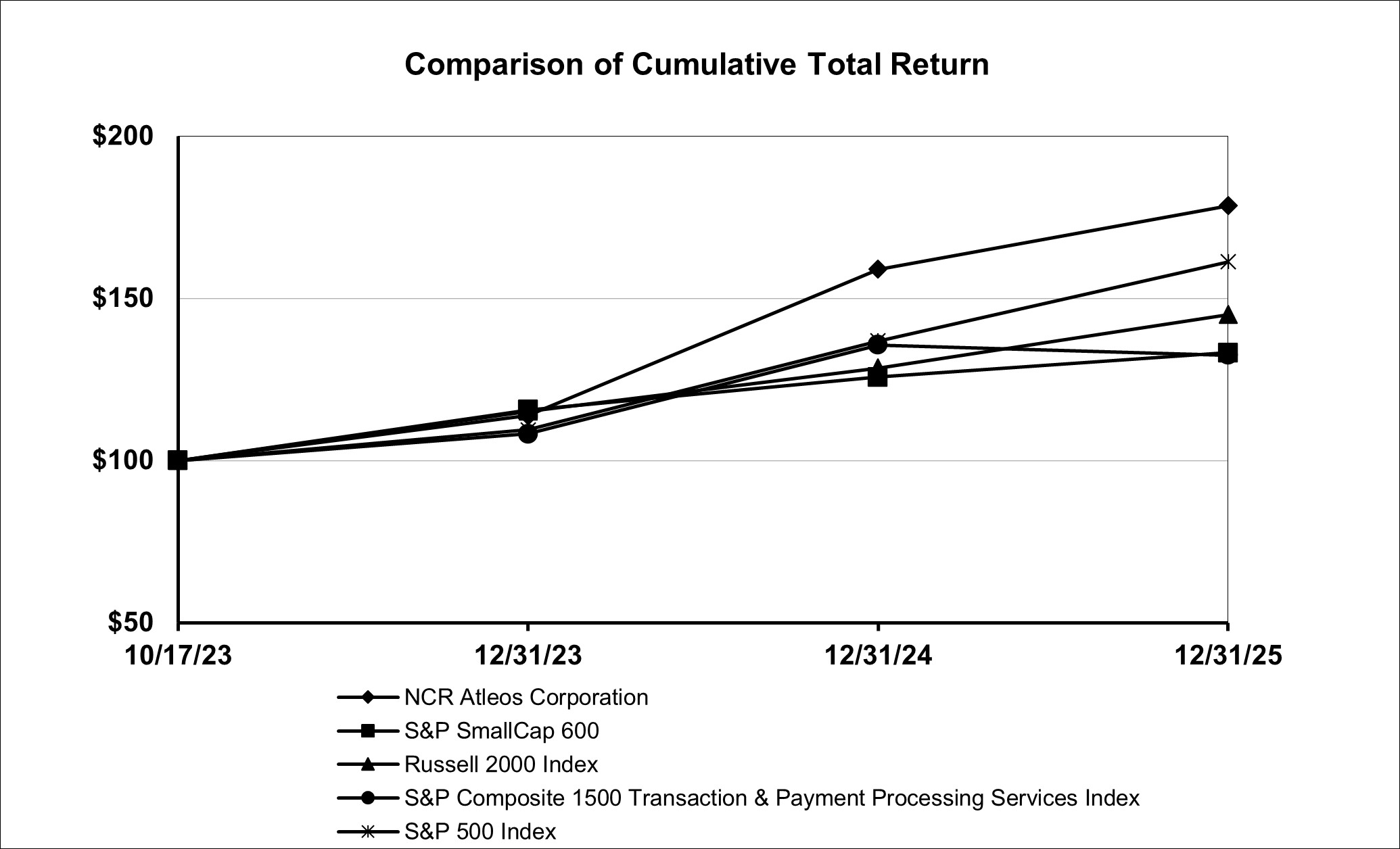
| Company / Index | 10/23 | 12/23 | 12/24 | 12/25 | ||||||||||||||||||||||
| NCR Atleos Corporation | $ | 100 | $ | 114 | $ | 159 | $ | 179 | ||||||||||||||||||
| S&P SmallCap 600 | $ | 100 | $ | 116 | $ | 126 | $ | 133 | ||||||||||||||||||
| Russell 2000 Index | $ | 100 | $ | 115 | $ | 129 | $ | 145 | ||||||||||||||||||
| S&P Composite 1500 Transaction & Payment Processing Services Index | $ | 100 | $ | 108 | $ | 136 | $ | 132 | ||||||||||||||||||
| S&P 500 Index | $ | 100 | $ | 109 | $ | 137 | $ | 161 | ||||||||||||||||||
36
Purchase of Company Common Stock
The following table presents information with respect to purchases of the Company’s common stock during the three months ended December 31, 2025.
| Total Number of Shares Purchased | Average Price Paid per Share | Total Number of Shares Purchased as Part of Publicly Announced Plan | Approximate Dollar Value of Shares that May Yet Be Purchased Under the Plan | |||||||||||||||||||||||
| October 1 - October 31, 2025 | — | $ | — | — | $ | 200,000,000 | ||||||||||||||||||||
| November 1 - November 30, 2025 | 400,950 | 35.85 | 400,950 | 185,627,673 | ||||||||||||||||||||||
| December 1 - December 31, 2025 | 364,351 | 37.96 | 364,351 | 171,797,707 | ||||||||||||||||||||||
| Total | 765,301 | $ | 36.85 | 765,301 | $ | 171,797,707 | ||||||||||||||||||||
On July 25, 2025, our Board approved a Share Repurchase Program, authorizing the repurchase of shares of the Company’s common stock in an aggregate amount up to $200 million. The repurchase program is for 24 months but does not obligate us to acquire a specific number or dollar amount of shares. We may repurchase shares of common stock from time to time using a variety of methods, including through open market purchases, privately negotiated transactions, and other means, including through the use of trading plans intended to qualify under Rule 10b5-1 under the Exchange Act. The timing, manner, price and amount of any repurchases will be determined by the Company, in its discretion, and will depend on a variety of factors, including legal requirements, price, and economic and market conditions and may be limited, suspended or discontinued at any time without prior notice.
During the year ended December 31, 2025, we repurchased approximately 0.8 million shares of our common stock for an aggregate purchase price of $28 million, including commissions and fees. All shares repurchased during the period were immediately retired, and the cost of the repurchased shares was recorded as a reduction to retained earnings within stockholders’ equity.
As of December 31, 2025, approximately $172 million remained available for repurchases under the Share Repurchase Program.
The repurchase of our common stock has certain restrictions under our senior secured credit facility and the terms of the indentures for our senior secured notes and is further subject to the discretion of Atleos’ Board.
Item 6. [Reserved]
37
Index to Management’s Discussion and Analysis of Financial Condition and Results of Operations (MD&A)
| Page | |||||
38
Item 7. MANAGEMENT’S DISCUSSION AND ANALYSIS OF FINANCIAL CONDITION AND RESULTS OF OPERATIONS (MD&A)
This section should be read in conjunction with the audited Consolidated Financial Statements and related Notes included in Item 8 of Part II of this Report. Management’s Discussion and Analysis of Financial Condition and Results of Operations contains forward-looking statements. See sections entitled “Forward-Looking Statements” and “Risk Factors” in Item 1A of this Annual Report on Form 10-K for a discussion of the uncertainties, risks and assumptions associated with these forward-looking statements that could cause future results to differ materially from those reflected in this section.
Our discussion within MD&A is organized as follows:
•Overview. This section contains background information on our company, summary of significant themes and events during the year as well as strategic initiatives and trends in order to provide context for management’s discussion and analysis of our financial condition and results of operations.
•Results of operations. This section contains an analysis of our results of operations presented in the accompanying Consolidated Statements of Operations by comparing the results for the year ended December 31, 2025 to the results for the year ended December 31, 2024. Refer to the section below entitled “Spin-off from NCR” for additional information regarding the basis of presentation for the year ended December 31, 2023.
•Liquidity and capital resources. This section provides an analysis of our cash flows and a discussion of our contractual obligations at December 31, 2025.
•Critical accounting estimates. This section contains a discussion of the accounting policies that we believe are important to our financial condition and results of operations and that require judgment and estimates on the part of management in their application. In addition, all of our significant accounting policies, including critical accounting policies, are summarized in Note 1, “Basis of Presentation and Significant Accounting Policies”, in the Notes to Consolidated Financial Statements in Item 8 of Part II of this Report.
For management’s discussion of our consolidated results for the year ended December 31, 2024 in comparison with the year ended December 31, 2023, and other financial information related to fiscal year 2023, refer to Item 7 “Management’s Discussion and Analysis of Financial Condition and Results of Operations”, included in our 2024 amended and restated Annual Report on Form 10-K/A filed with the SEC on November 5, 2025 (the “2024 Form 10-K/A”).
OVERVIEW
BUSINESS OVERVIEW
Atleos is an industry-leading financial technology company providing self-directed banking solutions to a global customer base including financial institutions, merchants, manufacturers, retailers and consumers. Self-directed banking is a rapidly growing, secular trend that allows banking customers to transact seamlessly between various channels all for the same transaction. Our comprehensive solutions enable the acceleration of self-directed banking through automated teller machine (“ATM”) and interactive teller machine (“ITM”) technology, including software, services, hardware and our proprietary Allpoint network. While we provide all our solutions on a modular basis, we have also assembled these capabilities into a turnkey, end-to-end platform which we have branded “ATM as a Service.”
Atleos operates two leading business segments focused on facilitating self-service banking through ATMs supported by a shared set of tools, systems and platforms. In addition, we operate a Telecommunications and Technology (“T&T”) segment offering managed network and infrastructure services to enterprise clients across all industries via direct relationships with communications service providers and technology manufacturers.
We manage our operations in the following segments: Self-Service Banking, Network, and T&T.
•Self-Service Banking - Offers solutions to enable customers in the financial services industry to reduce costs, generate new revenue streams and enhance customer loyalty. These solutions include a comprehensive line of ATM hardware and software, and related installation, maintenance, and managed and professional services. We also offer an ATM as a service (“ATMaaS”) solution to manage and run the ATM channel end-to-end for financial institutions that include back office, cash management, software management and ATM deployment, among other services.
39
•Network - Provides a cost-effective way for financial institutions, fintechs, neobanks, and retailers to reach and serve their customers through our network of ATMs and multi-functioning financial services kiosks. We offer credit unions, banks, digital banks, fintechs, stored-value debit card issuers, and other consumer financial services providers access to our ATM network, including our proprietary Allpoint network, providing convenient and fee-free cash withdrawal and deposit access to their customers and cardholders as well as the ability to convert a digital value to cash, or vice versa, via ReadyCode. We also provide ATM branding solutions to financial institutions, ATM management and services to retailers and other businesses, and our LibertyX solution gives consumers the ability to buy and sell Bitcoin.
•T&T - Offers managed network and infrastructure services to enterprise clients across all industries via direct relationships with communications service providers and technology manufacturers. Our customers rely on us as a strategic partner to help them reduce complexity, improve cost efficiency, and enable global geographical reach. We deliver expert professional, field, and remote services for modern network technologies including Software-Defined Wide Area Networking, Network Functions Virtualization, Wireless Local Area Networks, Optical Networking, and Edge Networks.
Spin-off from NCR
On October 16, 2023, NCR Corporation (now known as NCR Voyix Corporation or “Voyix,” and referred to as “NCR” when discussing periods prior to the Separation), completed a spin-off to NCR shareholders of its self-service banking, network, and telecommunications and technology businesses (the “Spin-off” or “Separation”). Concurrent with the Spin-off, we became a stand alone publicly-traded company and our financial statements are now presented on a consolidated basis.
In connection with the Spin-off, we have incurred and expect to incur in the future one-time separation costs, which include one-time and non-recurring expenses associated with the Spin-off and stand up of functions required to operate as a stand-alone public entity. These non-recurring costs primarily relate to system implementation costs, business and facilities separation, applicable employee related costs, development of our brand and other matters. We expect the separation-related costs will continue through at least fiscal year 2026 but will be lower as compared to 2024 and 2025.
Periods prior to Separation
On October 16, 2023, the Company became a standalone publicly traded company, and its financial statements are now presented on a consolidated basis. Prior to the Separation, the Company’s historical combined financial statements were prepared on a standalone basis and were derived from NCR’s consolidated financial statements and accounting records.
Prior to the Separation, the Consolidated Statements of Operations include all revenues and costs directly attributable to Atleos, including costs for facilities, functions and services used by Atleos. Atleos’ businesses historically functioned together with the other businesses controlled by NCR. Accordingly, Atleos relied on NCR’s corporate overhead and other support functions for its business. Therefore, certain corporate overhead and shared costs have been allocated to Atleos including (i) certain general and administrative expenses related to NCR support functions that are provided on a centralized basis within NCR (e.g., expenses for corporate facilities, executive oversight, treasury, finance, legal, human resources, compliance, information technology, employee benefit plans, stock compensation plans, and other corporate functions) and (ii) certain operations support costs incurred by NCR, including product sourcing, maintenance and support services, and other supply chain functions. These expenses have been specifically identified, when possible, or allocated based on revenues, headcount, usage or other allocation methods that are considered to be a reasonable reflection of the utilization of services provided or benefit received. Management considers that such allocations have been made on a reasonable basis consistent with benefits received but may not necessarily be indicative of the costs that would have been incurred if Atleos had been operated on a standalone basis for the periods presented. All charges and allocations for facilities, functions and services performed by NCR have been deemed settled in cash by Atleos to NCR in the period in which the cost was recorded in the Consolidated Statements of Operations.
Prior to the Separation, NCR’s external debt and related interest expense had not been attributed to the Company for the periods presented because NCR’s borrowings were neither directly attributable to the Company nor was the Company the legal obligor of such borrowings.
Prior to the Separation, the aggregate net effect of related party transactions historically settled in cash between the Company and NCR are reflected in the Consolidated Statements of Cash Flows as Related party receivables and payables within operating activities, Amounts advanced for or Repayments received from related party notes receivable in investing activities, or Proceeds from or payments on related party borrowings within financing activities. Other balances between the Company and NCR were considered to be effectively settled in the Consolidated Financial Statements at the time the transactions were recorded. The
40
aggregate net effect of transactions between the Company and NCR that were not historically settled in cash had been reflected in the Consolidated Statements of Cash Flows as Net transfers from (to) NCR Corporation within financing activities.
Prior to the Separation, income tax expense and tax balances were calculated on a separate tax return basis. The separate tax return method applies the accounting guidance for income taxes to the standalone financial statements as if the Company was a separate taxpayer and a standalone company even though the Company filed as part of NCR’s tax group in certain jurisdictions prior to Separation. The Company’s portion of income tax expense for domestic, and certain jurisdictions outside the United States (“U.S.”), were deemed to have been settled in the period the related tax expense was recorded.
Periods Post Separation
For the periods subsequent to October 16, 2023, as a standalone publicly traded company, Atleos presents its financial statements on a consolidated basis. The Consolidated Financial Statements in Item 8 of this Annual Report on Form 10-K have been prepared in accordance with GAAP.
In connection with the Spin-off, we entered into a Separation and Distribution Agreement and various other agreements with Voyix. These agreements provide a framework for our relationship with Voyix and govern various interim and ongoing relationships between Atleos and Voyix. These agreements with Voyix are described in the section of the Information Statement titled “Certain Relationships and Related Transactions-Agreements with NCR.” Following the Separation, certain functions continue to be provided by or for Voyix under the Transition Services Agreements or are being performed using Atleos’ own resources or third-party service providers. Additionally, certain maintenance services, manufacturing services, product resale and other support services and supply chain operations will continue to be provided by or to Voyix under the Commercial Agreements. On August 6, 2024, Voyix announced its intention to move the manufacturing services to another party and to further reduce the maintenance services that are being performed under the Commercial Agreements. Manufacturing services provided to Voyix were completed in the fourth quarter of 2024.
STRATEGIC INITIATIVES AND TRENDS
We expect to be a cash-generative business positioned to focus on delivering ATMaaS to a large, installed customer base across banks and retailers. We believe it will build on our leadership in self-service banking and ATM networks to meet global demand for ATM access and leverage new ATM transaction types, including digital currency solutions, to drive market growth. We also expect to continue shifting to a highly recurring revenue model to drive stable cash flow.
We are continuing our transition to software-led solutions. Today, our software platform, which runs in the cloud and includes microservices and application programming interfaces (“APIs”) that integrate with our customers’ systems, and our ATMaaS solutions, bring together all our capabilities and competencies to power the technology to run our customers’ self-directed banking networks, at the same time allowing us to earn a greater proportion of recurring revenues.
We have grown organically, as well as through acquisitions, to add software, services and other capabilities that complement or enhance our existing portfolio. We intend to continue pursuing opportunities to win new customers, expand our footprint and drive more transactions and foot traffic for our customers. We also plan to continue to improve our execution to drive solid returns and to transform our business to enhance value for all stockholders.
Impacts from Geopolitical and Macroeconomic Challenges
We continue to be exposed to macroeconomic pressures such as higher interest rates, increased logistics costs, tariffs, and foreign currency fluctuations as a result of geopolitical challenges, including those due to various conflicts in and around the Red Sea region. We are navigating through these challenges with a sharp focus on, and goal of, safeguarding our employees, helping our customers and managing impacts to the business. Despite the rapidly changing environment, our teams are executing at a high level and we are advancing our strategy.
In the first quarter of 2025, the United States introduced trade policy actions that have increased or proposed to increase import tariffs across a wide range of countries at various rates. Multiple countries responded with reciprocal tariffs and other actions, and the U.S. government continues to pursue various negotiations related to trade policy. We currently import finished goods and service parts to the United States from a number of countries that are impacted by the tariff rate changes. On February 20, 2026, the U.S. Supreme Court ruled that the reciprocal tariffs imposed under the International Emergency Economic Powers Act ("IEEPA") were unlawful. We continue to actively monitor tariff developments, analyze their potential impact and review actions that can be
41
taken to moderate and/or minimize their effects; however, the trade policies and responses and their related impacts are rapidly evolving. The impact of these trade policy actions on our performance was immaterial in 2025.
Changing U.S. immigration policy has negatively impacted our Network segment as there have been fewer transactions with prepaid payroll cards and dynamic currency conversion transactions.
Global macroeconomic conditions have caused a degree of uncertainty in the investor community and among bank customers, and could significantly impact the national, regional and local banking industry and the global business environment in which we operate. If there is a severe or prolonged economic downturn, it could result in a variety of risks to our business, including driving banking customers to curtail spending, which would negatively impact our sales and business.
We expect the factors discussed above may continue to negatively impact our business at least in the short-term. The ultimate impact on our overall financial condition and operating results will depend on the duration and severity of these geopolitical and macroeconomic pressures and any governmental and public actions taken in response. We continue to evaluate the long-term impact that these may have on our business model, however, there can be no assurance that the measures we have taken or will take will completely offset the negative impact.
For further information on the risks posed to our business from geopolitical and macroeconomic factors, refer to Part I, Item 1A “Risk Factors”, of this Form 10-K, including the risk factor titled, “A major natural disaster or catastrophic event could have a materially adverse effect on our business, financial condition and results of operations, or have other adverse consequences.” For further information on exposures to interest rate and foreign exchange risk, refer to Item 7A, “Quantitative and Qualitative Disclosures about Market Risk”, in this Form 10-K.
Impacts from Seasonality and Tourism
Our business is generally seasonal, with lower revenue and fewer transactions occurring in the first quarter of each year. Transaction volumes at our ATMs located in regions affected by strong winter weather patterns typically experience declines in volume during winter months due to decreases in the amount of consumer traffic through such locations. We usually have an increase in transaction volume during the warmer summer months, aided by increased vacation and holiday travel. Such seasonality causes our working capital cash flow requirements to vary from quarter to quarter depending on variability in the volume, timing and mix of sales. We expect the fluctuations in transaction volume to continue. For further information on the seasonality of our business, refer to Part I, Item 1 “Business - Seasonality” of this Form 10-K.
RESULTS OF OPERATIONS
Key Strategic Financial Metrics
The following two tables show our key strategic financial metrics for the years ended December 31, the relative percentage that those amounts represent to total revenue, and the change in those amounts year-over-year.
Recurring revenue as a percentage of total revenue
| Percentage of Total Revenue | Increase (Decrease) | |||||||||||||||||||||||||||||||||||||||||||||||||
| In millions | 2025 | 2024 | 2023 | 2025 | 2024 | 2023 | 2025 v 2024 | 2024 v 2023 | ||||||||||||||||||||||||||||||||||||||||||
Recurring revenue (1) | $ | 3,075 | $ | 3,124 | $ | 2,977 | 70.6 | % | 72.6 | % | 71.1 | % | (2) | % | 5 | % | ||||||||||||||||||||||||||||||||||
| All other products and services | 1,279 | 1,181 | 1,209 | 29.4 | % | 27.4 | % | 28.9 | % | 8 | % | (2) | % | |||||||||||||||||||||||||||||||||||||
| Total Revenue | $ | 4,354 | $ | 4,305 | $ | 4,186 | 100.0 | % | 100.0 | % | 100.0 | % | 1 | % | 3 | % | ||||||||||||||||||||||||||||||||||
(1) Refer to our definition of Recurring revenue in the section entitled “Non-GAAP Financial Measures and Use of Certain Terms.”
Net income (loss) attributable to Atleos and Adjusted EBITDA(2) as a percentage of total revenue
| Percentage of Total Revenue | Increase (Decrease) | |||||||||||||||||||||||||||||||||||||||||||||||||
| In millions | 2025 | 2024 | 2023 | 2025 | 2024 | 2023 | 2025 v 2024 | 2024 v 2023 | ||||||||||||||||||||||||||||||||||||||||||
| Net income (loss) attributable to Atleos | $ | 162 | $ | 80 | $ | (150) | 3.7 | % | 1.9 | % | (3.6) | % | 103 | % | 153 | % | ||||||||||||||||||||||||||||||||||
Adjusted EBITDA (2) | $ | 830 | $ | 785 | $ | 738 | 19.1 | % | 18.2 | % | 17.6 | % | 6 | % | 6 | % | ||||||||||||||||||||||||||||||||||
(2) Refer to our definition of Adjusted EBITDA in the section entitled “Non-GAAP Financial Measures and Use of Certain Terms.”
42
Other performance metrics
| In millions, unless otherwise noted | 2025 | 2024 | 2023 | ||||||||||||||
| Self-Service Banking | |||||||||||||||||
Annualized recurring revenue(1) | $ | 1,714 | $ | 1,684 | $ | 1,525 | |||||||||||
Recurring revenue(1) as a % of SSB Revenue | 58 | % | 61 | % | 59 | % | |||||||||||
| Revenue from ATMaaS arrangements | $ | 258 | $ | 194 | $ | 153 | |||||||||||
| Network | |||||||||||||||||
LTM ARPU(1) (in thousands) | $ | 16.2 | $ | 16.1 | $ | 15.1 | |||||||||||
Network Managed Units(1) (in thousands) | 78.4 | 77.8 | 83.0 | ||||||||||||||
(1) Refer to our definitions of Annualized recurring revenue, recurring revenue, LTM ARPU and Network Managed Units in the section entitled “Non-GAAP Financial Measures and Use of Certain Terms.”
Non-GAAP Financial Measures and Use of Certain Terms:
Non-GAAP Financial Measures
We supplement the reporting of our financial information determined under generally accepted accounting principles in the United States (“GAAP”) with certain non-GAAP financial measures. Adjusted financial measures should be considered in addition to, and not as an alternative for, our reported results prepared in accordance with GAAP. Our adjusted financial measures do not represent a comprehensive basis of accounting and therefore may not be comparable to similarly titled measures reported by other companies. We believe these measures are useful for investors because they provide a more complete understanding of our underlying operational performance, as well as consistency and comparability with past reports of financial results.
Adjusted Earnings Before Interest, Taxes, Depreciation and Amortization (Adjusted EBITDA) (non-GAAP) and Adjusted EBITDA margin (non-GAAP) are calculated as GAAP Net income (loss) attributable to Atleos plus interest expense, net; plus income tax expense (benefit); plus depreciation and amortization; plus acquisition-related costs; plus pension mark-to-market adjustments and other one-time pension-related costs; plus separation-related costs; plus transformation and restructuring charges, which include integration, severance, divestiture and other exit and disposal costs; plus stock-based compensation expense; plus Voyix legal and environmental indemnification expense; plus other amounts included in Other income (expense), net. Adjusted EBITDA margin is calculated by dividing Adjusted EBITDA by total revenue, and Adjusted EBITDA margin by segment is calculated based on segment Adjusted EBITDA divided by the related segment revenue. We use these non-GAAP measures to evaluate performance consistently from period to period.
Adjusted gross margin as a percentage of revenue (non-GAAP) and Adjusted selling, general and administrative expenses as a percentage of revenue (non-GAAP) are calculated utilizing GAAP gross margin and selling, general and administrative expenses, respectively, and excluding, as applicable, acquisition-related costs; one-time pension-related costs; separation-related costs; amortization of acquisition-related intangibles; stock-based compensation expense; transformation and restructuring charges (which includes integration, severance, divestiture and other exit and disposal costs); Voyix legal indemnification expense; and other non-recurring or unusual items. We use these non-GAAP measures to evaluate performance consistently from period to period.
Atleos’ definitions and calculations of these non-GAAP measures may differ from similarly-titled measures reported by other companies and cannot, therefore, be compared with similarly-titled measures of other companies. These non-GAAP measures should not be considered as substitutes for, or superior to, results determined in accordance with GAAP.
Use of Certain Terms
Recurring revenue is all revenue streams from contracts where there is a predictable revenue pattern that will occur at regular intervals with a relatively high degree of certainty. This includes hardware and software maintenance revenue, processing revenue, interchange and network revenue, Bitcoin-related revenue, and certain professional services arrangements, as well as term-based software license arrangements that include customer termination rights.
Annualized Recurring Revenue (“ARR”) is an operating metric defined as recurring revenue, excluding software licenses sold as a subscription, for the last three months times four, plus the rolling four quarters for term-based software license arrangements that include customer termination rights. We believe this metric may be useful to investors in evaluating the Company’s achievement of strategic goals related to the conversion of the self-service banking business to recurring revenue streams over time. ARR does not
43
necessarily reflect the pattern of revenue recognition in accordance with GAAP and should not be considered a substitute for GAAP revenue.
Last twelve months average revenue per unit (“LTM ARPU”) is an operating metric for the Network segment defined as total Network segment revenue for the previous twelve months divided by the average Network Managed Units for the previous twelve months. We believe this metric may be useful to investors in evaluating our achievement of strategic goals related to the improved monetization of our ATM fleet over a specified period, excluding the impact of seasonality. LTM ARPU does not represent revenue generated solely by our Network Managed Units, as total Network segment revenue includes revenue generated from other sources.
Network Managed Units are all transacting ATMs as of period end, whether Company-owned or Merchant-owned, other than those for which we only provide third-party processing services and those under legacy managed services arrangements.
Reconciliation of Net income (loss) attributable to Atleos (GAAP) to Adjusted EBITDA (Non-GAAP)
| In millions | 2025 | % of Revenue | 2024 | % of Revenue | 2023 | % of Revenue | ||||||||||||||||||||
| Net income (loss) attributable to Atleos (GAAP) | $ | 162 | 3.7 | % | $ | 80 | 1.9 | % | $ | (150) | (3.6) | % | ||||||||||||||
Interest expense, net(1) | 270 | 6.2 | % | 309 | 7.1 | % | 90 | 2.2 | % | |||||||||||||||||
| Interest income | (6) | (0.1) | % | (7) | (0.2) | % | (5) | (0.1) | % | |||||||||||||||||
| Income tax expense | 27 | 0.6 | % | 44 | 1.0 | % | 237 | 5.7 | % | |||||||||||||||||
| Depreciation and amortization expense | 168 | 3.9 | % | 176 | 4.1 | % | 151 | 3.6 | % | |||||||||||||||||
| Acquisition-related amortization of intangibles | 95 | 2.2 | % | 95 | 2.2 | % | 98 | 2.3 | % | |||||||||||||||||
| Stock-based compensation expense | 34 | 0.8 | % | 38 | 0.9 | % | 68 | 1.6 | % | |||||||||||||||||
| Separation costs | 11 | 0.3 | % | 22 | 0.5 | % | 170 | 4.1 | % | |||||||||||||||||
| Acquisition-related costs | 2 | — | % | (5) | (0.1) | % | — | — | % | |||||||||||||||||
| Transformation and restructuring costs | 10 | 0.2 | % | 22 | 0.5 | % | 28 | 0.7 | % | |||||||||||||||||
| Loss on debt extinguishment | — | — | % | 24 | 0.6 | % | — | — | % | |||||||||||||||||
| Pension mark-to-market adjustments | 2 | — | % | (38) | (0.9) | % | 27 | 0.6 | % | |||||||||||||||||
| Voyix indemnification expense | 51 | 1.2 | % | 14 | 0.3 | % | — | — | % | |||||||||||||||||
Other (income) expense items(2) | 4 | 0.1 | % | 11 | 0.3 | % | 24 | 0.5 | % | |||||||||||||||||
| Adjusted EBITDA (Non-GAAP) | $ | 830 | 19.1 | % | $ | 785 | 18.2 | % | $ | 738 | 17.6 | % | ||||||||||||||
(1) Includes Related party interest expense, net, as presented in the Consolidated Statements of Operations for the year ended December 31, 2023.
(2) Includes certain items reported within Other income (expense), net on the Consolidated Statements of Operations, such as bank fees, the components of pension, post-employment and postretirement expense other than service cost, and the impact of foreign currency exchange rate fluctuations. Prior to 2025, Adjusted EBITDA did not exclude these Other (income) expense items. All periods presented have been recast to reflect the new definition. Certain other amounts reported in Other income (expense), net are separately captured in this reconciliation. As a result, Other (income) expense items as presented does not agree to total Other income (expense), net on the Consolidated Statements of Operations.
Reconciliation of Gross Margin Rate (Gross Margin as a Percentage of Revenue) (GAAP) to Adjusted Gross Margin Rate (Adjusted Gross Margin as a Percentage of Revenue) (Non-GAAP)
| 2025 | 2024 | 2023 | |||||||||||||||
| Gross Margin Rate (GAAP) | 24.4 | % | 23.7 | % | 22.2 | % | |||||||||||
| Plus: Special Items | |||||||||||||||||
| Acquisition-related amortization of intangibles | 1.8 | % | 1.8 | % | 1.5 | % | |||||||||||
| Stock-based compensation expense | 0.1 | % | 0.1 | % | 0.5 | % | |||||||||||
| Separation costs | — | % | — | % | 1.2 | % | |||||||||||
| Transformation and restructuring | 0.2 | % | 0.2 | % | — | % | |||||||||||
| Adjusted Gross Margin Rate (Non-GAAP) | 26.5 | % | 25.8 | % | 25.4 | % | |||||||||||
44
Reconciliation of Selling, General and Administrative Expenses (“SG&A”) as a Percentage of Revenue (GAAP) to Adjusted SG&A as a Percentage of Revenue (Non-GAAP)
| 2025 | 2024 | 2023 | |||||||||||||||
| SG&A as a percentage of revenue (GAAP) | 11.8 | % | 12.1 | % | 14.0 | % | |||||||||||
| Plus: Special Items | |||||||||||||||||
| Acquisition-related amortization of intangibles | (0.3) | % | (0.4) | % | (0.8) | % | |||||||||||
| Stock-based compensation expense | (0.6) | % | (0.7) | % | (1.0) | % | |||||||||||
| Separation costs | (0.3) | % | (0.5) | % | (2.3) | % | |||||||||||
| Transformation and restructuring | (0.3) | % | (0.2) | % | (0.2) | % | |||||||||||
| Voyix indemnification expense | (0.5) | % | — | % | — | % | |||||||||||
| Adjusted SG&A as a percentage of revenue (Non-GAAP) | 9.8 | % | 10.3 | % | 9.7 | % | |||||||||||
Consolidated Results
The following table shows our results for the years December 31, the relative percentage that those amounts represent to revenue, and the change in those amounts year-over-year.
Percentage of Revenue (1) | Increase (Decrease) | ||||||||||||||||||||||||||||||||||||||||||||||
| In millions | 2025 | 2024 | 2023 | 2025 | 2024 | 2023 | 2025 v 2024 | 2024 v 2023 | |||||||||||||||||||||||||||||||||||||||
| Product revenue | $ | 1,030 | $ | 993 | $ | 1,030 | 23.7 | % | 23.1 | % | 24.6 | % | 4 | % | (4) | % | |||||||||||||||||||||||||||||||
| Service revenue | 3,324 | 3,312 | 3,156 | 76.3 | % | 76.9 | % | 75.4 | % | — | % | 5 | % | ||||||||||||||||||||||||||||||||||
| Total revenue | 4,354 | 4,305 | 4,186 | 100.0 | % | 100.0 | % | 100.0 | % | 1 | % | 3 | % | ||||||||||||||||||||||||||||||||||
| Product gross margin | 204 | 153 | 185 | 19.8 | % | 15.4 | % | 18.0 | % | 33 | % | (17) | % | ||||||||||||||||||||||||||||||||||
| Service gross margin | 857 | 867 | 743 | 25.8 | % | 26.2 | % | 23.5 | % | (1) | % | 17 | % | ||||||||||||||||||||||||||||||||||
| Total gross margin | 1,061 | 1,020 | 928 | 24.4 | % | 23.7 | % | 22.2 | % | 4 | % | 10 | % | ||||||||||||||||||||||||||||||||||
| Selling, general and administrative expenses | 513 | 521 | 585 | 11.8 | % | 12.1 | % | 14.0 | % | (2) | % | (11) | % | ||||||||||||||||||||||||||||||||||
| Research and development expenses | 70 | 62 | 80 | 1.6 | % | 1.4 | % | 1.9 | % | 13 | % | (23) | % | ||||||||||||||||||||||||||||||||||
| Income from operations | 478 | 437 | 263 | 11.0 | % | 10.2 | % | 6.3 | % | 9 | % | 66 | % | ||||||||||||||||||||||||||||||||||
| Loss on extinguishment of debt | — | (24) | — | — | % | (0.6) | % | — | % | n/m | n/m | ||||||||||||||||||||||||||||||||||||
| Interest expense | (270) | (309) | (77) | (6.2) | % | (7.2) | % | (1.8) | % | (13) | % | 301 | % | ||||||||||||||||||||||||||||||||||
| Related party interest expense, net | — | — | (13) | — | % | — | % | (0.3) | % | — | % | (100) | % | ||||||||||||||||||||||||||||||||||
| Other (expense) income, net | (19) | 21 | (84) | (0.4) | % | 0.5 | % | (2.0) | % | (190) | % | 125 | % | ||||||||||||||||||||||||||||||||||
| Income before income taxes | 189 | 125 | 89 | 4.3 | % | 2.9 | % | 2.1 | % | 51 | % | 40 | % | ||||||||||||||||||||||||||||||||||
| Income tax expense | 27 | 44 | 237 | 0.6 | % | 1.0 | % | 5.7 | % | (39) | % | (81) | % | ||||||||||||||||||||||||||||||||||
| Net income (loss) | $ | 162 | $ | 81 | $ | (148) | 3.7 | % | 1.9 | % | (3.5) | % | 100 | % | 155 | % | |||||||||||||||||||||||||||||||
(1) Percentage of revenue is expressed relative to total revenue except for product gross margin and service gross margin, which are expressed relative to the applicable component of revenue.
45
Revenue
Percentage of Revenue(1) | Increase (Decrease) | ||||||||||||||||||||||||||||||||||||||||||||||
| In millions | 2025 | 2024 | 2023 | 2025 | 2024 | 2023 | 2025 v 2024 | 2024 v 2023 | |||||||||||||||||||||||||||||||||||||||
| Revenue | |||||||||||||||||||||||||||||||||||||||||||||||
| Self-Service Banking | $ | 2,881 | $ | 2,685 | $ | 2,577 | 66.2 | % | 62.4 | % | 61.6 | % | 7 | % | 4 | % | |||||||||||||||||||||||||||||||
| Network | 1,265 | 1,284 | 1,266 | 29.1 | % | 29.8 | % | 30.2 | % | (1) | % | 1 | % | ||||||||||||||||||||||||||||||||||
| T&T | $ | 168 | $ | 194 | $ | 196 | 3.8 | % | 4.5 | % | 4.7 | % | (13) | % | (1) | % | |||||||||||||||||||||||||||||||
| Total segment revenue | $ | 4,314 | $ | 4,163 | $ | 4,039 | 99.1 | % | 96.7 | % | 96.5 | % | 4 | % | 3 | % | |||||||||||||||||||||||||||||||
Other(2) | $ | 40 | $ | 142 | $ | 147 | 0.9 | % | 3.3 | % | 3.5 | % | (72) | % | (3) | % | |||||||||||||||||||||||||||||||
| Consolidated revenue | $ | 4,354 | $ | 4,305 | $ | 4,186 | 100.0 | % | 100.0 | % | 100.0 | % | 1 | % | 3 | % | |||||||||||||||||||||||||||||||
(1)Percentage of revenue is expressed relative to consolidated revenue.
(2)Contains certain immaterial business operations that do not represent a reportable segment, including commerce-related operations in countries that Voyix exited that are aligned to Atleos. Other also includes revenues from commercial agreements with Voyix.
Consolidated revenue for the year ended December 31, 2025 increased 1% compared to the year ended December 31, 2024, primarily driven by $151 million, or 4%, increase in core business segment revenues. Within this consolidated revenue growth rate, Self-Service Banking contributed 5%, offset by a reduction of approximately 2% from the T&T and Network segments compared to the prior year. The consolidated revenue growth rate was also impacted by a 2% expected reduction in other non-core revenues as the Voyix commercial agreements and commerce-related contracts continue to wind down. Growth in total segment revenues was driven by increases in hardware, software and services, including ATMaaS, offset by a slight decrease in transactional revenue.
Gross Margin
| Percentage of Revenue | Increase (Decrease) | ||||||||||||||||||||||||||||||||||||||||||||||
| In millions | 2025 | 2024 | 2023 | 2025 | 2024 | 2023 | 2025 v 2024 | 2024 v 2023 | |||||||||||||||||||||||||||||||||||||||
| Total gross margin | $ | 1,061 | $ | 1,020 | $ | 928 | 24.4 | % | 23.7 | % | 22.2 | % | 4 | % | 10 | % | |||||||||||||||||||||||||||||||
Gross margin as a percentage of revenue for the year ended December 31, 2025 increased to 24.4% compared to 23.7% for the year ended December 31, 2024. The increase was driven by hardware, as well as ATMaaS growth, and was partially offset by higher vault cash interest expense. Adjusted gross margin as a percentage of revenue (non-GAAP) increased from 25.8% to 26.5% due to the same factors discussed above.
Selling, General and Administrative Expenses
| Percentage of Total Revenue | Increase (Decrease) | ||||||||||||||||||||||||||||||||||||||||||||||
| In millions | 2025 | 2024 | 2023 | 2025 | 2024 | 2023 | 2025 v 2024 | 2024 v 2023 | |||||||||||||||||||||||||||||||||||||||
| Selling, general and administrative expenses | $ | 513 | $ | 521 | $ | 585 | 11.8 | % | 12.1 | % | 14.0 | % | (2) | % | (11) | % | |||||||||||||||||||||||||||||||
Selling, general, and administrative expenses for the year ended December 31, 2025 decreased $8 million and 30 basis points to 11.8% of revenue compared to the year ended December 31, 2024. We benefited from a continuous focus on cost optimization efforts, recognized gains on the sale-leaseback of certain owned ATMs associated with ATMasS and Network contracts and incurred lower separation-related costs and stock-based compensation expense. These improvements were partially offset by the pre-Spin-off litigation matter shared with Voyix. Adjusted selling, general and administrative expenses as a percentage of revenue (non-GAAP) decreased from 10.3% to 9.8%, primarily due to decreases in Voyix-related costs and labor costs.
46
Research and Development Expenses
| Percentage of Total Revenue | Increase (Decrease) | ||||||||||||||||||||||||||||||||||||||||||||||
| In millions | 2025 | 2024 | 2023 | 2025 | 2024 | 2023 | 2025 v 2024 | 2024 v 2023 | |||||||||||||||||||||||||||||||||||||||
| Research and development expenses | $ | 70 | $ | 62 | $ | 80 | 1.6 | % | 1.4 | % | 1.9 | % | 13 | % | (23) | % | |||||||||||||||||||||||||||||||
Research and development expenses for the year ended December 31, 2025 increased $8 million and 20 basis points to 1.6% of revenue compared to the year ended December 31, 2024, due to an increase in employee-related costs.
Loss on Extinguishment of Debt
| Increase (Decrease) | |||||||||||||||||||||||||||||
| In millions | 2025 | 2024 | 2023 | 2025 v 2024 | 2024 v 2023 | ||||||||||||||||||||||||
| Loss on extinguishment of debt | $ | — | $ | 24 | $ | — | n/m | n/m | |||||||||||||||||||||
On October 17, 2024, Atleos entered into an Amended Credit Agreement and completed financing transactions that included the refinancing of the Term Loan B Facility. In connection with the transactions, Atleos recorded a loss on extinguishment of debt of $24 million, including the write-off of discount and deferred financing fees of $17 million and a cash redemption premium of $7 million. Refer to Note 4, “Debt Obligations”, for further details on the financing transactions.
Interest Expense and Related Party Interest Expense, Net
| Increase (Decrease) | |||||||||||||||||||||||||||||
| In millions | 2025 | 2024 | 2023 | 2025 v 2024 | 2024 v 2023 | ||||||||||||||||||||||||
| Interest expense | $ | 270 | $ | 309 | $ | 77 | (13) | % | 301 | % | |||||||||||||||||||
| Related party interest expense, net | $ | — | $ | — | $ | 13 | — | % | (100) | % | |||||||||||||||||||
Interest expense for the year ended December 31, 2025 decreased $39 million compared to the year ended December 31, 2024. This decrease was driven by a reduction in variable interest rates on our outstanding debt following an amendment and a refinancing of our senior secured credit facility in the fourth quarter of 2024 and third quarter of 2025, respectively, as well as a reduction in the outstanding balance of the Term Loan Facilities. Refer to Note 4, “Debt Obligations”, for additional information on our outstanding debt.
Other (Expense) Income, net
| In millions | 2025 | 2024 | 2023 | ||||||||||||||
| Other income (expense), net | |||||||||||||||||
| Interest income | $ | 6 | $ | 7 | $ | 5 | |||||||||||
| Foreign currency fluctuations and foreign exchange contracts | (10) | (19) | (43) | ||||||||||||||
| Employee benefit plans | 12 | 60 | (22) | ||||||||||||||
| Bank-related fees | (15) | (15) | (14) | ||||||||||||||
| Voyix environmental indemnification expense | (28) | (14) | — | ||||||||||||||
| Other, net | 16 | 2 | (10) | ||||||||||||||
| Total other income (expense), net | $ | (19) | $ | 21 | $ | (84) | |||||||||||
For the year ended December 31, 2025, we recorded expense of $19 million compared to income of $21 million in the comparative period. Income related to our company-sponsored defined benefit plans decreased, driven by reductions in the discount rates. Expense related to the Voyix environmental indemnification expense increased due to the acceleration of investigatory and remedial activities at the Kalamazoo River site. These unfavorable impacts were partially offset by the gain on divestiture of a non-core business and a decrease in losses from foreign currency exchange rate movements, primarily in hyperinflationary economies.
47
Income Taxes
| Increase (Decrease) | |||||||||||||||||||||||||||||
| In millions | 2025 | 2024 | 2023 | 2025 v 2024 | 2024 v 2023 | ||||||||||||||||||||||||
| Income tax expense | $ | 27 | $ | 44 | $ | 237 | (39) | % | (81) | % | |||||||||||||||||||
Income tax expense for the the twelve months ended December 31, 2025 was $27 million compared to $44 million in the prior year. The change was driven by a lower estimated annual effective income tax rate. Our effective tax rate was 14% in 2025 compared to 35% in 2024. In 2025, our tax rate benefited from $25 million release of valuation allowance offset by $9 million Foreign Derived Intangible Income decrease in benefit compared to prior year. In 2024, our tax rate benefited from $17 million Foreign Derived Intangible Income deduction and $17 million provision to return adjustments, of which $11 million is classified as U.S. tax impact on foreign income. Additionally, in 2024, our tax rate was impacted by an increase in the valuation allowance on U.S. interest expense disallowance carryforward by $32 million.
While we are subject to numerous federal, state and foreign tax audits, we believe that appropriate reserves exist for issues that might arise from these audits. Should these audits be settled, the resulting tax effect could impact the tax provision and cash flows in future periods. During 2026, the Company may resolve certain tax matters in foreign jurisdictions that could have an impact on the effective tax rate.
Segment Financial Results
We manage and report our business in the following segments: Self-Service Banking, Network, and Telecommunications & Technology (“T&T”). Our Chief Operating Decision Maker evaluates segment performance using revenue and Adjusted EBITDA. Refer to the section entitled “Non-GAAP Financial Measures and Use of Certain Terms” for our definition of Adjusted EBITDA and the reconciliation of Net income (loss) attributable to Atleos (GAAP) to Adjusted EBITDA (non-GAAP).
Services revenues include hardware maintenance revenue, transaction services revenue, managed services revenue and ATMaaS revenue. Software revenues include cloud revenue, software license and maintenance revenues, as well as professional services revenues. Transactional revenue includes payments processing revenue, interchange and network revenue and Bitcoin-related revenue. Hardware revenue primarily comprises revenue from sales of ATM hardware.
Self-Service Banking Revenue and Adjusted EBITDA
The following table shows our Self-Service Banking segment revenue by product and segment Adjusted EBITDA for the years ended December 31, the relative percentage that those amounts represent to Self-Service Banking segment revenue and the change in those amounts year-over-year.
| Percentage of Segment Revenue | Increase (Decrease) | ||||||||||||||||||||||||||||||||||||||||||||||
| In millions | 2025 | 2024 | 2023 | 2025 | 2024 | 2023 | 2025 v 2024 | 2024 v 2023 | |||||||||||||||||||||||||||||||||||||||
| Revenue | |||||||||||||||||||||||||||||||||||||||||||||||
| Services | $ | 1,476 | $ | 1,452 | $ | 1,390 | 51.2 | % | 54.1 | % | 53.9 | % | 2 | % | 4 | % | |||||||||||||||||||||||||||||||
| Software | 544 | 477 | 406 | 18.9 | % | 17.8 | % | 15.8 | % | 14 | % | 17 | % | ||||||||||||||||||||||||||||||||||
| Hardware | 861 | 756 | 781 | 29.9 | % | 28.1 | % | 30.3 | % | 14 | % | (3) | % | ||||||||||||||||||||||||||||||||||
| Total Self-Service Banking revenue | $ | 2,881 | $ | 2,685 | $ | 2,577 | 100.0 | % | 100.0 | % | 100.0 | % | 7 | % | 4 | % | |||||||||||||||||||||||||||||||
| Total Adjusted EBITDA | $ | 751 | $ | 629 | $ | 626 | 26.1 | % | 23.4 | % | 24.3 | % | 19 | % | — | % | |||||||||||||||||||||||||||||||
For the year ended December 31, 2025, Self-Service Banking revenue increased 7% compared to the prior year period. Hardware revenue increased 14%, based on demand related to the industry refresh cycle and newer ATM models. ATMaaS solutions grew 33%, with banks continuing to outsource more software and services.
Adjusted EBITDA for the year ended December 31, 2025 increased 19% compared to the prior year period due to profitable growth, including favorable ATMaaS revenue margins, the sale-leaseback of certain owned ATMs used in ATMaaS arrangements and continuous productivity improvements.
48
Network Revenue and Adjusted EBITDA
The following table shows our Network segment revenue by product and segment Adjusted EBITDA for the years ended December 31, the relative percentage that those amounts represent to Network segment revenue and the change in those amounts year-over-year.
| Percentage of Segment Revenue | Increase (Decrease) | ||||||||||||||||||||||||||||||||||||||||||||||
| In millions | 2025 | 2024 | 2023 | 2025 | 2024 | 2023 | 2025 v 2024 | 2024 v 2023 | |||||||||||||||||||||||||||||||||||||||
| Revenue | |||||||||||||||||||||||||||||||||||||||||||||||
| Software | 32 | 29 | 24 | 2.5 | % | 2.3 | % | 1.9 | % | 10 | % | 21 | % | ||||||||||||||||||||||||||||||||||
| Transactional | 1,233 | 1,255 | 1,242 | 97.5 | % | 97.7 | % | 98.1 | % | (2) | % | 1 | % | ||||||||||||||||||||||||||||||||||
| Total Network revenue | $ | 1,265 | $ | 1,284 | $ | 1,266 | 100.0 | % | 100.0 | % | 100.0 | % | (1) | % | 1 | % | |||||||||||||||||||||||||||||||
| Total Adjusted EBITDA | $ | 359 | $ | 403 | $ | 377 | 28.4 | % | 31.4 | % | 29.8 | % | (11) | % | 7 | % | |||||||||||||||||||||||||||||||
Network revenue for the year ended December 31, 2025, decreased 1% compared to the prior year period. Withdrawal transactions decreased largely due to U.S. immigration policies, and revenue from Bitcoin was lower from transaction volume declines. These decreases were partially offset by volume increases in certain international markets.
Adjusted EBITDA for the year ended December 31, 2025 decreased 11% compared to the prior year period, driven mainly by an increase in vault cash cost as the amortization of gains on terminated derivatives expired and a decrease in higher margin revenue streams largely attributed to U.S. immigration policies. These impacts were partially offset by gains from the sale-leaseback of certain owned ATMs and ongoing productivity improvements.
Telecommunications & Technology (T&T) Revenue and Adjusted EBITDA
The following table shows our T&T segment revenue by product and segment Adjusted EBITDA for the years ended December 31, the relative percentage that those amounts represent to T&T segment revenue and the change in those amounts year-over-year.
| Percentage of Segment Revenue | Increase (Decrease) | ||||||||||||||||||||||||||||||||||||||||||||||
| In millions | 2025 | 2024 | 2023 | 2025 | 2024 | 2023 | 2025 v 2024 | 2024 v 2023 | |||||||||||||||||||||||||||||||||||||||
| Revenue | |||||||||||||||||||||||||||||||||||||||||||||||
| Services | $ | 158 | $ | 179 | $ | 184 | 94.0 | % | 92.3 | % | 93.9 | % | (12) | % | (3) | % | |||||||||||||||||||||||||||||||
| Software | 4 | 5 | 5 | 2.4 | % | 2.6 | % | 2.6 | % | (20) | % | — | % | ||||||||||||||||||||||||||||||||||
| Hardware | 6 | 10 | 7 | 3.6 | % | 5.1 | % | 3.5 | % | (40) | % | 43 | % | ||||||||||||||||||||||||||||||||||
| Total T&T revenue | $ | 168 | $ | 194 | $ | 196 | 100.0 | % | 100.0 | % | 100.0 | % | (13) | % | (1) | % | |||||||||||||||||||||||||||||||
| Total Adjusted EBITDA | $ | 31 | $ | 35 | $ | 33 | 18.5 | % | 18.0 | % | 16.8 | % | (11) | % | 6 | % | |||||||||||||||||||||||||||||||
T&T revenue for the year ended December 31, 2025 decreased 13% compared to the prior year period due to decreases in hardware maintenance and installation services revenue, and a decrease in third-party hardware sales driven by a decline in customer projects.
Adjusted EBITDA for the year ended December 31, 2025 decreased 11% compared to the prior year period due to the decrease in revenue described above.
FINANCIAL CONDITION, LIQUIDITY AND CAPITAL RESOURCES
Our primary liquidity needs in the ordinary course of business are to: (i) fund normal operating expenses; (ii) meet the interest and principal requirements of our outstanding indebtedness, including finance leases; (iii) fund capital expenditures and operating lease payments; (iv) fund indemnification payments related to legal and environmental matters; (v) meet our expected pension, postretirement and post-employment plan contributions; and (vi) fund payments related to transformation and restructuring initiatives. Our principal sources of cash are generated from operations, borrowings under our revolving credit facility and issuances of debt. We continually evaluate our liquidity requirements based on our operating needs, growth initiatives and capital resources.
We use a non-GAAP measure called “Adjusted free cash flow-unrestricted” to assess our financial performance and liquidity. We define Adjusted free cash flow-unrestricted as net cash provided by operating activities less capital expenditures, less additions to capitalized software, plus/minus the change in restricted cash settlement activity, plus proceeds from certain sale-leaseback transactions, plus pension contributions and settlements, and plus legal and environmental indemnification payments made to
49
Voyix. Restricted cash settlement activity represents the net change in amounts collected on behalf of, but not yet remitted to, certain of our merchant customers or third-party service providers that are pledged for a particular use or restricted to support these obligations. These amounts can fluctuate significantly period to period based on the number of days for which settlement has not yet occurred or day of the week on which a reporting period ends. We believe Adjusted free cash flow-unrestricted is useful for investors because it indicates the amount of cash available for, among other things, investments in our existing businesses, strategic acquisitions and repayment of our debt obligations. Adjusted free cash flow-unrestricted does not represent the residual cash flow available, since there may be other non-discretionary expenditures that are not deducted from the measure. Adjusted free cash flow-unrestricted does not have a uniform definition under GAAP, and therefore our definition may differ from other companies’ definitions of this measure. This non-GAAP measure should not be considered a substitute for, or superior to, cash flows from operating activities under GAAP.
Summarized cash flow information for the twelve months ended December 31 is as follows:
| In millions | 2025 | 2024 | 2023 | ||||||||||||||
| Net cash provided by operating activities | $ | 356 | $ | 344 | $ | 355 | |||||||||||
| Net cash used in investing activities | $ | (116) | $ | (135) | $ | (316) | |||||||||||
| Net cash provided by (used in) financing activities | $ | (253) | $ | (134) | $ | 31 | |||||||||||
Net cash provided by operating activities increased $12 million for the year ended December 31, 2025 compared to the prior year period driven by higher net income and the timing of cash settlement payments to our merchant partners, which are impacted by the weekday on which the period closes. This was offset by higher contributions to our company-sponsored pension plans in the current period.
Net cash used in investing activities decreased $19 million for the year ended December 31, 2025 compared to the prior year period. Proceeds from the sale of property, plant and equipment increased $45 million, primarily due to sale-leaseback transactions on certain of our owned ATM units. We also received proceeds on divestiture of a non-core business of $11 million. These favorable impacts were partially offset by increases in capital expenditures of $30 million driven by expenditures to support ATMaaS growth, and an acquisition.
Net cash used in financing activities increased $119 million for the year ended December 31, 2025 compared to the prior year period, primarily due to a $95 million increase in the use of cash related to our focus to pay down debt in 2025, $28 million related to the share repurchase program, and higher acquisition holdback payments of $11 million. These were partially offset by an increase in proceeds from employee stock plans of $7 million.
The table below reconciles net cash provided by operating activities, the most directly comparable GAAP measure, to Atleos’ non-GAAP measure of Adjusted free cash flow-unrestricted for the years ended December 31:
| In millions | 2025 | 2024 | 2023 | ||||||||||||||
| Net cash provided by operating activities (GAAP) | $ | 356 | $ | 344 | $ | 355 | |||||||||||
| Capital expenditures | (117) | (87) | (108) | ||||||||||||||
| Additions to capitalized software | (39) | (39) | (24) | ||||||||||||||
| Change in restricted cash settlement activity | 35 | 21 | (27) | ||||||||||||||
| Pension contributions | 30 | 3 | 154 | ||||||||||||||
| Indemnification payments to Voyix | 17 | — | — | ||||||||||||||
| Proceeds from ATM sale-leaseback transactions | 44 | — | — | ||||||||||||||
Adjusted free cash flow-unrestricted (non-GAAP)(1) | $ | 326 | $ | 242 | $ | 350 | |||||||||||
(1)We updated the definition of Adjusted free cash flow-unrestricted (non-GAAP) in the current year to include the net impact of reduction or reinvestments in the trade receivable facility, and as such, all prior year reconciliations presented have been revised to reflect the new definition.
Long Term Borrowings The Senior Secured Credit Facility consists of term loan facilities in an aggregate principal amount of $1,580 million, of which $1,315 million was outstanding as of December 31, 2025. Additionally, the Senior Secured Credit Facility provides for a five-year Revolving Credit Facility with an aggregate principal amount of $600 million, of which $125 million was outstanding as of December 31, 2025. The Revolving Credit Facility also contains a sub-facility to be used for letters of credit, and as of December 31, 2025, there were $28 million letters of credit outstanding.
50
As of December 31, 2025, we had outstanding $1,350 million in aggregate principal balance of 9.500% senior secured notes due in 2029.
On September 18, 2025, we entered into a Refinancing Facility Agreement, which modified the Amended Credit Agreement. The Refinancing Facility Agreement provided for the refinancing of our Term B Loans, which will bear interest at the Secured Overnight Financing Rate (“SOFR”) or, at our option, the Base Rate, plus, as applicable, a margin of 3.00% per annum for SOFR-based loans and 2.00% for Base Rate-based loans. See Note 4, “Debt Obligations”, of the Notes to Consolidated Financial Statements included in Item 8 of Part II of this Report for further information on our debt transactions.
Employee Benefit Plans The Company made $23 million contributions to the U.S. pension plan and contributed $4 million to its international pension plans, $11 million to the postemployment plan and none to the postretirement plan in 2025. Additionally, the Company contributed $3 million to other, immaterial international pension plans in 2025. In 2026, the Company expects to contribute $48 million to its U.S. pension plan, $4 million to the international pension plans, $8 million to the postemployment plan and none to the postretirement plan. See Note 8, “Employee Benefit Plans”, of the Notes to Consolidated Financial Statements included in Item 8 of Part II of this Report for additional discussion on our pension, postemployment and postretirement plans.
Cash and Cash Equivalents Held by Foreign Subsidiaries Cash and cash equivalents held by our foreign subsidiaries were $299 million and $329 million at December 31, 2025 and 2024, respectively. Under current tax laws and regulations, if cash and cash equivalents and short-term investments held outside the U.S. are distributed to the U.S. in the form of dividends or otherwise, we may be subject to additional U.S. income taxes and foreign withholding taxes, which could be significant.
Share Repurchase Program On July 25, 2025, our Board approved a Share Repurchase Program, authorizing the repurchase of shares of the Company’s common stock in an aggregate amount up to $200 million.
During the year ended December 31, 2025, we repurchased approximately 0.8 million shares of our common stock for an aggregate purchase price of $28 million, including commissions and fees. The repurchases were funded primarily though cash generated from operations and available liquidity and were executed pursuant to the Share Repurchase Program.
Summary As of December 31, 2025, our cash and cash equivalents totaled $456 million and our total debt, excluding discount and deferred financing fees, was $2,798 million. Our borrowing capacity under our senior secured credit facility was $447 million at December 31, 2025.
Our ability to generate positive cash flows from operations is dependent on general economic conditions, and the competitive environment in our industry, and is subject to the business and other risk factors described in Item 1A of Part I of this Report. If we are unable to generate sufficient cash flows from operations, or otherwise comply with the terms of our credit facilities, we may be required to seek additional financing alternatives. However, we cannot assure that we will be able to obtain additional debt or equity financing on acceptable terms in the future.
Management believes that our cash balances and funds provided by operating activities, along with our borrowing capacity under the senior secured credit facility and access to capital markets, taken as a whole, provide (i) adequate liquidity to meet all of our current and long-term (i.e., beyond December 31, 2026) material cash requirements when due, including third-party debt, (ii) adequate liquidity to fund capital expenditures and (iii) flexibility to meet investment opportunities that may arise. We expect to utilize our cash flows to continue to invest in our business, growth strategies, people and the communities we operate in as well as to repay our indebtedness over time.
Material Cash Requirements from Contractual and Other Obligations In the normal course of business, we enter into various contractual obligations that impact, or could impact, the liquidity of our operations. The following table and discussion outlines our material obligations as of December 31, 2025 on an undiscounted basis, with projected cash payments in the years shown:
| In millions | Total Amounts | 2026 | 2027-2028 | 2029-2030 | 2031 & Thereafter | ||||||||||||
| Debt obligations | $ | 2,792 | $ | 80 | $ | 1,042 | $ | 1,670 | $ | — | |||||||
| Interest on debt obligations | 824 | 215 | 406 | 203 | — | ||||||||||||
| Lease obligations | 232 | 56 | 87 | 55 | 34 | ||||||||||||
| Purchase obligations | 913 | 818 | 59 | 23 | 13 | ||||||||||||
| Voyix indemnification obligations | 48 | 48 | — | — | — | ||||||||||||
| Total obligations | $ | 4,809 | $ | 1,217 | $ | 1,594 | $ | 1,951 | $ | 47 | |||||||
51
For purposes of this table, we used projected interest rates based on the reporting period to estimate the future interest on debt obligations outstanding as of December 31, 2025 and have assumed no voluntary prepayments of existing debt. See Note 4, “Debt Obligations”, of the Notes to Consolidated Financial Statements included in Item 8 of Part II of this Report for additional disclosure related to our debt obligations and the related interest rate terms.
Our lease obligations are primarily for future rental amounts for our corporate offices, as well as for certain sales and manufacturing facilities in various domestic and international locations and leases related to equipment and vehicles.
Purchase obligations represent committed purchase orders and other contractual commitments for goods or services. The purchase obligation amounts were determined through information in our procurement systems and payment schedules for significant contracts.
We have a liability related to our uncertain tax positions. Due to the nature of the underlying liabilities and the extended time often needed to resolve income tax uncertainties, we cannot make reliable estimates of the amount or timing of cash payments that may be required to settle these liabilities. For additional information, refer to Note 6, “Income Taxes”, of the Notes to Consolidated Financial Statements included in Item 8 of Part II of this Report.
Voyix indemnification obligations represent our obligations pursuant to the Separation and Distribution Agreement whereby we will indemnify Voyix for retained environmental remediation obligations and shared legal matters. The above table includes only amounts communicated to us by Voyix pursuant to the protocols set forth in the Separation and Distribution Agreement for the year ended December 31, 2026. Our obligations regarding these environmental remediation and legal matters are subject to significant uncertainties, which are out of our control and may not be resolved for many years. As such, we are not able to estimate our future contractual obligation with respect to these obligations. For additional information, refer to Note 9, “Commitments and Contingencies”, of the Notes to Consolidated Financial Statements included in Item 8 of Part II of this Report.
Our U.S. and international employee benefit plans, which are described in Note 8, “Employee Benefit Plans”, of the Notes to Consolidated Financial Statements included in Item 8 of Part II of this Report, could require significant future cash payments. We expect mandatory contributions of $48 million and $4 million for our U.S. and International employee benefit plans, respectively, in 2026. We do not expect further mandatory contributions until 2027 based on current funding requirements and assuming the Company does not complete any further actions, including, but not limited to, a further pre-fund or de-risking action. The funded status of Atleos’ U.S. pension plan is an underfunded position of $248 million as of December 31, 2025. The Company’s international pension plans were in a net funded position of $211 million as of December 31, 2025.
Our senior secured credit facility and the indenture for our senior secured notes include affirmative and negative covenants that restrict or limit our ability to, among other things, incur indebtedness; create liens on assets; engage in certain fundamental corporate changes or changes to our business activities; make investments; sell or otherwise dispose of assets; engage in sale-leaseback or hedging transactions; pay dividends or make similar distributions; repay other indebtedness; engage in certain affiliate transactions; or enter into agreements that restrict our ability to create liens, pay dividends or make loan repayments. Our senior secured credit facility also includes financial covenants that require us to maintain a consolidated leverage ratio not to exceed 4.25 to 1.00 on the last day of any fiscal quarter ending on or following September 30, 2025.
CRITICAL ACCOUNTING ESTIMATES
Our Consolidated Financial Statements are prepared in accordance with GAAP. In connection with the preparation of these financial statements, we are required to make assumptions, estimates and judgments that affect the reported amounts of assets, liabilities, revenue, expenses and the related disclosure of contingent liabilities. These assumptions, estimates and judgments are based on historical experience and are believed to be reasonable at the time. However, because future events and their effects cannot be determined with certainty, the determination of estimates requires the exercise of judgment. Our critical accounting policies are those that require assumptions to be made about matters that are highly uncertain. Different estimates could have a material impact on our financial results. Judgments and uncertainties affecting the application of these policies and estimates may result in materially different amounts being reported under different conditions or circumstances. Our management continually reviews these assumptions, estimates and judgments to ensure that our financial statements are presented fairly and are materially correct.
In many cases, the accounting treatment of a particular transaction is specifically dictated by GAAP and does not require significant management judgment in its application. There are also areas in which management’s judgment in selecting among available alternatives would not produce a materially different result. The significant accounting policies are discussed in Note 1, “Basis of Presentation and Significant Accounting Policies”, of the Notes to Consolidated Financial Statements in Item 8 of Part II of this Report, which contains additional information regarding our accounting policies and other disclosures required by GAAP. The
52
estimates that we believe are the most critical to aid in fully understanding and evaluating our reported financial results are discussed in the paragraphs below.
Revenue Recognition We enter into contracts to sell our products and services, which may be sold separately or bundled with other products and services. As a result, interpretation and judgment are sometimes required to determine the appropriate accounting for these transactions, including: (i) whether performance obligations are considered distinct that should be accounted for separately versus together, how the price should be allocated among the performance obligations, and when to recognize revenue for each performance obligation; (ii) developing an estimate of the stand-alone selling price, or SSP, of each distinct performance obligation; (iii) combining contracts that may impact the allocation of the transaction price between product and services; and (iv) estimating and accounting for variable consideration, including rights of return, rebates, expected penalties or other price concessions as a reduction of the transaction price.
Our estimates of SSP for each performance obligation require judgment that considers multiple factors, including, but not limited to, historical discounting trends for products and services, pricing practices in different geographies and industries, gross margin objectives, and internal costs. Our estimates for rebates are based on specific criteria outlined in customer contracts or rebate agreements, and other factors known at the time. Our estimates for expected penalties and other price concessions are based on historical trends and expectations regarding future occurrence.
Changes in judgments with respect to these assumptions and estimates could impact the timing or amount of revenue recognition. Additional information regarding our revenue recognition policy is included in Note 1, “Basis of Presentation and Significant Accounting Policies”, in the Notes to Consolidated Financial Statements.
Inventory Valuation We assess the valuation of our inventory on a periodic basis and make adjustments to the value to properly provide for potential exposure due to slow-moving, excess, obsolete or unusable inventory. Inventories are written down to net realizable value based on forecasted usage of parts, sales orders, technological obsolescence and inventory aging. These factors can be impacted by market conditions, technology changes, changes in strategic direction, and customer demand and require estimates and management judgment that may include elements that are uncertain. On a quarterly basis, we review the current net realizable value of inventory and adjust for any inventory exposure due to age, obsolescence, or excess of cost over net realizable value.
Goodwill Atleos tests goodwill at the reporting unit level for impairment on an annual basis during the fourth quarter or more frequently if certain events occur indicating that the carrying value of goodwill may be impaired. A significant amount of judgment is involved in determining if an indicator of impairment has occurred. Such indicators may include a decline in expected cash flows, a significant adverse change in legal factors or in the business climate, a decision to sell a business, unanticipated competition, or slower growth rates, among others.
In the evaluation of goodwill for impairment, we have the option to perform a qualitative assessment to determine whether further impairment testing is necessary or to perform a quantitative assessment by comparing the fair value of a reporting unit to its carrying amount, including goodwill. Under the qualitative assessment, an entity is not required to calculate the fair value of a reporting unit unless the entity determines that it is more likely than not that its fair value is less than its carrying amount. If under the quantitative assessment the fair value of a reporting unit is less than its carrying amount, then the amount of the impairment loss, if any, is determined based on the amount by which the carrying amount exceeds the fair value up to the total value of goodwill assigned to the reporting unit. Fair values of the reporting units are estimated using a weighted methodology considering the output from both the income and market approaches. The income approach incorporates the use of a discounted cash flow (“DCF”) analysis. A number of significant assumptions and estimates are involved in the application of the DCF model to forecast operating cash flows, including revenue growth rates, EBITDA margins and discount rates. Several of these assumptions vary among reporting units. The cash flow forecasts are generally based on approved strategic operating plans. The market approach is performed using the Guideline Public Companies (“GPC”) method which is based on earnings multiple data. We perform a reconciliation between our market capitalization and our estimate of the aggregate fair value of the reporting units, including considerations of a control premium.
Some of the inherent estimates and assumptions used in determining fair value of the reporting units are outside the control of management, including interest rates, cost of capital, tax rates, market revenue and EBITDA comparables and credit ratings. While we believe we have made reasonable estimates and assumptions to calculate the fair value of the reporting units, it is possible a material change could occur. If our actual results are not consistent with our estimates and assumptions used to calculate fair value, it could result in material impairments of our goodwill.
Pension, Postemployment and Postretirement Benefits We sponsor domestic and foreign defined benefit pension and postemployment plans as well as domestic postretirement plans. As a result, we have significant pension, postemployment and postretirement benefit costs, which are developed from actuarial valuations. Actuarial assumptions attempt to anticipate future
53
events and are used in calculating the expense and liability relating to these plans. These factors include assumptions we make about interest rates, expected investment return on plan assets, involuntary turnover rates, and rates of future compensation increases. In addition, our actuarial consultants advise us about subjective factors such as withdrawal rates and mortality rates to use in our valuations. We generally review and update these assumptions on an annual basis at the end of each fiscal year. We are required to consider current market conditions, including changes in interest rates, in making these assumptions. The actuarial assumptions that we use may differ materially from actual results due to changing market and economic conditions, higher or lower withdrawal rates, or longer or shorter life spans of participants. These differences may result in a significant impact to the amount of pension, postemployment and postretirement benefits expense we have recorded or may record. Ongoing pension, postemployment and postretirement expense impacts all of our segments. Pension mark-to-market adjustments, settlements, curtailments and special termination benefits are excluded from our segment results as those items are not included in the evaluation of segment performance. See Note 3, “Segment Information and Concentrations”, in the Notes to Consolidated Financial Statements in Item 8 of Part II of this Report for a reconciliation of our segment results to Net income (loss) attributable to Atleos.
The key assumptions used in developing the 2025 expense for our U.S. pension plan were discount rates of 5.2% and an expected return on assets assumption of 7.0%. The U.S. plan represented 68% of our total pension obligation as of December 31, 2025. Holding all other assumptions constant, a 0.25% change in the discount rate used for the U.S. pension plan would have increased or decreased 2025 ongoing pension expense by approximately $2 million. A 0.25% change in the expected rate of return on plan assets assumption for the U.S. pension plan would have increased or decreased 2025 ongoing pension expense by approximately $2 million. Our expected return on plan assets has historically been and will likely continue to be material to net income. To determine 2026 ongoing pension expense for the U.S. plan, we intend to use a discount rate of 4.6% and an expected rate of return on plan assets of 7.5%.
The most significant assumption used in developing our 2025 postemployment plan expense was the assumed rate of involuntary turnover of 5.0%. The involuntary turnover rate is based on historical trends and projections of involuntary turnover in the future. A 0.25% change in the rate of involuntary turnover would have increased or decreased 2025 expense by an immaterial amount. The sensitivity of the assumptions described above is specific to each individual plan and not to our pension, postemployment and postretirement plans in the aggregate. We intend to use an involuntary turnover assumption of 4.7% in determining the 2026 postemployment expense.
Income Taxes We recognize deferred tax assets and liabilities based on the differences between the financial statement carrying amounts and the tax basis of assets and liabilities. The deferred tax assets and liabilities are determined based on the enacted tax rates expected to apply in the periods in which the deferred tax assets or liabilities are anticipated to be settled or realized.
We regularly review our deferred tax assets for recoverability and establish a valuation allowance if it is more likely than not that some portion or all of a deferred tax asset will not be realized. The determination as to whether a deferred tax asset will be realized is made on a jurisdictional basis and is based on the evaluation of positive and negative evidence. This evidence includes historical taxable income, projected future taxable income, the expected timing of the reversal of existing temporary differences and the implementation of tax planning strategies. Projected future taxable income is based on our expected results and assumptions as to the jurisdiction in which the income will be earned. The expected timing of the reversals of existing temporary differences is based on current tax law and our tax methods of accounting. As a result of this determination, we had valuation allowances of $243 million and $265 million as of December 31, 2025 and 2024, respectively, related to certain deferred income tax assets, primarily tax loss carryforwards, in jurisdictions where there is uncertainty as to the ultimate realization of a benefit from those tax assets.
If we are unable to generate sufficient future taxable income, or if there is a material change in the actual effective tax rates or the time period within which the underlying temporary differences become taxable or deductible, or if the tax laws change unfavorably, then we could be required to increase our valuation allowance against our deferred tax assets, resulting in an increase in our effective tax rate.
The Company recognizes the tax benefit from an uncertain tax position only if it is more likely than not that the tax position will be sustained on examination by the taxing authorities, based on the technical merits of the position. The tax benefits recognized in the Consolidated Financial Statements from such a position are measured based on the largest benefit that has a greater than fifty percent likelihood of being realized upon settlement. Interest and penalties related to uncertain tax positions are recognized as part of the provision for income taxes and are accrued beginning in the period that such interest and penalties would be applicable under relevant tax law until such time that the related tax benefits are recognized.
Income taxes as presented in the Consolidated Financial Statements of the Company for periods prior to the Separation attribute current and deferred income taxes of NCR to the Company’s stand-alone financial statements in a manner that is systematic, rational and consistent with the asset and liability method prescribed by Financial Accounting Standards Board Accounting Standards Codification Topic 740: Income Taxes (“ASC 740”). Accordingly, the Company’s income tax provision for periods prior to the
54
Separation was prepared following the separate return method. The separate return method applies ASC 740 to the stand-alone financial statements of each member of the consolidated group as if the group members were a separate taxpayer and a stand-alone enterprise. The calculation of our income taxes on a separate return basis requires a considerable amount of judgment and use of both estimates and allocations. As a result, actual transactions included in the Consolidated Financial Statements of NCR may not be included in the Consolidated Financial Statements of the Company. Similarly, the tax treatment of certain items reflected in the Consolidated Financial Statements of the Company may not be reflected in the Consolidated Financial Statements and tax returns of NCR. Therefore, such items as net operating losses, credit carry-forwards and valuation allowances may exist in the stand-alone financial statements that may or may not exist in NCR’s Consolidated Financial Statements. As such, the income taxes of the Company as presented in the Consolidated Financial Statements prior to the Separation may not be indicative of the income taxes that the Company will report in the future.
The provision for income taxes may change period-to-period based on non-recurring events, such as the settlement of income tax audits and changes in tax laws, as well as recurring factors including the geographic mix of income before taxes, state and local taxes and the effects of various global income tax strategies. We maintain certain strategic management and operational activities in overseas subsidiaries and our foreign earnings are taxed at rates that are generally lower than in the United States. As of December 31, 2025, we did not provide for U.S. federal income taxes or foreign withholding taxes on approximately $3.7 billion of undistributed earnings of our foreign subsidiaries as such earnings are expected to be reinvested indefinitely. The amount of unrecognized deferred tax liability associated with these indefinitely reinvested earnings is approximately $144 million.
Refer to Note 6, “Income Taxes”, in the Notes to Consolidated Financial Statements in Item 8 of Part II of this Report for disclosures related to foreign and domestic pretax income, foreign and domestic income tax (benefit) expense and the impact of foreign taxes on our overall effective tax rate.
Cost Allocations For periods prior to the Separation from Voyix, the Consolidated Financial Statements include certain overhead and shared costs allocated to Atleos including: (i) certain general and administrative expenses related to NCR support functions that are provided on a centralized basis within NCR, including expenses for corporate facilities, executive oversight, treasury, finance, legal, human resources, compliance, information technology, employee benefit plans, stock compensation plans, and other corporate functions and (ii) certain operations support costs incurred by NCR, including professional services, product maintenance and services, product sourcing, warehousing, distribution and other supply chain support functions. These expenses have been allocated to Atleos based on a specific identification basis or, when specific identification is not practicable, a proportional cost allocation method primarily based on sales, directly identifiable actual costs, headcount, usage or other allocation methods that are considered to be a reasonable reflection of the utilization of services provided or benefit received by Atleos during the periods presented, depending on the nature of the services received.
RECENTLY ISSUED ACCOUNTING PRONOUNCEMENTS
A discussion of recently issued accounting pronouncements is described in Note 1, “Basis of Presentation and Significant Accounting Policies”, of the Notes to Consolidated Financial Statements in Item 8 of Part II of this Report, and we incorporate by reference such discussion in this MD&A.
Item 7A. QUANTITATIVE AND QUALITATIVE DISCLOSURES ABOUT MARKET RISK
Foreign Exchange Risk
As a substantial portion of our operations are located outside the United States, our results can be significantly impacted by changes in foreign currency exchange rates. We are exposed to foreign currency exchange risk with respect to our sales, profits, assets and liabilities denominated in currencies other than the U.S. Dollar. Although we use financial instruments to hedge certain foreign currency risks, we are not fully protected against foreign currency exchange rate fluctuations and our reported results of operations could be affected by changes in such rates.
To manage our exposures and mitigate the impact of currency fluctuations on the operations of our foreign subsidiaries, we hedge our main transactional exposures using foreign currency exchange contracts. This is primarily done by hedging foreign currency denominated intercompany inventory purchases by our marketing units and purchases of foreign currency denominated inputs to our manufacturing units. We also use derivatives not designated as hedging instruments consisting primarily of forward contracts to hedge foreign currency denominated balance sheet exposures. A discussion of our accounting policies for derivative instruments and further disclosures are provided in Note 13, “Derivatives and Hedging Instruments”, in Item 8 of Part II of this Report.
For purposes of analyzing potential risk, we use sensitivity analysis to quantify potential impacts that market rate changes may have on the fair values of our hedge portfolio related to firmly committed or forecasted transactions involving the U.S. Dollar, which
55
represents our most significant exposure. The sensitivity analysis represents a hypothetical change in value of the hedge positions and does not reflect the related gain or loss on the forecasted underlying transaction.
For purposes of analyzing potential risk, we use sensitivity analysis to quantify potential impacts that market rate changes may have on the fair values of our hedge portfolio related to firmly committed or forecasted transactions. The sensitivity analysis represents the hypothetical changes in value of the hedge position and does not reflect the related gain or loss on the forecasted underlying transaction.
•A 10% appreciation in the value of the U.S. Dollar against foreign currencies from the prevailing market rates would have resulted in a corresponding increase in the fair value of the hedge portfolio of $9 million as of December 31, 2025.
•A 10% depreciation in the value of the U.S. Dollar against foreign currencies from the prevailing market rates would have resulted in a corresponding decrease in the fair value of the hedge portfolio of $8 million as of December 31, 2025.
We expect that any increase or decrease in the fair value of the portfolio would be substantially offset by increases or decreases in the underlying exposures being hedged.
Interest Rate Risk
We are subject to interest rate risk principally in relation to variable-rate debt. Approximately 48% of our borrowings were on a fixed rate basis as of December 31, 2025. We utilize interest rate swap contracts to add stability to interest cost and to manage exposure to interest rate movements as part of our interest rate risk management strategy. Payments and receipts related to interest rate swap contracts are included in cash flows from operating activities in the Consolidated Statements of Cash Flows.
The increase in pre-tax interest expense for the twelve months ended December 31, 2025 from a hypothetical 100 basis point increase in variable interest rates would be approximately $17 million, including the impact from outstanding interest rate swap agreements on our variable rate debt for the period they were outstanding. We terminated the interest swap agreements associated with our Term Loan Facilities on February 18, 2025.
As our ATM vault cash rental expense is based on market rates of interest, it is sensitive to changes in applicable interest rates in the countries in which we operate. We pay a monthly fee on the average outstanding vault cash balances in our ATMs under floating rate formulas based on a spread above various interbank offered rates. The increase in vault cash rental expense for the twelve months ended December 31, 2025 from a hypothetical 100 basis point increase in variable interest rates would be approximately $39 million, excluding the impact from outstanding interest rate swap agreements related to our vault cash.
Refer to Note 13, “Derivatives and Hedging Instruments”, in Item 8 of Part II of this Report for further information on our interest rate derivative contracts in effect as of December 31, 2025.
Concentrations of Credit Risk
We may be subject to concentrations of credit risk on accounts receivable, financial instruments, such as hedging instruments, and cash and cash equivalents. Credit risk includes the risk of nonperformance by counterparties and the maximum potential loss may exceed the amount recognized on our Consolidated Balance Sheets. Exposure to credit risk is managed through credit approvals, credit limits, the selection of major international financial institutions as counterparties to hedging transactions and monitoring procedures. As of December 31, 2025 and 2024, we did not have any major concentration of credit risk related to financial instruments.
Our business often involves large transactions with customers for which we do not require collateral, and if one or more of those customers were to default on its obligations under applicable contractual arrangements, we could be exposed to potentially significant losses. We believe that our reserves for potential losses are adequate.
56
Index to Financial Statements and Supplemental Data
| Page | |||||
57
Item 8. FINANCIAL STATEMENTS AND SUPPLEMENTAL DATA
Report of Independent Registered Public Accounting Firm
To the Board of Directors and Stockholders of NCR Atleos Corporation
Opinions on the Financial Statements and Internal Control over Financial Reporting
We have audited the accompanying consolidated balance sheets of NCR Atleos Corporation and its subsidiaries (the “Company”) as of December 31, 2025 and 2024, and the related consolidated statements of operations, of comprehensive income (loss), of changes in stockholders’ equity and of cash flows for each of the three years in the period ended December 31, 2025, including the related notes and financial statement schedule listed in the index appearing under Item 15(a)(2) (collectively referred to as the “consolidated financial statements”). We also have audited the Company’s internal control over financial reporting as of December 31, 2025, based on criteria established in Internal Control - Integrated Framework (2013) issued by the Committee of Sponsoring Organizations of the Treadway Commission (COSO).
In our opinion, the consolidated financial statements referred to above present fairly, in all material respects, the financial position of the Company as of December 31, 2025 and 2024, and the results of its operations and its cash flows for each of the three years in the period ended December 31, 2025 in conformity with accounting principles generally accepted in the United States of America. Also in our opinion, the Company maintained, in all material respects, effective internal control over financial reporting as of December 31, 2025, based on criteria established in Internal Control - Integrated Framework (2013) issued by the COSO.
Basis for Opinions
The Company’s management is responsible for these consolidated financial statements, for maintaining effective internal control over financial reporting, and for its assessment of the effectiveness of internal control over financial reporting, included in Management’s Report on Internal Control over Financial Reporting appearing under Item 9A. Our responsibility is to express opinions on the Company’s consolidated financial statements and on the Company’s internal control over financial reporting based on our audits. We are a public accounting firm registered with the Public Company Accounting Oversight Board (United States) (PCAOB) and are required to be independent with respect to the Company in accordance with the U.S. federal securities laws and the applicable rules and regulations of the Securities and Exchange Commission and the PCAOB.
We conducted our audits in accordance with the standards of the PCAOB. Those standards require that we plan and perform the audits to obtain reasonable assurance about whether the consolidated financial statements are free of material misstatement, whether due to error or fraud, and whether effective internal control over financial reporting was maintained in all material respects.
Our audits of the consolidated financial statements included performing procedures to assess the risks of material misstatement of the consolidated financial statements, whether due to error or fraud, and performing procedures that respond to those risks. Such procedures included examining, on a test basis, evidence regarding the amounts and disclosures in the consolidated financial statements. Our audits also included evaluating the accounting principles used and significant estimates made by management, as well as evaluating the overall presentation of the consolidated financial statements. Our audit of internal control over financial reporting included obtaining an understanding of internal control over financial reporting, assessing the risk that a material weakness exists, and testing and evaluating the design and operating effectiveness of internal control based on the assessed risk. Our audits also included performing such other procedures as we considered necessary in the circumstances. We believe that our audits provide a reasonable basis for our opinions.
Definition and Limitations of Internal Control over Financial Reporting
A company’s internal control over financial reporting is a process designed to provide reasonable assurance regarding the reliability of financial reporting and the preparation of financial statements for external purposes in accordance with generally accepted accounting principles. A company’s internal control over financial reporting includes those policies and procedures that (i) pertain to the maintenance of records that, in reasonable detail, accurately and fairly reflect the transactions and dispositions of the assets of the company; (ii) provide reasonable assurance that transactions are recorded as necessary to permit preparation of financial statements in accordance with generally accepted accounting principles, and that receipts and expenditures of the company are being made only in accordance with authorizations of management and directors of the company; and (iii) provide reasonable assurance regarding prevention or timely detection of unauthorized acquisition, use, or disposition of the company’s assets that could have a material effect on the financial statements.
Because of its inherent limitations, internal control over financial reporting may not prevent or detect misstatements. Also, projections of any evaluation of effectiveness to future periods are subject to the risk that controls may become inadequate because of changes in conditions, or that the degree of compliance with the policies or procedures may deteriorate.
58
Critical Audit Matters
The critical audit matter communicated below is a matter arising from the current period audit of the consolidated financial statements that was communicated or required to be communicated to the audit committee and that (i) relates to accounts or disclosures that are material to the consolidated financial statements and (ii) involved our especially challenging, subjective, or complex judgments. The communication of critical audit matters does not alter in any way our opinion on the consolidated financial statements, taken as a whole, and we are not, by communicating the critical audit matter below, providing a separate opinion on the critical audit matter or on the accounts or disclosures to which it relates.
Revenue Recognition
As described in Note 1 to the consolidated financial statements, services revenue includes professional consulting and managed services, payment processing services, installation services and maintenance support services, while product revenue includes hardware and software products. The Company’s total revenue was $4,354 million for the year ended December 31, 2025. Management records revenue when, or as, performance obligations are satisfied by transferring control of a promised good or service to the customer, in an amount that reflects the consideration the Company expects to be entitled to in exchange for products and services. Management evaluates the transfer of control primarily from the customer’s perspective where the customer has the ability to direct the use of and obtain substantially all the remaining benefits from that good or service.
The principal consideration for our determination that performing procedures relating to revenue recognition is a critical audit matter is a high degree of auditor effort in performing procedures related to recognition of the Company’s product and service revenues. As disclosed by management, a material weakness existed during the year related to this matter.
Addressing the matter involved performing procedures and evaluating audit evidence in connection with forming our overall opinion on the consolidated financial statements. These procedures included testing the effectiveness of controls relating to the revenue recognition process. These procedures also included, among others (i) evaluating the Company’s accounting policies related to the recognition of revenue; (ii) testing the revenue recognized for a sample of product and service revenue transactions by obtaining and inspecting source documents, such as executed contracts, invoices, evidence of products delivered or services provided, and evidence of customer remittance of payment; and (iii) testing the completeness and accuracy of data provided by management.
/s/ PricewaterhouseCoopers LLP
February 27, 2026
We have served as the Company’s auditor since 2023.
59
NCR Atleos Corporation
Consolidated Statements of Operations
| For the years ended December 31, (in millions, except per share amounts) | 2025 | 2024 | 2023 | ||||||||||||||
| Product revenue | $ | $ | $ | ||||||||||||||
| Service revenue | |||||||||||||||||
| Total revenue | |||||||||||||||||
| Cost of products | |||||||||||||||||
| Cost of services | |||||||||||||||||
| Selling, general and administrative expenses | |||||||||||||||||
| Research and development expenses | |||||||||||||||||
| Total operating expenses | |||||||||||||||||
| Income from operations | |||||||||||||||||
| Loss on extinguishment of debt | ( | ||||||||||||||||
| Interest expense | ( | ( | ( | ||||||||||||||
| Related party interest expense, net | ( | ||||||||||||||||
| Other (expense) income, net | ( | ( | |||||||||||||||
| Income before income taxes | |||||||||||||||||
| Income tax expense | |||||||||||||||||
| Net income (loss) | ( | ||||||||||||||||
| Net income attributable to noncontrolling interests | |||||||||||||||||
| Net income (loss) attributable to Atleos | $ | $ | $ | ( | |||||||||||||
| Net income (loss) per share attributable to Atleos common stockholders: | |||||||||||||||||
| Net income (loss) per common share | |||||||||||||||||
| Basic | $ | $ | $ | ( | |||||||||||||
| Diluted | $ | $ | $ | ( | |||||||||||||
| Weighted average common shares outstanding | |||||||||||||||||
| Basic | |||||||||||||||||
| Diluted | |||||||||||||||||
The accompanying notes are an integral part of the Consolidated Financial Statements.
60
NCR Atleos Corporation
Consolidated Statements of Comprehensive Income (Loss)
| For the years ended December 31 (in millions) | 2025 | 2024 | 2023 | ||||||||||||||
| Net income (loss) | $ | $ | $ | ( | |||||||||||||
| Other comprehensive income (loss): | |||||||||||||||||
| Currency translation adjustments | |||||||||||||||||
| Currency translation adjustments gain (loss) | ( | ||||||||||||||||
| Derivatives | |||||||||||||||||
| Unrealized gain (loss) on derivatives | ( | ||||||||||||||||
| Loss (gain) on derivatives arising during the period | ( | ( | ( | ||||||||||||||
| Less income tax | |||||||||||||||||
| Available for sale securities | |||||||||||||||||
| Unrealized gain (loss) on securities | ( | ||||||||||||||||
| Less income tax | |||||||||||||||||
| Employee benefit plans | |||||||||||||||||
| Net gain (loss) arising during the period | ( | ( | |||||||||||||||
| Amortization of actuarial (loss) gain | |||||||||||||||||
| Less income tax | ( | ||||||||||||||||
| Other comprehensive income (loss) | ( | ||||||||||||||||
| Total comprehensive income (loss) | ( | ( | |||||||||||||||
| Less comprehensive income (loss) attributable to noncontrolling interests: | |||||||||||||||||
| Net income (loss) | |||||||||||||||||
| Currency translation adjustments | ( | ||||||||||||||||
| Amounts attributable to noncontrolling interests | ( | ||||||||||||||||
| Comprehensive income (loss) attributable to Atleos common stockholders | $ | $ | ( | $ | ( | ||||||||||||
The accompanying notes are an integral part of the Consolidated Financial Statements.
61
NCR Atleos Corporation
Consolidated Balance Sheets
| As of December 31 (in millions except per share amounts) | 2025 | 2024 | |||||||||
| Assets | |||||||||||
| Current assets | |||||||||||
| Cash and cash equivalents | $ | $ | |||||||||
Accounts receivable, net of allowances of $ | |||||||||||
| Inventories | |||||||||||
| Restricted cash | |||||||||||
| Other current assets | |||||||||||
| Total current assets | |||||||||||
| Property, plant and equipment, net | |||||||||||
| Goodwill | |||||||||||
| Intangibles, net | |||||||||||
| Operating lease right of use assets | |||||||||||
| Prepaid pension cost | |||||||||||
| Deferred income tax assets | |||||||||||
| Other assets | |||||||||||
| Total assets | $ | $ | |||||||||
| Liabilities and stockholders’ equity | |||||||||||
| Current liabilities | |||||||||||
| Short-term borrowings | $ | $ | |||||||||
| Accounts payable | |||||||||||
| Payroll and benefits liabilities | |||||||||||
| Contract liabilities | |||||||||||
| Settlement liabilities | |||||||||||
| Other current liabilities | |||||||||||
| Total current liabilities | |||||||||||
| Long-term borrowings | |||||||||||
| Pension and indemnity plan liabilities | |||||||||||
| Postretirement and postemployment benefits liabilities | |||||||||||
| Income tax accruals | |||||||||||
| Operating lease liabilities | |||||||||||
| Deferred income tax liabilities | |||||||||||
| Other liabilities | |||||||||||
| Total liabilities | |||||||||||
| Commitments and Contingencies (Note 9) | |||||||||||
| Stockholders’ equity | |||||||||||
| Atleos stockholders’ equity | |||||||||||
Preferred stock: par value $ | |||||||||||
Common stock: par value $ | |||||||||||
| Paid-in capital | |||||||||||
| Retained earnings | |||||||||||
| Accumulated other comprehensive income (loss) | ( | ||||||||||
| Total Atleos stockholders’ equity | |||||||||||
| Noncontrolling interests in subsidiaries | ( | ||||||||||
| Total stockholders’ equity | |||||||||||
| Total liabilities and stockholders’ equity | $ | $ | |||||||||
The accompanying notes are an integral part of the Consolidated Financial Statements.
62
NCR Atleos Corporation
Consolidated Statements of Cash Flows
| For the years ended December 31 (in millions) | 2025 | 2024 | 2023 | ||||||||||||||
| Operating activities | |||||||||||||||||
| Net income (loss) | $ | $ | $ | ( | |||||||||||||
| Adjustments to reconcile net income (loss) to net cash provided by operating activities: | |||||||||||||||||
| Depreciation and amortization expense | |||||||||||||||||
| Stock-based compensation expense | |||||||||||||||||
| Deferred income taxes | ( | ( | |||||||||||||||
| (Gain) loss on divestiture and disposal of assets, net | ( | ||||||||||||||||
| Bargain purchase gain from acquisition | ( | ||||||||||||||||
| Loss from equity investments | |||||||||||||||||
| Loss on debt extinguishment | |||||||||||||||||
| Changes in assets and liabilities: | |||||||||||||||||
| Receivables | ( | ||||||||||||||||
| Related party receivables and payables | ( | ||||||||||||||||
| Inventories | ( | ( | |||||||||||||||
| Current payables and accrued expenses | |||||||||||||||||
| Contract liabilities | |||||||||||||||||
| Employee benefit plans | ( | ( | ( | ||||||||||||||
| Settlement assets and liabilities, net | ( | ||||||||||||||||
| Other assets and liabilities | ( | ( | |||||||||||||||
| Net cash provided by operating activities | $ | $ | $ | ||||||||||||||
| Investing activities | |||||||||||||||||
| Capital expenditures | $ | ( | $ | ( | $ | ( | |||||||||||
| Additions to capitalized software | ( | ( | ( | ||||||||||||||
| Business acquisitions, net of cash acquired | ( | ( | |||||||||||||||
| Purchase of intellectual property | ( | ||||||||||||||||
| Proceeds from sale of property, plant and equipment | |||||||||||||||||
| Proceeds from divestiture | |||||||||||||||||
| Sale (purchase) of investments, net | ( | ||||||||||||||||
| Amounts advanced for related party notes receivable | ( | ||||||||||||||||
| Repayments received from related party notes receivable | |||||||||||||||||
| Other investing activities, net | ( | ||||||||||||||||
| Net cash (used in) investing activities | $ | ( | $ | ( | $ | ( | |||||||||||
| Financing activities | |||||||||||||||||
| Proceeds from related party borrowings | $ | $ | $ | ||||||||||||||
| Payments on related party borrowings | ( | ||||||||||||||||
| Proceeds from issuance of senior secured notes | |||||||||||||||||
| Borrowings on term credit facilities | |||||||||||||||||
| Payments on term credit facilities | ( | ( | |||||||||||||||
| Borrowings on revolving credit facilities | |||||||||||||||||
| Payments on revolving credit facilities | ( | ( | ( | ||||||||||||||
| Payments on other financing arrangements | ( | ( | ( | ||||||||||||||
| Debt issuance costs | ( | ( | |||||||||||||||
| Call premium paid on debt extinguishments | ( | ||||||||||||||||
| Principal payments for finance lease obligations | ( | ( | ( | ||||||||||||||
| Tax withholding payments on behalf of employees | ( | ( | ( | ||||||||||||||
| Proceeds from employee stock plans | |||||||||||||||||
| Payments on acquisition holdback | ( | ( | |||||||||||||||
| Repurchases of common stock | ( | ||||||||||||||||
| Net transfers to NCR Corporation | ( | ||||||||||||||||
| Consideration paid to NCR Corporation in connection with the Separation | ( | ||||||||||||||||
| Other financing activities | |||||||||||||||||
| Net cash (used in) provided by financing activities | $ | ( | $ | ( | $ | ||||||||||||
| Effect of exchange rate changes on cash, cash equivalents and restricted cash | ( | ||||||||||||||||
| Increase in cash, cash equivalents and restricted cash | |||||||||||||||||
| Cash, cash equivalents and restricted cash at beginning of period | |||||||||||||||||
| Cash, cash equivalents and restricted cash at end of period | $ | $ | $ | ||||||||||||||
The accompanying notes are an integral part of the Consolidated Financial Statements.
63
NCR Atleos Corporation
Consolidated Statements of Changes in Stockholders’ Equity
| Atleos Stockholders | ||||||||||||||||||||||||||||||||||||||||||||||||||
| Common Stock | Accumulated Other Comprehensive Income (Loss) | Noncontrolling Interests in Subsidiaries | ||||||||||||||||||||||||||||||||||||||||||||||||
| In millions | Shares | Amount | Paid-in Capital | Retained Earnings | Net Investment from NCR Corporation | Total | ||||||||||||||||||||||||||||||||||||||||||||
| December 31, 2022 | $ | $ | $ | $ | $ | ( | $ | ( | $ | |||||||||||||||||||||||||||||||||||||||||
| Comprehensive income (loss): | ||||||||||||||||||||||||||||||||||||||||||||||||||
| Net income (loss) | — | — | — | ( | ( | — | ( | |||||||||||||||||||||||||||||||||||||||||||
| Other comprehensive income (loss) | — | — | — | — | — | |||||||||||||||||||||||||||||||||||||||||||||
| Total comprehensive income (loss) | — | — | — | ( | ( | ( | ||||||||||||||||||||||||||||||||||||||||||||
| Net transfers from NCR Corporation | — | — | — | — | ( | — | — | ( | ||||||||||||||||||||||||||||||||||||||||||
| Accumulated Other Comprehensive Income transferred from NCR Corporation | — | — | — | — | — | — | ||||||||||||||||||||||||||||||||||||||||||||
| Consideration paid to NCR Corporation in connection with the Separation | — | — | — | — | ( | — | — | ( | ||||||||||||||||||||||||||||||||||||||||||
| Issuance of Common Stock in connection with Separation and reclassification of Net investment from NCR Corporation | — | ( | — | — | ||||||||||||||||||||||||||||||||||||||||||||||
| Stock compensation plans | — | — | — | — | — | — | ||||||||||||||||||||||||||||||||||||||||||||
| December 31, 2023 | $ | $ | $ | $ | $ | $ | $ | |||||||||||||||||||||||||||||||||||||||||||
| Comprehensive income (loss): | ||||||||||||||||||||||||||||||||||||||||||||||||||
| Net income (loss) | — | — | — | — | — | |||||||||||||||||||||||||||||||||||||||||||||
| Other comprehensive income (loss) | — | — | — | — | — | ( | — | ( | ||||||||||||||||||||||||||||||||||||||||||
| Total comprehensive income (loss) | — | — | — | — | ( | ( | ||||||||||||||||||||||||||||||||||||||||||||
| Net transfers from Voyix | — | — | — | ( | — | — | — | ( | ||||||||||||||||||||||||||||||||||||||||||
| Stock compensation plans | — | — | — | — | — | |||||||||||||||||||||||||||||||||||||||||||||
| December 31, 2024 | $ | $ | $ | $ | $ | ( | $ | $ | ||||||||||||||||||||||||||||||||||||||||||
| Comprehensive income (loss): | ||||||||||||||||||||||||||||||||||||||||||||||||||
| Net income (loss) | — | — | — | — | — | — | ||||||||||||||||||||||||||||||||||||||||||||
| Other comprehensive income (loss) | — | — | — | — | ( | |||||||||||||||||||||||||||||||||||||||||||||
| Total comprehensive income (loss) | — | — | — | ( | ||||||||||||||||||||||||||||||||||||||||||||||
| Stock compensation plans | — | — | — | — | — | |||||||||||||||||||||||||||||||||||||||||||||
| Shares repurchased and retired | ( | — | — | ( | — | — | — | ( | ||||||||||||||||||||||||||||||||||||||||||
| Dividends paid to minority shareholders | — | — | — | — | — | — | ( | ( | ||||||||||||||||||||||||||||||||||||||||||
| Net transfers from Voyix | — | — | — | ( | — | — | ( | ( | ||||||||||||||||||||||||||||||||||||||||||
| December 31, 2025 | $ | $ | $ | $ | $ | $ | ( | $ | ||||||||||||||||||||||||||||||||||||||||||
The accompanying notes are an integral part of the Consolidated Financial Statements.
64
NCR Atleos Corporation
Notes to Consolidated Financial Statements
1. BASIS OF PRESENTATION AND SUMMARY OF SIGNIFICANT ACCOUNTING POLICIES
Background
NCR Atleos Corporation (“Atleos,” the “Company,” “we,” or “our”) is an industry-leading financial technology company providing self-directed banking solutions to a global customer base, including financial institutions, retailers and consumers. The Company’s comprehensive solutions enable the acceleration of self-directed banking through automated teller machine (“ATM”) and interactive teller machine (“ITM”) technology, including software, services, hardware and our proprietary Allpoint network. Atleos is a global company that is headquartered in Atlanta, Georgia.
On September 15, 2022, NCR Corporation (now known as NCR Voyix Corporation or “Voyix,” and referred to as “NCR” prior to the Separation), announced its plan to separate its businesses into two distinct, publicly traded companies, whereby NCR would execute a spin-off to NCR stockholders of its self-service banking, network, and telecommunications and technology businesses (previously referred to as NCR Atleos or NCR ATMCo), (the “Spin-off” or “Separation”). On September 22, 2023, the Board of Directors of NCR authorized the Spin-off of Atleos, which was completed on October 16, 2023. Prior to October 16, 2023, the Company was wholly owned by NCR.
On September 27, 2023, and in connection with the Spin-off, we executed senior secured notes and term loan facilities and used the aggregate proceeds of $2,894 million received from the issuance of the senior secured notes and the term loan facilities, as well as cash on-hand, to make a net distribution payment of $2,996 million to Voyix in consideration for the net assets contributed to Atleos. Refer to Note 4, “Debt Obligations”, for additional information on our current outstanding debt.
The Spin-off was achieved by means of a pro-rata distribution of all of Atleos’ common stock to Voyix’s stockholders at the close of business on October 2, 2023 (“Record Date”) (collectively, the “Distribution”). Each holder of Voyix’s common stock received one share of Atleos’ common stock for every two shares of Voyix’s common stock held as of the Record Date. Upon completion of the Distribution, on October 17, 2023, we commenced trading as an independent public company under the ticker symbol “NATL” on the New York Stock Exchange (“NYSE”). Following the Distribution, Voyix does not beneficially own any shares of Atleos common stock and no longer consolidates Atleos with Voyix’s financial results.
In preparation for the Spin-off, NCR transferred certain assets and liabilities to Atleos, including, but not limited to, the United States pension, postemployment, and postretirement plans. Additionally, we entered into agreements that provide a framework for the relationship between Atleos and Voyix, including, a Separation and Distribution Agreement, a Transition Services Agreement, a Tax Matters Agreement, an Employee Matters Agreement, a Patent and Technology Cross-License Agreement, a Trademark License and Use Agreement, a Masters Services Agreement, and a Manufacturing Services Agreement (collectively, the “Separation Agreements”). Atleos also entered into a Trade Receivable Facility agreement, various sublease agreements, and established a stock compensation incentive plan in connection with the Spin-off.
Merger Agreement
On February 26, 2026, The Brink’s Company, a Virginia corporation (“Brink’s”) and Atleos announced that the companies entered into a definitive Agreement and Plan of Merger pursuant to which Brink’s will acquire Atleos in a cash and stock transaction. Under the terms of this agreement, Brink’s will acquire each outstanding share of Atleos stock for $30.00 in cash and 0.1574 shares of Brink’s common stock. The transaction is currently expected to close in the first quarter of 2027, subject to customary closing conditions, including regulatory approvals and the approval of both companies’ shareholders.
Basis of Presentation
On October 16, 2023, we became a standalone publicly traded company, and our financial statements are now presented on a consolidated basis. Prior to the Separation, our historical combined financial statements were prepared on a standalone basis and were derived from NCR’s consolidated financial statements and accounting records. The financial statements for all periods presented, including our historical results prior to October 16, 2023, are now referred to as “Consolidated Financial Statements”, and have been prepared in accordance with accounting principles generally accepted in the United States of America (“GAAP”).
65
All intracompany accounts and transactions within the Company have been eliminated in the preparation of the Consolidated Financial Statements.
Unless otherwise noted, all figures within the Consolidated Financial Statements are stated in U.S. Dollars (USD) and millions.
Periods Prior to Separation
Prior to the Separation, the Consolidated Statements of Operations include all revenues and costs directly attributable to the Company, including costs for facilities, functions and services used by or for the benefit of the Company. We had historically functioned together with the other businesses controlled by NCR. Accordingly, we relied on NCR’s corporate overhead and other support functions for its business. Therefore, certain corporate overhead and shared costs had been allocated to the Company, including: (i) certain general and administrative expenses related to NCR support functions that were provided on a centralized basis within NCR (e.g., expenses for corporate facilities, executive oversight, treasury, finance, legal, human resources, compliance, information technology, employee benefit plans, stock compensation plans, and other corporate functions) and (ii) certain operations support costs incurred by NCR, including product sourcing, maintenance and support services, and other supply chain functions. These expenses had been specifically identified, when possible, or allocated based on revenues, headcount, usage or other allocation methods that were considered to be a reasonable reflection of the utilization of services provided or benefits received. All charges and allocations for facilities, functions and services performed by NCR had been deemed settled in cash by Atleos to NCR in the period in which the cost was recorded in the Consolidated Statements of Operations. Management considers that such allocations had been made on a reasonable basis consistent with benefits received but may not necessarily be indicative of the costs that would have been incurred if the Company had been operated on a standalone basis for the periods presented prior to Separation. The amounts that would have been, or are currently being incurred, on a stand-alone basis could materially differ from the amounts allocated due to economies of scale, a requirement for more or fewer employees, or other factors. Management did not believe, however, that it was practicable to estimate what these expenses would have been for the periods presented had we operated as an independent entity, prior to Separation, including any expenses associated with obtaining any of these services from unaffiliated entities.
Prior to the Separation, NCR’s external debt and related interest expense had not been attributed to the Company for the periods presented because NCR’s borrowings were neither directly attributable to the Company nor was the Company the legal obligor of such borrowings.
Prior to the Separation, the aggregate net effect of related party transactions historically settled in cash between the Company and NCR are reflected in the Consolidated Statements of Cash Flows as Related party receivables and payables within operating activities, Amounts advanced for or Repayments received from related party notes receivable in investing activities, or Proceeds from or Payments on related party borrowings within financing activities. Other balances between the Company and NCR were considered to be effectively settled in the Consolidated Financial Statements at the time the transactions were recorded. The aggregate net effect of transactions between the Company and NCR that were not historically settled in cash had been reflected in the Consolidated Statements of Cash Flows as Net transfers from (to) NCR Corporation within financing activities.
Prior to the Separation, income tax expense and tax balances were calculated on a separate tax return basis. The separate tax return method applies the accounting guidance for income taxes to the standalone financial statements as if the Company was a separate taxpayer and a standalone company even though the Company filed as part of NCR’s tax group in certain jurisdictions prior to Separation. The Company’s portion of income tax expense for domestic, and certain jurisdictions outside the United States (“U.S.”), were deemed to have been settled in the period the related tax expense was recorded.
Periods Post Separation
Following the Separation, certain functions continue to be provided by or for Voyix under the Transition Services Agreements or are being performed using Atleos’ own resources or third-party service providers. Additionally, certain maintenance services, manufacturing services, product resale and other support services and supply chain operations will continue to be provided by or to Voyix under the Commercial Agreements. On August 6, 2024, Voyix announced its intention to move the manufacturing services to another party and to further reduce the maintenance services that are being performed under the Commercial Agreements. Manufacturing services provided to Voyix were completed in the fourth quarter of 2024. As of October 16, 2025, all services provided under the Transition Services Agreement were terminated.
The Company incurred certain costs in its establishment as a standalone public company and expects to incur ongoing additional costs associated with operating as an independent, publicly traded company.
66
Summary of Significant Accounting Policies
Use of Estimates The preparation of financial statements in accordance with GAAP requires management to make estimates and judgments that affect the reported amounts of assets and liabilities, the disclosure of contingent assets and liabilities at the date of the financial statements, and revenue and expenses during the periods reported. Estimates are used when accounting for receivable and inventory reserves, depreciation and amortization of long-lived assets, employee benefit plan obligations, asset retirement obligations, product liabilities, income and withholding taxes, contingencies, valuation of business combinations, and certain aspects of revenue recognition.
Although our estimates contemplate current and expected future conditions, as applicable, it is reasonably possible that actual conditions could differ from our expectations, which could materially affect our results of operations and financial position. In particular, a number of estimates have been and will continue to be affected by macroeconomic pressures and geopolitical challenges. The ultimate impact on our overall financial condition and operating results will depend on the duration and severity of supply chain challenges and cost escalations including materials, interest, labor and freight, and any additional governmental and public actions taken in response. Our accounting estimates and assumptions may change over time as a consequence of these external factors. Such changes could result in future impairments of goodwill, intangible assets, long-lived assets, incremental credit losses on accounts receivable and decreases in the carrying amount of our tax assets.
Evaluation of Subsequent Events We evaluated subsequent events through the date that our Consolidated Financial Statements were issued. Other than the items discussed within the Notes to Consolidated Financial Statements, no matters were identified that required adjustment of the Consolidated Financial Statements or additional disclosure.
Other During the fourth quarter of 2025, the Company recorded out of period corrections related to the Spin-Off, inclusive of other insignificant errors identified in 2025, resulting in an aggregate debit of $18 million included in the ‘Net transfers from Voyix’ line in the Consolidated Statements of Changes in Stockholders’ Equity and a $6 million credit to pre-tax net income.
Revenue Recognition We record revenue, net of sales tax, when the following five steps have been completed:
•Identification of the contract(s) with a customer
•Identification of the performance obligation(s) in the contract
•Determination of the transaction price
•Allocation of the transaction price to the performance obligations in the contract
•Recognition of revenue when, or as, we satisfy performance obligations
We record revenue when, or as, performance obligations are satisfied by transferring control of a promised good or service to the customer, in an amount that reflects the consideration we expect to be entitled to in exchange for products and services. We evaluate the transfer of control primarily from the customer’s perspective where the customer has the ability to direct the use of and obtain substantially all of the remaining benefits from that good or service. We do not adjust the transaction price for taxes collected from customers, as those amounts are netted against amounts remitted to government authorities.
We enter into contracts that include multiple distinct performance obligations, including hardware, software, professional consulting and managed services, payment processing services, installation services and maintenance support services. A promise to a customer is considered distinct when the product or service is both capable of being distinct, and distinct in the context of the contract. For these arrangements, we allocate the transaction price, at contract inception, to each distinct performance obligation on a relative standalone selling price basis. The primary method used to estimate standalone selling price is the price that the we charge for that good or service when we sell it separately in similar circumstances to similar customers.
67
For hardware products, control is generally transferred when the customer has the ability to direct the use of and obtain substantially all of the remaining benefits of the products, which generally coincides with when the customer has assumed title and risk of loss of the goods sold. In certain instances, customer acceptance is required prior to the passage of title and risk of loss of the delivered products. In such cases, revenue is not recognized until the customer acceptance is obtained. Delivery, acceptance, and transfer of title and risk of loss generally occur in the same reporting period. Hardware products may also be included in an ATM as a service (“ATMaaS”) package and sold in a bundle with managed services. In these ATMaaS contracts, title to the hardware is not transferred to the customer and there is considered to be an embedded lease in the contract. The ATMaaS packages are not separated into lease and non-lease components and the revenue for the entire ATMaaS contract qualifies for accounting and disclosure as a services contract that is recognized over time as services are performed.
Software products may be sold as perpetual licenses or term-based licenses. Perpetual license revenue is recognized at a point in time when control transfers to the customer and is reported within product revenue. Control is typically transferred when the customer takes possession of, or has access to, the software. Term-based license revenue is recognized at a point in time upon the commencement of the committed term of the contract, concurrent with the possession of the license, and reported within product revenue. The committed term of the contract is typically to two years due to customer termination rights. If the amount of consideration we expect to be paid in exchange for the licenses depends on customer usage, revenue is recognized when the usage occurs.
Services revenue includes professional consulting and managed services, payment processing services, installation services and maintenance support services.
Professional consulting primarily consists of software implementation, integration, customization and optimization services. Revenue from professional consulting contracts is recognized when the services are completed or customer acceptance of the service is received, if required.
Under our managed service agreements, we provide various forms of services, including monitoring, cash management, cash delivery, customer service, on-screen advertising, processing and other services, under one contract package. We typically receive a monthly service fee, fee per transaction, or fee per service provided in return for providing the agreed-upon services. The managed services fees are recognized as the related services are provided to the customers.
Payment processing services include surcharge and other fees paid by cardholders and/or the cardholder’s financial institutions for the use of processing services. Surcharge revenues are recognized daily as the associated transactions are processed. In addition, relative to ATM transactions, we typically receive a majority of the interchange fee paid by the cardholder’s financial institution, net of the amount retained by the payment network, and recognize the net amount received from the network as revenue. Relative to credit card processing, revenue is comprised of fees charged to our customers, net of interchange fees and assessments charged by the credit card associations and payment networks, which are pass-through charges collected on behalf of the card issuers and payment networks.
For installation services and maintenance services, control is transferred as the services are provided or ratably over the service period, or, if applicable, after customer acceptance of the service. For recurring services that we perform over a contract term, we analyze if the services are performed evenly throughout the term for fixed consideration. If so, we ratably recognize the corresponding consideration over the committed term. Otherwise, we apply the ‘as invoiced’ practical expedient, for performance obligations satisfied over time, if the amount we may invoice corresponds directly with the value to the customer of our performance to date. This expedient permits us to recognize revenue in the amount we invoice the customer.
We also recognize revenue related to branding arrangements and providing access to our surcharge-free network and equipment. Customers may be charged on a per transaction basis or a fixed monthly fee. Under these arrangements, we provide a series of distinct services with similar patterns of transfer to the customer. As a result, these arrangements create performance obligations that are satisfied over-time for which we have the right to consideration that corresponds directly with the value of our performance completed to date. In conjunction with these arrangements, we recognize revenue in the amount that we have a right to receive using the ‘as invoiced’ practical expedient described above. Revenues are generally recognized on a ratable basis over the contract term beginning on the date that our service is made available to the customer, except for transaction-based fee arrangements which are recognized daily as the transactions are processed. Any up-front fees associated with these arrangements are recognized ratably over the life of the arrangement.
Payment terms with our customers are established based on industry and regional practices and generally do not exceed 30 days. We do not typically include extended payment terms in our contracts with customers. As a practical expedient, we do not adjust the promised amount of consideration for the effects of a significant financing component when we expect, at contract inception, that the period between our transfer of a promised product or service to a customer and when the customer pays for that product or service will be one year or less. If the period between transfer of the promised product or service and payment is more than one year, we analyze whether a significant financing component is present. If so, we adjust the total consideration to reflect the significant financing component.
68
We account for shipping and handling activities related to contracts with customers as costs to fulfill our promise to transfer the associated products, rather than as a separate performance obligation. Accordingly, we record amounts billed for shipping and handling costs as a component of product revenue, and classify such costs as a component of cost of products.
In addition to the standard product warranty, we periodically offer extended warranties to our customers in the form of product maintenance services. For maintenance contracts that have been combined with product contracts, we defer revenue at an amount based on the relative standalone selling price, and recognize the deferred revenue over the service term. For non-combined maintenance contracts, we defer the stated amount of the separately priced service and recognize the deferred revenue over the service term.
Remaining Performance Obligations Remaining performance obligations represent the transaction price of contracts for which products have not been delivered or services have not been performed. As of December 31, 2025, the aggregate amount of the transaction price allocated to remaining performance obligations was approximately $2.2 billion. We expect to recognize revenue on approximately three-quarters of the remaining performance obligations over the next 12 months, with the remainder recognized thereafter. The majority of our professional services are expected to be recognized over the next 12 months but this is contingent upon a number of factors, including customers’ needs and schedules.
We have made three elections which affect the value of remaining performance obligations described above. We do not disclose remaining performance obligations for contracts where variable consideration is directly allocated based on usage or when the original expected duration is one year or less. Additionally, we do not disclose remaining performance obligations for contracts where we recognize revenue from the satisfaction of the performance obligation in accordance with the ‘right to invoice’ practical expedient.
Stock-based Compensation Stock-based compensation awards, classified as equity awards, are measured at grant date, based on the estimated fair value of the award to be recognized over the requisite service period. Forfeitures are recognized as they occur. Prior to the Separation, the Consolidated Statements of Operations include all stock-based compensation expenses directly attributable to Atleos employees, as well as an allocation of any stock-based compensation expenses related to NCR corporate and other shared employees. See Note 7, “Stock Compensation Plans”, for further information.
Income Taxes Income tax expense is provided based on income before income taxes. We recognize deferred tax assets and liabilities based on the differences between the financial statement carrying amounts and the tax basis of assets and liabilities. The deferred tax assets and liabilities are determined based on the enacted tax rates expected to apply in the periods in which the deferred tax assets or liabilities are anticipated to be settled or realized.
We regularly review our deferred tax assets for recoverability and establish a valuation allowance if it is more likely than not that some portion or all of a deferred tax asset will not be realized. The determination as to whether a deferred tax asset will be realized is made on a jurisdictional basis and is based on the evaluation of positive and negative evidence. This evidence includes historical taxable income, projected future taxable income, the expected timing of the reversal of existing temporary differences and the implementation of tax planning strategies. Projected future taxable income is based on our expected results and assumptions as to the jurisdiction in which the income will be earned. The expected timing of the reversals of existing temporary differences is based on current tax law and our tax methods of accounting.
If we are unable to generate sufficient future taxable income, or if there is a material change in the actual effective tax rates or the time period within which the underlying temporary differences become taxable or deductible, or if the tax laws change
69
unfavorably, then we could be required to increase our valuation allowance against our deferred tax assets, resulting in an increase in our effective tax rate.
We recognize the tax benefit from an uncertain tax position only if it is more likely than not that the tax position will be sustained on examination by the taxing authorities, based on the technical merits of the position. The tax benefits recognized in the Consolidated Financial Statements from such a position are measured based on the largest benefit that has a greater than fifty percent likelihood of being realized upon settlement. Interest and penalties related to uncertain tax positions are recognized as part of the provision for income taxes and are accrued beginning in the period that such interest and penalties would be applicable under relevant tax law until such time that the related tax benefits are recognized.
Segment Reporting We evaluated segment reporting in accordance with ASC 280, Segment Reporting, and concluded that we are comprised of three operating segments. This conclusion is based on the discrete operating results regularly reviewed by the chief operating decision maker (“CODM”) to assess the performance of the business and to make resource allocations. These three operating segments also represent our three reportable segments: (i) Self-Service Banking, (ii) Network and (iii) Telecommunications & Technology (“T&T”). See Note 3, “Segment Information and Concentrations”, for further information.
Cash, Cash Equivalents, and Restricted Cash All short-term, highly liquid investments having original maturities of three months or less, including time deposits, are considered to be cash equivalents. As of December 31, 2025, we have restricted cash on deposit with a bank as collateral for letters of credit as well as cash included in settlement processing assets.
The reconciliation of cash, cash equivalents and restricted cash in the Consolidated Statements of Cash Flows is as follows:
| In millions | Balance Sheet Location | December 31, 2025 | December 31, 2024 | December 31, 2023 | ||||||||||||||||||||||
| Cash and cash equivalents | Cash and cash equivalents | $ | $ | $ | ||||||||||||||||||||||
| Cash included in settlement processing assets | Restricted cash | |||||||||||||||||||||||||
| Short term restricted cash | Restricted cash | |||||||||||||||||||||||||
| Long term restricted cash | Other assets | |||||||||||||||||||||||||
| Total cash, cash equivalents and restricted cash | $ | $ | $ | |||||||||||||||||||||||
Supplemental cash flow information External interest paid in cash was $268 million, $271 million, $36 million for fiscal years 2025, 2024 and 2023, respectively. Related party interest paid in cash was $36 million for fiscal year 2023. Refer to Note 6, “Income Taxes”, for supplemental information related to cash paid for income taxes.
Accounts Receivable, net Accounts receivable, net includes amounts billed and currently due from customers as well as amounts unbilled that typically result from sales under contracts where revenue recognized exceeds the amount billed to the customer and where we have an unconditional right to consideration. The amounts due are stated at their net estimated realizable value.
70
The components of accounts receivable are summarized as follows:
| In millions | December 31, 2025 | December 31, 2024 | |||||||||
| Accounts receivable | |||||||||||
| Trade | $ | $ | |||||||||
| Other | |||||||||||
| Accounts receivable, gross | |||||||||||
| Less: allowance for credit losses | ( | ( | |||||||||
| Total accounts receivable, net | $ | $ | |||||||||
The allowance for credit losses as of December 31, 2025 and 2024 was $12 million and $15 million, respectively. We continue to evaluate our reserves in light of the age and quality of our outstanding accounts receivable as well as risks to specific industries or countries and adjust the reserves accordingly. Provisions, write-offs and recoveries against the reserve for each of the years ending December 31, 2025, 2024 and 2023 were immaterial.
Inventories Inventories are stated at the lower of cost or net realizable value, using the average cost method. Cost includes materials, labor and manufacturing overhead related to the purchase and production of inventories. Service parts are included in inventories and include reworkable and non-reworkable service parts. We regularly review inventory quantities on hand, future purchase commitments with suppliers and the estimated utility of inventory. If the review indicates a reduction in utility below carrying value, inventory is reduced to a new cost basis. Excess and obsolete write-offs are established based on forecasted usage, orders, technological obsolescence and inventory aging. In connection with the Spin-off, management re-evaluated these assumptions, recording an increase to the inventory reserves of $41 million as of December 31, 2023 to adjust the value of inventory.
Contract Assets and Liabilities Contract assets include unbilled amounts where the right to payment is not solely subject to the passage of time. Amounts may not exceed their net realizable value. Contract liabilities consist of advance payments, billings in excess of revenue recognized and deferred revenue.
The following table presents the net contract liability balances as of December 31, 2025 and 2024:
| In millions | Location in the Consolidated Balance Sheet | December 31, 2025 | December 31, 2024 | ||||||||||||||
| Current portion of contract liabilities | Contract liabilities | $ | $ | ||||||||||||||
| Non-current portion of contract liabilities | Other liabilities | $ | $ | ||||||||||||||
During the twelve months ended December 31, 2025, 2024, and 2023, we recognized $272 million, $259 million, and $245 million, respectively, in revenue that was included in contract liabilities as of December 31, 2024, 2023, and 2022, respectively.
Deferred Commissions Our incremental costs of obtaining a contract, which consist of certain sales commissions, are deferred and amortized on a straight-line basis over the period of expected benefit. We determined the period of expected benefit by taking into consideration customer contracts, the estimated life of the customer relationship, including renewals when the
71
renewal commission is not commensurate with the initial commission, the expected life of the underlying technology and other factors. We classify deferred commissions as current or non-current based on the timing of when we expect to recognize the expense. The current and non-current portions of deferred commissions are included in Other current assets and Other assets, respectively, in the Consolidated Balance Sheets. Amortization of deferred commissions is included in Selling, general and administrative expenses in the Consolidated Statements of Operations.
Settlement Processing Assets and Obligations Funds settlement refers to the process of transferring funds for sales and credits between card issuers and merchants or financial institutions. The debit network is used to transfer the information and funds in either direction between the sponsoring bank and card issuing bank to complete the link between merchants or financial institutions and card issuers. In certain of our processing arrangements, merchant funding occurs after the sponsoring bank or the Company receives the funds from the card issuer through the card networks, creating a settlement obligation to the merchant or financial institution on our Consolidated Balance Sheets. In a limited number of other arrangements, the sponsoring bank funds the merchants before it receives the net settlement funds from the card networks, creating a settlement asset on our Consolidated Balance Sheets.
Capitalized Software Certain direct development costs associated with internal-use software are capitalized within Other assets and amortized over the estimated useful lives of the resulting software. We typically amortizes capitalized internal-use software on a straight-line basis over to seven years beginning when the asset is substantially ready for use, as this is considered to approximate the usage pattern of the software. When it becomes probable that internal-use software being developed will not be completed or placed into service, the internal-use software is reported at the lower of the carrying amount or fair value.
Capitalized software, primarily relating to software that will be sold, leased or otherwise marketed, was $65 million and $77 million as of December 31, 2025 and 2024, respectively.
Goodwill and Other Intangible Assets Goodwill represents the excess of purchase price over the fair value of the net tangible and identifiable intangible assets of businesses acquired. Goodwill is tested at the reporting unit level for impairment on an annual basis during the fourth quarter or more frequently if certain events occur indicating that the carrying value of goodwill may be impaired. A significant amount of judgment is involved in determining if an indicator of impairment has occurred. Such indicators may include a decline in expected cash flows, a significant adverse change in legal factors or in the business climate, a decision to sell a business, unanticipated competition, or slower growth rates, among others.
In the evaluation of goodwill for impairment, we have the option to perform a qualitative assessment to determine whether further impairment testing is necessary or to perform a quantitative assessment by comparing the fair value of a reporting unit to
72
its carrying amount, including goodwill. Under the qualitative assessment, an entity is not required to calculate the fair value of a reporting unit unless the entity determines that it is more likely than not that its fair value is less than its carrying amount. If, under the quantitative assessment, the fair value of a reporting unit is less than its carrying amount, then the amount of the impairment loss, if any, is determined based on the amount by which the carrying amount exceeds the fair value up to the total value of goodwill assigned to the reporting unit. Fair values of the reporting units are estimated using a weighted methodology considering the output from both the income and market approaches. The income approach incorporates the use of discounted cash flow (“DCF”) analysis. A number of significant assumptions and estimates are involved in the application of the DCF model to forecast operating cash flows, including revenue growth rates, earnings before interest, taxes, depreciation, and amortization (“EBITDA”) margin and discount rates. Several of these assumptions vary among reporting units. The cash flow forecasts are generally based on approved strategic operating plans. The market approach is performed using the Guideline Public Companies (“GPC”) method which is based on earnings multiple data. We perform a reconciliation between our market capitalization and our estimate of the aggregate fair value of the reporting units, including consideration of a control premium. Refer to Note 2, “Goodwill and Purchased Intangible Assets”, for further information.
Property, Plant and Equipment, net Property, plant and equipment, net are stated at cost less accumulated depreciation. Depreciation is computed over the estimated useful lives of the related assets primarily on a straight-line basis. Buildings are depreciated over 25 to 45 years, machinery and other equipment are depreciated over 3 to 20 years, and leasehold improvements are depreciated over the life of the lease or the asset, whichever is shorter. Upon retirement or disposition of property, plant and equipment, the related cost and accumulated depreciation or amortization are removed from our accounts, and a gain or loss is recorded. For the years ending December 31, 2025, 2024 and 2023, the Company recognized $134 million, $139 million, and $126 million, respectively, in depreciation expense related to property, plant and equipment.
Also reported in property and equipment are ATMs and the associated equipment the Company has acquired for future installation or has temporarily removed from service and plans to re-deploy. Significant refurbishment costs that extend the useful life of an asset, or enhance its functionality, are capitalized and depreciated over the estimated remaining life of the improved asset. Maintenance costs are expensed as incurred.
Leasing We determine whether an arrangement is a lease at the inception of the arrangement based on the terms and conditions in the contract. A contract contains a lease if there is an identified asset and the Company has the right to control the asset.
Lessee We lease property, vehicles and equipment under operating and financing leases. For leases with terms greater than twelve months, we record the related asset and obligation at the present value of lease payments over the term. We determine the lease term by assuming the exercise of renewal options that are reasonably certain. Leases with a lease term of twelve months or less at inception are not recorded on our Consolidated Balance Sheets and are expensed on a straight-line basis over the lease term in our Consolidated Statements of Operations. Our leases may include rental escalation clauses, renewal options and/or termination options that are factored into our determination of lease payments when appropriate. When available, we use
73
the rate implicit in the lease to discount lease payments to present value; however, most of our leases do not provide a readily determinable implicit rate. Therefore, we must estimate our incremental borrowing rate to discount the lease payments based on information available at lease commencement. Our incremental borrowing rate is based on a credit-adjusted risk-free rate at commencement date, which best approximates a secured rate over a similar term of lease. Additionally, we do not separate lease and non-lease components for any asset classes, except for those leases embedded in certain service arrangements. Fixed and in-substance fixed payments are included in the recognition of the operating and financing assets and lease liabilities, however, variable lease payments, other than those based on a rate or index, are recognized in the Consolidated Statements of Operations in the period in which the obligation for those payments is incurred. Our variable lease payments generally relate to payments tied to various indices, non-lease components and payments above a contractual minimum fixed payment.
Lessor We have arrangements for various international office and warehouse spaces under which we are lessor. These leases meet the criteria for operating lease classification. Lease income associated with these leases is not material.
Sublease Agreements We entered into various sublease agreements with Voyix and others for corporate offices including, but not limited to, Atleos Headquarters in Atlanta, Georgia. Lease income associated with these subleases is not material.
Pension, Postemployment and Postretirement Benefits Certain of our employees, former employees, and retirees participate in pension, postretirement and postemployment plans sponsored by the Company. Prior to Separation, these plans were sponsored by NCR (“Shared Plans”) or the Company (“Dedicated Plans”); however, before the Spin-off, NCR transferred certain assets and liabilities to Atleos, including, but not limited to, the United States pension, postemployment, and postretirement plans.
Pension, postemployment and postretirement benefit costs are developed from actuarial valuations. Actuarial assumptions are established to anticipate future events and are used in calculating the expense and liabilities relating to these plans. These factors include assumptions we make about interest rates, expected investment return on plan assets, rate of increase in healthcare costs, involuntary turnover rates, and rates of future compensation increases. In addition, subjective factors, such as withdrawal rates and mortality rates are used to develop the plan’s valuations. These assumptions are reviewed and updated on an annual basis. The actuarial assumptions used may differ materially from actual results due to changing market and economic conditions, higher or lower withdrawal rates, or longer or shorter life spans of participants. These differences may result in a significant impact to the amount of pension, postemployment and postretirement benefits expense, and the related assets and liabilities, we have recorded or may record.
Prior to the Spin-off, we accounted for the Shared Plans as multiemployer plans and therefore the related assets and liabilities were not reflected in the Consolidated Balance Sheets. The 2023 Consolidated Statements of Operations reflects a proportional allocation of service costs for the Shared Plans associated with the Company. These costs are considered to have been settled with NCR at the time of allocation of these expenses to the Company.
Following the transfer of these plans to Atleos in connection with the Spin-off, all pension, postemployment, and postretirement plans are considered Dedicated Plans whereby we account for the Dedicated Plans as single employer plans with the net funded status of the plans recognized as an asset or liability on the Consolidated Balance Sheets.
Legal Contingencies In the normal course of business, we are subject to various proceedings, lawsuits, claims and other matters, including, for example, those that relate to the environment and health and safety, labor and employment, employee benefits, import/export compliance, patents or other intellectual property, data privacy and security, product liability, commercial disputes and regulatory compliance, among others. Additionally, we are subject to diverse and complex laws and regulations, including those relating to corporate governance, public disclosure and reporting, environmental safety and the discharge of materials into the environment, product safety, import and export compliance, data privacy and security, antitrust and competition, government contracting, anti-corruption, and labor and human resources, which are rapidly changing and subject to many possible changes in the future. Compliance with these laws and regulations, including changes in accounting standards, taxation requirements and federal securities laws, among others, may create a substantial burden on, and substantially increase our costs or could have a material adverse effect on our consolidated results of operations, capital expenditures, competitive position, financial condition or cash flows and there can be no assurances that the actual amounts required to comply with applicable laws and regulations will not exceed the amounts reflected in our Consolidated Financial Statements set forth herein. We have reflected all liabilities when a loss is considered probable and reasonably estimable in the Consolidated Financial Statements. Any costs that may be incurred in excess of those amounts provided as of December 31, 2025 cannot currently be reasonably determined or are not currently considered probable. Legal fees and expenses related to loss contingencies are typically expensed as incurred.
74
Foreign Currency For many of our international operations, the local currency is designated as the functional currency. Accordingly, assets and liabilities are translated into U.S. Dollars at year-end exchange rates, and revenue and expenses are translated at average exchange rates prevailing during the year. Currency translation adjustments from local functional currency countries resulting from fluctuations in exchange rates are recorded in Other comprehensive income (loss). Remeasurement adjustments are recorded in Other (expense) income, net in the Consolidated Statements of Operations.
Derivative Instruments In the normal course of business, we enter into various financial instruments, including derivative financial instruments. We account for derivatives as either assets or liabilities in the Consolidated Balance Sheets at fair value and recognize the resulting gains or losses as adjustments to earnings or other comprehensive income (loss). For derivative instruments that are designated and qualify as hedging instruments, we document the relationship between hedging instruments and hedged items, as well as the risk management objective and strategy for undertaking various hedge transactions. Hedging activities are transacted only with highly rated institutions, reducing exposure to credit risk in the event of nonperformance. Additionally, we complete assessments related to the risk of counterparty nonperformance on a regular basis.
The accounting for changes in fair value of a derivative instrument depends on whether it has been designated and qualifies as part of a hedging relationship, and further, on the type of hedging relationship. For those derivative instruments that are designated and qualify as hedging instruments, we have designated the hedging instrument, based on the exposure being hedged, as a fair value hedge, a cash flow hedge or a hedge of a net investment in a foreign operation. For derivative instruments designated as fair value hedges, the effective portion of the hedge is recorded as an offset to the change in the fair value of the hedged item, and the ineffective portion of the hedge, if any, is recorded in the Consolidated Statements of Operations. For derivative instruments designated as cash flow hedges and determined to be highly effective, the gains or losses are deferred in Other comprehensive income (loss) and recognized in the determination of income as adjustments of carrying amounts when the underlying hedged transaction is realized, canceled or otherwise terminated. When hedging certain foreign currency transactions of a long-term investment nature (net investments in foreign operations), gains and losses are recorded in the currency translation adjustment component of Accumulated other comprehensive income (loss) (“AOCI”). Gains and losses on foreign exchange contracts that are not used to hedge currency transactions of a long-term investment nature, or that are not designated as cash flow or fair value hedges, are recognized in Other (expense) income, net in the Consolidated Statements of Operations as exchange rates change.
Fair Value of Assets and Liabilities Fair value is defined as an exit price, representing an amount that would be received to sell an asset or the amount paid to transfer a liability in an orderly transaction between market participants at the measurement date. As such, fair value is a market-based measurement determined based on assumptions that market participants would use in pricing an asset or liability. As a basis for considering such assumptions, the accounting guidance prioritizes the inputs used to measure fair value into the following three-tier fair value hierarchy:
•Level 1: Unadjusted quoted prices in active markets for identical assets or liabilities
•Level 2: Unadjusted quoted prices in active markets for similar assets or liabilities, unadjusted quoted prices for identical or similar assets or liabilities in markets that are not active or inputs, other than quoted prices in active markets, that are observable either directly or indirectly
•Level 3: Unobservable inputs for which there is little or no market data
75
Assets and liabilities are classified based on the lowest level of input that is significant to the fair value measurements. We review the fair value hierarchy classification on a quarterly basis. Changes to the observability of valuation inputs may result in a reclassification of levels for certain securities within the fair value hierarchy.
We measure our financial assets and financial liabilities at fair value based on one or more of the following three valuation techniques:
•Market approach: Prices and other relevant information generated by market transactions involving identical or comparable assets or liabilities.
•Cost approach: Amount that would be required to replace the service capacity of an asset (replacement cost).
•Income approach: Techniques to convert future amounts to a single present amount based upon market expectations (including present value techniques, option pricing and excess earnings models).
Noncontrolling Interests in Subsidiaries Ownership interests in our subsidiaries held by parties other than us are presented separately as Noncontrolling interests within equity on the Consolidated Balance Sheets. The amount of net income attributable to us and the noncontrolling interests are both presented on the Consolidated Statements of Operations. The activity attributable to noncontrolling interests for the years ended December 31, 2025, 2024 and 2023 are presented in the Consolidated Statements of Changes in Stockholders’ Equity.
Recent Accounting Pronouncements
Adoption of New Accounting Pronouncements in fiscal year 2025
In December 2023, the Financial Accounting Standards Board (“FASB”) issued accounting standards update (“ASU”) 2023-09, Income Taxes (Topic 740): Improvements to Income Tax Disclosures, which requires more detailed income tax disclosures. The guidance requires entities to disclose disaggregated information about their effective tax rate reconciliation as well as expanded information on income taxes paid by jurisdiction. The disclosure requirements are applied on a prospective basis. The new standard is effective for annual periods beginning after December 15, 2024. The adoption of this new standard impacted our financial statement disclosures but did not have a material impact on our consolidated financial position, results of operations, cash flows or related accounting policies.
In December 2023, the FASB issued ASU 2023-08, Intangibles-Goodwill and Other-Crypto Assets (Subtopic 350-60): Accounting for and Disclosure of Crypto Assets, which requires entities that hold crypto assets to subsequently measure such assets at fair value with changes recognized in net income each reporting period. The guidance also requires crypto assets measured at fair value to be presented separately from other intangible assets on the balance sheet and changes in the fair value measurement of crypto assets to be presented separately on the income statement from changes in the carrying amounts of other intangible assets. The new standard is effective for fiscal years beginning after December 15, 2024, including interim periods within those fiscal years, with early adoption permitted. The adoption of this ASU did not have an effect on our Consolidated Financial Statements and related disclosures because we do not carry a material amount of Bitcoin.
Adoption of New Accounting Pronouncements in fiscal 2024
In January 2025, the SEC staff issued Staff Accounting Bulletin No. 122 (“SAB 122”), which rescinds the interpretive guidance in the Staff Accounting Bulletin No. 121 (“SAB 121”) for reporting entities that have an obligation to safeguard customers’ crypto assets. Under SAB 121, entities were required to recognize both a liability and a corresponding asset for their safeguarding obligations. With the new guidance, an entity that has a safeguarding obligation should assess whether it has any loss contingencies under ASC 450, Contingencies. SAB 122 must be applied retrospectively for annual periods beginning after December 15, 2024, with an early adoption permitted in any interim or annual financial statement filed with the SEC on or after January 30, 2025. We are not currently offering digital asset safeguarding services to our customers and the adoption of this new guidance did not have an impact on our net income, cash flows or financial condition.
76
In November 2023, the FASB issued ASU 2023-07, Segment Reporting (Topic 280): Improvements to Reportable Segment Disclosures, which is intended to improve reportable segment disclosure requirements, primarily through additional disclosures about significant segment expenses on an interim and annual basis. Additionally, it requires a public entity to disclose the title and position of the chief operating decision maker. The new standard is effective for fiscal years beginning after December 15, 2023, and interim periods within fiscal years beginning after December 15, 2024, with early adoption permitted. The amendments should be applied retrospectively to all prior periods presented in the financial statements unless impracticable. The adoption of this accounting standards update did not have an effect on our net income, cash flows or financial condition.
Adoption of New Accounting Pronouncements in fiscal 2023
In October 2021, the FASB issued ASU 2021-08, Business Combinations (Topic 805): Accounting for Contract Assets and Contract Liabilities from Contracts with Customers, with new guidance for contract assets and contract liabilities acquired in a business combination. The new guidance requires contract assets and contract liabilities, such as deferred revenue, acquired in a business combination to be recognized and measured by the acquirer on the acquisition date in accordance with ASC 606, Revenue from Contracts with Customers. Prior to the issuance of this guidance, contract assets and contract liabilities were recognized by the acquirer at fair value on the acquisition date. The accounting standards update is effective for fiscal years, and interim periods within those fiscal years, beginning after December 15, 2022, with early adoption permitted and should be applied prospectively to acquisitions occurring on or after the effective date. The adoption of this accounting standards update did not have a material effect on our net income, cash flows or financial condition.
Although there are several other new accounting pronouncements issued by the FASB and adopted by or effective for us, we do not believe any of these accounting pronouncements had a material impact on our Consolidated Financial Statements.
Accounting Pronouncements Issued But Not Yet Adopted
In December 2025, the FASB issued ASU 2025-11, Interim Reporting (Topic 270): Narrow-Scope Improvements, which clarifies the scope of interim reporting guidance and recognizes certain interim disclosure requirements. The guidance is effective for interim periods beginning after December 15, 2027, with early adoption permitted. We do not expect the adoption of this standard to have a material impact on our consolidated financial statements or related disclosures.
In November 2024, the FASB issued ASU 2024-03, Income Statement - Reporting Comprehensive Income - Expense Disaggregation Disclosures (Subtopic 220-40). This ASU requires disclosure in the notes to financial statements, at each interim and annual reporting period, of specified information about certain costs and expenses including purchases of inventory, employee compensation, depreciation, and intangible asset amortization included in each relevant expense caption. Also required is a qualitative description of the amounts remaining in relevant expense captions that are not separately disaggregated. This ASU is effective for all public entities for fiscal years beginning after December 15, 2026, and interim periods beginning after December 15, 2027, with early adoption permitted. The disclosure requirements will be applied on a prospective basis, with the option to apply them retrospectively. We are in the process of evaluating these new disclosure requirements and the impact of adoption.
Although there are several other new accounting pronouncements issued by the FASB and not yet adopted by or effective for us, we do not believe any of these accounting pronouncements will have a material impact on our Consolidated Financial Statements.
2. GOODWILL AND PURCHASED INTANGIBLE ASSETS
Goodwill by Segment The carrying amounts of goodwill by segment as of December 31 are included in the table below. Foreign currency fluctuations are included within other adjustments .
| December 31, 2023 | December 31, 2024 | December 31, 2025 | ||||||||||||||||||||||||
| In millions | Goodwill | Additions | Other | Goodwill | Additions | Other | Total | |||||||||||||||||||
| Network | $ | $ | $ | ( | $ | $ | $ | $ | ||||||||||||||||||
Self-Service Banking(1) | ( | |||||||||||||||||||||||||
| Total goodwill | $ | $ | $ | ( | $ | $ | $ | $ | ||||||||||||||||||
77
As discussed in Note 1, “Basis of Presentation and Significant Accounting Policies”, management completed the annual goodwill impairment test during the fourth quarter of 2025. We elected to perform a qualitative assessment for the Self-Service Banking reporting unit and a quantitative assessment for the Network reporting unit.
The qualitative assessment included, but was not limited to, our consideration of macroeconomic conditions such as higher interest rates, escalating tariffs, increased logistical costs, foreign currency fluctuations, and significant cost inflation to the current year cash flows, the potential impacts to future cash flows as well as the excess of the fair value over the carrying value from the assessment performed during the fourth quarter of 2023. Based on the qualitative assessment completed for the annual goodwill impairment test of the Self-Service Banking reporting unit, it was determined that it was more likely than not that the fair value of this reporting unit was in excess of its carrying value. However, if the actual results differ from our expectations, there is a possibility we would have to perform an interim test in 2026, which could lead to an impairment of goodwill for the Self-Service Banking reporting unit.
For the quantitative assessment, the fair value of the Network reporting unit was estimated using a weighted methodology considering the output from both the income and market approaches. The income approach incorporates the use of discounted cash flow analysis. A number of significant assumptions and estimates are involved in the application of the discounted cash flow model to forecast operating cash flows, including revenue growth rates, EBITDA margin and discount rates. The market approach is performed using the guideline public company method which is based on earnings multiple data of peer companies.
Based on the quantitative assessment completed for the annual goodwill impairment test of the Network reporting unit, we determined the fair value of this reporting unit was greater than its carrying value by more than 20%, consistent with the prior year. Assumptions used in the quantitative impairment testing are made at a point in time and require significant judgment; therefore, they are subject to change based on the facts and circumstances present at each annual and interim impairment test date. Additionally, these assumptions are generally interdependent and do not change in isolation. Some of the inherent estimates and assumptions used in determining fair value of the reporting units are outside the control of management, including interest rates, cost of capital, tax rates, market revenue and EBITDA comparables and credit ratings. While we believe we have made reasonable estimates and assumptions to calculate the fair value of the reporting unit, it is possible a material change could occur. If our actual results are not consistent with our estimates and assumptions used to calculate fair value, it could result in material impairment of goodwill for the Network reporting unit.
Identifiable Intangible Assets Our acquired intangible assets, reported in Intangibles, net in the Consolidated Balance Sheets, were specifically identified when acquired, and are deemed to have finite lives. The gross carrying amount and accumulated amortization for these identifiable intangible assets were as set forth in the table below.
| Amortization Period (in Years) | December 31, 2025 | December 31, 2024 | |||||||||||||||||||||||||||
| In millions | Gross Carrying Amount | Accumulated Amortization | Gross Carrying Amount | Accumulated Amortization | |||||||||||||||||||||||||
| Identifiable intangible assets | |||||||||||||||||||||||||||||
| Direct customer relationships | $ | $ | ( | $ | $ | ( | |||||||||||||||||||||||
| Technology-software | ( | ( | |||||||||||||||||||||||||||
| Tradenames | ( | ( | |||||||||||||||||||||||||||
| Total identifiable intangible assets | $ | $ | ( | $ | $ | ( | |||||||||||||||||||||||
The increase in the gross carrying amount of acquired intangible assets was driven by business combinations and acquisitions of intellectual property.
Amortization expense related to acquired intangible assets was $95 million, $95 million, and $98 million for the years ended December 31, 2025, 2024, and 2023, respectively.
The aggregate estimated amortization expense for acquired intangible assets for the following periods is:
| For the years ended December 31 | |||||||||||||||||||||||||||||
| In millions | 2026 | 2027 | 2028 | 2029 | 2030 | ||||||||||||||||||||||||
| Amortization expense | $ | $ | $ | $ | $ | ||||||||||||||||||||||||
78
3. SEGMENT INFORMATION AND CONCENTRATIONS
Our Company is organized primarily based on our operating model, management structure and organizational responsibilities. We manage and report our operations in the following three segments: Self-Service Banking, Network, and Telecommunications & Technology (“T&T”). Resources are allocated and segment performance is assessed by our President and Chief Executive Officer, whom we have determined to be our Chief Operating Decision Maker (“CODM”). The following is a description of our reportable segments:
•Self-Service Banking—Offers solutions to enable customers in the financial services industry to reduce costs, generate new revenue streams and enhance customer loyalty. These solutions include a comprehensive line of ATM hardware and software, and related installation, maintenance, and managed and professional services. We also offer an ATM as a service (“ATMaaS”) solution to manage and run the ATM channel end-to-end for financial institutions that include back office, cash management, software management and ATM deployment, among other services.
•Network—Provides a cost-effective way for financial institutions, fintechs, neobanks, and retailers to reach and serve their customers through our network of ATMs and multi-functioning financial services kiosks. We offer credit unions, banks, digital banks, fintechs, stored-value debit card issuers, and other consumer financial services providers access to our ATM network, including our proprietary Allpoint network, providing convenient and fee-free cash withdrawal and deposit access to their customers and cardholders as well as the ability to convert a digital value to cash, or vice versa, via ReadyCode. We also provide ATM branding solutions to financial institutions, ATM management and services to retailers and other businesses, and our LibertyX solution gives consumers the ability to buy and sell Bitcoin.
•T&T—Offers managed network and infrastructure services to enterprise clients across all industries via direct relationships with communications service providers and technology manufacturers. Our customers rely on us as a strategic partner to help them reduce complexity, improve cost efficiency, and enable global geographical reach. We deliver expert professional, field, and remote services for modern network technologies including Software-Defined Wide Area Networking, Network Functions Virtualization, Wireless Local Area Networks, Optical Networking, and Edge Networks.
Corporate income and expenses not allocated to segments includes income and expenses related to corporate functions and certain allocations from NCR prior to Separation that are not specifically attributable to an individual reportable segment. Other income and expenses not allocated to segments includes certain other immaterial business operations, including commerce-related operations in countries that Voyix exited that are aligned to Atleos, that do not represent a reportable segment. For periods after the separation from Voyix, Other also includes revenues from commercial agreements with Voyix.
These segments represent components of the Company for which separate financial information is available that is utilized on a regular basis by the CODM in assessing segment performance and in allocating the Company’s resources. We evaluate the performance of the segments and allocates resources to them based on revenue and Adjusted EBITDA. We determine Adjusted EBITDA based on GAAP net income (loss) attributable to Atleos plus interest expense, net; plus income tax expense (benefit); plus depreciation and amortization; plus acquisition-related costs; plus pension mark-to-market adjustments and other one-time pension-related costs; plus separation-related costs; plus transformation and restructuring charges (which includes integration, severance, divestiture and other exit and disposal costs); plus stock-based compensation expense; plus Voyix legal and environmental indemnification expense; plus other amounts included in Other income (expense), net. We consider these adjustments non-operational or non-recurring in nature and we exclude them from the Adjusted EBITDA metric utilized by our CODM in evaluating segment performance.
The CODM uses segment Adjusted EBITDA in the annual budgeting and forecasting process for all segments. The CODM considers budget-to-actual variances on a monthly basis for its profit measure when making decisions about allocating capital and personnel to the segments.
Assets are not allocated to segments, and thus are not included in the assessment of segment performance. Consequently, we do not disclose total assets by reportable segment.
The accounting policies used to determine the results of the operating segments are the same as those utilized for the Consolidated Financial Statements as a whole. Inter-segment sales and transfers are not material.
The following tables present revenue, significant segment expenses and Adjusted EBITDA by segment for the years ended December 31, 2025, 2024, and 2023.
79
| For the year ended December 31, 2025 | |||||||||||||||||||||||
| In millions | Self-Service Banking | Network | T&T | Total | |||||||||||||||||||
| Segment Revenue | $ | $ | $ | $ | |||||||||||||||||||
Other (1) | |||||||||||||||||||||||
| Consolidated Revenue | $ | ||||||||||||||||||||||
| Less: | |||||||||||||||||||||||
Adjusted cost of products (2) | |||||||||||||||||||||||
Adjusted cost of services (2) | |||||||||||||||||||||||
Adjusted SG&A and R&D expenses (2) | |||||||||||||||||||||||
Other segment items (3) | ( | ( | ( | ( | |||||||||||||||||||
| Total Segment Adjusted EBITDA | $ | $ | $ | $ | |||||||||||||||||||
| Reconciliation of Segment Adjusted EBITDA to Net income (loss) attributable to Atleos | |||||||||||||||||||||||
| Segment Adjusted EBITDA | $ | ||||||||||||||||||||||
| Less unallocated amounts | |||||||||||||||||||||||
| Corporate income and expenses not allocated to segments | |||||||||||||||||||||||
| Other income and expenses not allocated to segments | ( | ||||||||||||||||||||||
| Interest expense | |||||||||||||||||||||||
| Interest income | ( | ||||||||||||||||||||||
| Income tax expense | |||||||||||||||||||||||
| Depreciation and amortization expense | |||||||||||||||||||||||
| Acquisition-related amortization of intangibles | |||||||||||||||||||||||
| Stock-based compensation expense | |||||||||||||||||||||||
| Separation costs | |||||||||||||||||||||||
| Acquisition-related costs | |||||||||||||||||||||||
| Transformation and restructuring | |||||||||||||||||||||||
| Pension mark-to-market adjustments | |||||||||||||||||||||||
Voyix indemnification expense (4) | |||||||||||||||||||||||
Other (income) expense items, net(5) | |||||||||||||||||||||||
| Net income (loss) attributable to Atleos | $ | ||||||||||||||||||||||
(1) Other revenue represents certain other immaterial business operations, including commerce-related operations in countries that Voyix exited that are aligned to Atleos, that do not represent a reportable segment. For periods after the separation from Voyix, Other also includes revenues from commercial agreements with Voyix.
(2) Adjusted cost of products, Adjusted cost of services and Adjusted SG&A and R&D expenses are determined by excluding, as applicable: acquisition-related costs; pension settlements, pension curtailments and pension special termination benefits; separation-related costs; amortization of acquisition-related intangibles; transformation and restructuring charges (which includes integration, severance, divestiture and other exit and disposal costs); and other non-recurring or unusual items from the cost of products, cost of services, selling, general and administrative expenses (“SG&A”), and research and development expenses (“R&D”) as presented on the statement of operations. These amounts are presented consistent with how they are viewed by the CODM. The costs are calculated consistent with our definition of Adjusted EBITDA, which is our measure of segment profit or loss, except that these amounts include depreciation and amortization expense. We believe these measures are useful for investors because they may provide a more complete understanding of our underlying operational performance, as well as consistency and comparability with past reports of financial results.
(3) Primarily includes an adjustment for depreciation and amortization expense to reconcile segment results to Adjusted EBITDA, which is our segment measure of profit or loss.
(4) Represents our indemnification of certain legal and environmental remediation-related costs shared with Voyix. Refer to Note 9, “Commitments and Contingencies”, for further details on the Shared Environmental Matters and Shared Legal Matters.
(5) Includes certain income and expense items reported within Other income (expense), net on the Consolidated Statements of Operations, such as bank fees, the components of pension, post-employment and postretirement expense other than service cost, and the impact of foreign currency fluctuations. Prior to 2025, our calculations of Adjusted EBITDA did not exclude these items. All periods presented have been recast to reflect the new definition. Additional amounts reported in Other income (expense), net are separately captured in this reconciliation. Therefore, Other (income) expense items, net shown here will not agree to total Other income (expense), net on the Consolidated Statements of Operations.
80
| For the year ended December 31, 2024 | |||||||||||||||||||||||
| In millions | Self-Service Banking | Network | T&T | Total | |||||||||||||||||||
| Segment Revenue | $ | $ | $ | $ | |||||||||||||||||||
Other (1) | |||||||||||||||||||||||
| Consolidated Revenue | $ | ||||||||||||||||||||||
| Less: | |||||||||||||||||||||||
Adjusted cost of products (2) | |||||||||||||||||||||||
Adjusted cost of services (2) | |||||||||||||||||||||||
Adjusted SG&A and R&D expenses (2) | |||||||||||||||||||||||
Other segment items (3) | ( | ( | ( | ( | |||||||||||||||||||
| Total Segment Adjusted EBITDA | $ | $ | $ | $ | |||||||||||||||||||
| Reconciliation of Segment Adjusted EBITDA to Net income (loss) attributable to Atleos | |||||||||||||||||||||||
| Segment Adjusted EBITDA | $ | ||||||||||||||||||||||
| Less unallocated amounts | |||||||||||||||||||||||
| Corporate income and expenses not allocated to segments | |||||||||||||||||||||||
| Other income and expenses not allocated to segments | ( | ||||||||||||||||||||||
| Interest expense | |||||||||||||||||||||||
| Interest income | ( | ||||||||||||||||||||||
| Income tax expense | |||||||||||||||||||||||
| Depreciation and amortization expense | |||||||||||||||||||||||
| Acquisition-related amortization of intangibles | |||||||||||||||||||||||
| Stock-based compensation expense | |||||||||||||||||||||||
| Separation costs | |||||||||||||||||||||||
| Acquisition-related costs | ( | ||||||||||||||||||||||
| Transformation and restructuring | |||||||||||||||||||||||
| Pension mark-to-market adjustments | ( | ||||||||||||||||||||||
Voyix indemnification expense (4) | |||||||||||||||||||||||
| Loss on debt extinguishment | |||||||||||||||||||||||
Other (income) expense items, net (5) | |||||||||||||||||||||||
| Net income (loss) attributable to Atleos | $ | ||||||||||||||||||||||
(1) Other revenue represents certain other immaterial business operations, including commerce-related operations in countries that Voyix exited that are aligned to Atleos, that do not represent a reportable segment. For periods after the separation from Voyix, Other also includes revenues from commercial agreements with Voyix.
(2) Adjusted cost of products, Adjusted cost of services and Adjusted SG&A and R&D expenses are determined by excluding, as applicable: acquisition-related costs; pension settlements, pension curtailments and pension special termination benefits; separation-related costs; amortization of acquisition-related intangibles; transformation and restructuring charges (which includes integration, severance, divestiture and other exit and disposal costs); and other non-recurring or unusual items from the cost of products, cost of services, selling, general and administrative expenses (“SG&A”), and research and development expenses (“R&D”) as presented on the statement of operations. These amounts are presented consistent with how they are viewed by the CODM. The costs are calculated consistent with our definition of Adjusted EBITDA, which is our measure of segment profit or loss, except that these amounts include depreciation and amortization expense. We believe these measures are useful for investors because they may provide a more complete understanding of our underlying operational performance, as well as consistency and comparability with past reports of financial results.
(3) Primarily includes an adjustment for depreciation and amortization expense to reconcile segment results to Adjusted EBITDA, which is our segment measure of profit or loss.
(4) Represents our indemnification of certain legal and environmental remediation-related costs shared with Voyix. Refer to Note 9, “Commitments and Contingencies”, for further details on the Shared Environmental Matters.
(5) Includes certain income and expense items reported within Other income (expense), net on the Consolidated Statements of Operations, such as bank fees, the components of pension, post-employment and postretirement expense other than service cost, and the impact of foreign currency fluctuations. Prior to 2025, our calculations of Adjusted EBITDA did not exclude these items. All periods presented have been recast to reflect the new definition. Additional amounts reported in Other income (expense), net are separately captured in this reconciliation. Therefore, Other (income) expense items, net shown here will not agree to total Other income (expense), net on the Consolidated Statements of Operations.
81
| For the year ended December 31, 2023 | ||||||||||||||||||||||||||
| In millions | Self-Service Banking | Network | T&T | Total | ||||||||||||||||||||||
| Segment Revenue | $ | $ | $ | $ | ||||||||||||||||||||||
Other (1) | $ | |||||||||||||||||||||||||
| Consolidated Revenue | ||||||||||||||||||||||||||
| Less: | ||||||||||||||||||||||||||
Adjusted cost of products (2) | ||||||||||||||||||||||||||
Adjusted cost of services (2) | ||||||||||||||||||||||||||
Adjusted SG&A and R&D expenses (2) | ||||||||||||||||||||||||||
Other segment items (3) | ( | ( | ( | ( | ||||||||||||||||||||||
| Total Segment Adjusted EBITDA | $ | $ | $ | $ | ||||||||||||||||||||||
| Reconciliation of Segment Adjusted EBITDA to Net income (loss) attributable to Atleos | ||||||||||||||||||||||||||
| Segment Adjusted EBITDA | $ | |||||||||||||||||||||||||
| Less unallocated amounts | ||||||||||||||||||||||||||
| Corporate income and expenses not allocated to segments | ||||||||||||||||||||||||||
| Other income and expenses not allocated to segments | ( | |||||||||||||||||||||||||
Interest expense, net (4) | ||||||||||||||||||||||||||
| Interest income | ( | |||||||||||||||||||||||||
| Income tax expense | ||||||||||||||||||||||||||
| Depreciation and amortization expense | ||||||||||||||||||||||||||
| Acquisition-related amortization of intangibles | ||||||||||||||||||||||||||
| Stock-based compensation expense | ||||||||||||||||||||||||||
| Separation costs | ||||||||||||||||||||||||||
| Transformation and restructuring | ||||||||||||||||||||||||||
| Pension mark-to-market adjustments | ||||||||||||||||||||||||||
Other (income) expense items, net (5) | ||||||||||||||||||||||||||
| Net income (loss) attributable to Atleos | $ | ( | ||||||||||||||||||||||||
(1) Other revenue represents certain other immaterial business operations, including commerce-related operations in countries that Voyix exited that are aligned to Atleos, that do not represent a reportable segment. For periods after the separation from Voyix, Other also includes revenues from commercial agreements with Voyix.
(2) Adjusted cost of products, Adjusted cost of services and Adjusted SG&A and R&D expenses are determined by excluding, as applicable: acquisition-related costs; pension settlements, pension curtailments and pension special termination benefits; separation-related costs; amortization of acquisition-related intangibles; transformation and restructuring charges (which includes integration, severance, divestiture and other exit and disposal costs); and other non-recurring or unusual items from the cost of products, cost of services, selling, general and administrative expenses (“SG&A”), and research and development expenses (“R&D”) as presented on the statement of operations. These amounts are presented consistent with how they are viewed by the CODM. The costs are calculated consistent with our definition of Adjusted EBITDA, which is our measure of segment profit or loss, except that these amounts include depreciation and amortization expense. We believe these measures are useful for investors because they may provide a more complete understanding of our underlying operational performance, as well as consistency and comparability with past reports of financial results.
(3) Primarily includes an adjustment for depreciation and amortization expense to reconcile segment results to Adjusted EBITDA, which is our segment measure of profit or loss.
(4) Includes Related Party interest expense, net, as presented in the Consolidated Statement of Operations.
(5) Includes certain income and expense items reported within Other income (expense), net on the Consolidated Statements of Operations, such as bank fees, the components of pension, post-employment and postretirement expense other than service cost, and the impact of foreign currency fluctuations. Prior to 2025, our calculations of Adjusted EBITDA did not exclude these items. All periods presented have been recast to reflect the new definition. Additional amounts reported in Other income (expense), net are separately captured in this reconciliation. Therefore, Other (income) expense items, net shown here will not agree to total Other income (expense), net on the Consolidated Statements of Operations.
82
The following table presents recurring revenue and all other products and services that are recognized at a point in time for the years ended December 31:
| In millions | 2025 | 2024 | 2023 | |||||||||||||||||
Recurring revenue(1) | $ | $ | $ | |||||||||||||||||
| All other products and services | ||||||||||||||||||||
| Total revenue | $ | $ | $ | |||||||||||||||||
(1) Recurring revenue includes all revenue streams from contracts where there is a predictable revenue pattern that will occur at regular intervals with a relatively high degree of certainty. This includes hardware and software maintenance revenue, processing revenue, interchange and network revenue, Bitcoin-related revenue, and certain professional services arrangements, as well as term-based software license arrangements that include customer termination rights.
Revenue is attributed to the geographic area to which the product is delivered or in which the service is provided. The following table presents revenue by geographic area for the years ended December 31:
| In millions | 2025 | % | 2024 | % | 2023 | % | ||||||||||||||||||||||||||||||||
| Revenue by Geographic Area | ||||||||||||||||||||||||||||||||||||||
| United States | $ | % | $ | % | $ | % | ||||||||||||||||||||||||||||||||
| Americas (excluding United States) | % | % | % | |||||||||||||||||||||||||||||||||||
| Europe, Middle East and Africa | % | % | % | |||||||||||||||||||||||||||||||||||
| Asia Pacific | % | % | % | |||||||||||||||||||||||||||||||||||
| Total revenue | $ | % | $ | % | $ | % | ||||||||||||||||||||||||||||||||
The following table presents property, plant and equipment by geographic area as of December 31:
| In millions | 2025 | 2024 | |||||||||
| Property, plant and equipment, net | |||||||||||
| United States | $ | $ | |||||||||
| Americas (excluding United States) | |||||||||||
| Europe, Middle East and Africa | |||||||||||
| Asia Pacific | |||||||||||
| Total property, plant and equipment, net | $ | $ | |||||||||
Concentrations No single customer accounts for more than 10% of our consolidated revenue and accounts receivable as of and for the years ended December 31, 2025, 2024, and 2023. As of December 31, 2025, 2024, and 2023, we are not aware of any significant concentration of business transacted with a particular customer that could, if suddenly eliminated, have a material adverse effect on our operations. We lack a concentration of available sources of labor, services, licenses or other rights that could, if suddenly eliminated, have a material adverse effect on our operations.
A number of our products, systems and solutions rely primarily on specific suppliers for microprocessors and other component products, manufactured assemblies, operating systems, commercial software and other central components. We also utilize contract manufacturers in order to complete manufacturing activities. There can be no assurances that any sudden impact to the availability or cost of these technologies or services would not have a material adverse effect on our operations.
83
The following table summarizes our short-term borrowings and long-term debt:
| December 31, 2025 | December 31, 2024 | |||||||||||||||||||
| In millions, except percentages | Amount | Weighted-Average Interest Rate | Amount | Weighted-Average Interest Rate | ||||||||||||||||
| Short-Term Borrowings | ||||||||||||||||||||
| Current portion of Senior Secured Credit Facility | $ | $ | ||||||||||||||||||
| Other | ||||||||||||||||||||
| Total short-term borrowings | $ | $ | ||||||||||||||||||
| Long-Term Borrowings | ||||||||||||||||||||
| Senior Secured Credit Facility: | ||||||||||||||||||||
| Term loan facilities | $ | $ | ||||||||||||||||||
| Revolving credit facility | ||||||||||||||||||||
| Senior Notes: | ||||||||||||||||||||
| $ | ||||||||||||||||||||
| Discount and deferred financing fees | ( | ( | ||||||||||||||||||
| Other | ||||||||||||||||||||
| Total long-term debt | $ | $ | ||||||||||||||||||
Senior Secured Credit Facility We are party to a Credit Agreement, amended on October 17, 2024 (the “Amended Credit Agreement”), which provides for a senior secured Term Loan A facility in an aggregate principal amount of $835 million (the loans thereunder being “Term A-1 Loans”), a senior secured Term Loan A-2 Facility in an aggregate principal amount of $300 million (the loans thereunder being “Term A-2 Loans”) and a senior secured Term Loan B Facility in an aggregate principal amount of $445 million (the loans thereunder being “Term B Loans” and together with the Term A-1 Loans and the Term A-2 Loans, the “Term Loan Facilities”) and a revolving credit facility with commitments in an aggregate principal amount of $600 million (the “Revolving Credit Facility” and the loans thereunder the “Revolving Credit Loans”).
We entered into the Amended Credit Agreement, by and among the Company, certain subsidiaries from time to time party thereto, the lenders party thereto, and Bank of America, N.A., as administrative agent (the “Administrative Agent”). For the year ended December 31, 2024, and in connection with entering into the Amended Credit Agreement, we recognized a loss of $20 million, which includes the write-off of deferred financing costs and original issue discount of $13 million and a cash redemption premium of $7 million.
On September 18, 2025, we entered into a Refinancing Facility Agreement, which modified the Amended Credit Agreement (the “Refinancing Facility Agreement”). The Refinancing Facility Agreement provided for the refinancing of the Term B Loans, which will bear interest at the Secured Overnight Financing Rate (“SOFR”) or, at our option, the Base Rate, plus, as applicable, a margin of 3.00 % per annum for SOFR-based Term B Loans and 2.00 % for Base Rate-based Term B Loans. As part of the refinancing, certain Term B Loans were extinguished and replaced by new loans under the Term Loan B Facility, resulting in an immaterial write off of deferred financing costs and original issuance discount. We accounted for the refinancing of the remaining Term B Loans as a modification of the existing debt.
As of December 31, 2025, the Term Loan Facilities under the Amended Credit Agreement have an aggregate principal amount of $1,580 million, of which $1,315 million remained outstanding. Additionally, as of December 31, 2025, there was $125 million outstanding under the Revolving Credit Facility. The revolving Credit Facility also contains a sub-facility to be used for letters of credit and, as of December 31, 2025, outstanding letters of credit were $28 million. Our borrowing capacity under the Revolving Credit Facility was $447 million at December 31, 2025.
The Term A-1 Loans, the Term A-2 Loans and the Revolving Credit Loans will bear interest based on the secured overnight financing rate (“SOFR”) (or an alternative reference rate for amounts denominated in a currency other than U.S. Dollars), or, at the Company’s option, in the case of amounts denominated in U.S. Dollars, at a base reference rate equal to the highest of (a) the federal funds rate plus 0.50 %, (b) the rate of interest last quoted by the Administrative Agent as its “prime rate”, (c) the one-month SOFR rate plus 1.00 %, and (d) 1.00 % (the “Base Rate”), plus, as applicable, a margin ranging from 2.00 % to 3.00 % per
84
annum for SOFR-based Term A-1 Loans, Term A-2 Loans and Revolving Credit Loans ranging from 1.00 % to 2.00 % per annum for Base Rate-based Term A-1 Loans, Term A-2 Loans and Revolving Credit Loans, in each case, depending on our consolidated leverage ratio.
In connection with the revolving credit commitments, we will pay customary agency fees and a commitment fee based on the daily unused portion of the Revolving Credit Loans and ranging from 0.25 % to 0.50 % per annum, depending on our consolidated leverage ratio.
The outstanding principal balance of the Term A-1 Loans is required to be repaid in quarterly installments that began on March 31, 2024, in an amount equal to (i) 1.875 % of the original aggregate principal amount during the first three years and (ii) 2.50 % of the original aggregate principal amount during the final two years. Any remaining outstanding balance will be due at maturity on October 16, 2028.
The outstanding principal balance of the Term A-2 Loans is required to be repaid in quarterly installments that began on March 31, 2025, in an amount equal to 1.250 % of the original aggregate principal amount until maturity. Any remaining outstanding balance will be due at maturity on October 16, 2028.
The Revolving Credit Loans and the Term B Loans are not subject to amortization and will mature on October 16, 2028 and April 16, 2029, respectively. During the fourth quarter of 2024, we voluntarily prepaid $105 million of the outstanding principal amount of the New Term B Loans, without penalty. In connection with the prepayment, the Company recognized a debt extinguishment loss of $4 million related to the write-off of deferred financing costs.
The obligations under the Amended Credit Agreement, and the guarantees of those obligations, are secured by substantially all of our assets and the assets of our wholly-owned domestic subsidiaries (the “Subsidiary Guarantors”), in each case, subject to customary exceptions and exclusions (the “Collateral”).
The Amended Credit Agreement contains customary representations and warranties, affirmative covenants, and negative covenants. The negative covenants limit the Company and its subsidiaries’ ability to, among other things, incur indebtedness, create liens on our or our subsidiaries’ assets, engage in fundamental changes, make investments, sell or otherwise dispose of assets, engage in sale-leaseback transactions, make restricted payments, repay subordinated indebtedness, engage in certain transactions with affiliates and enter into agreements restricting the ability of our subsidiaries to make distributions to the Company or incur liens on their assets.
The Amended Credit Agreement also contains a financial covenant, that does not permit us to allow our consolidated leverage ratio of Consolidated Total Debt to Consolidated EBITDA (each as defined in the Amended Credit Agreement) to exceed (i) in the case of any fiscal quarter ending on or following September 30, 2024 and prior to September 30, 2025, 4.50 to 1.00 and (ii) in the case of any fiscal quarter ending on or following September 30, 2025, 4.25 to 1.00, in each case subject, to (x) increases of 0.25 in connection with the consummation of any material acquisition and applicable to the fiscal quarter in which such acquisition is consummated and the three consecutive fiscal quarters thereafter, and (y) a maximum cap of 5.00 to 1.00.
The Amended Credit Agreement also contains customary events of default including, among other things, non-payment of principal, interest or fees, violation of covenants, inaccuracy of representations and warranties, bankruptcy and insolvency events, material judgments, cross-defaults to material indebtedness and change of control. The occurrence of an event of default could result in the termination of commitments under the Revolving Credit Loans and Term Loan Facilities (the “Credit Facilities”), the acceleration of all outstanding amounts thereunder and the requirement to cash collateralize outstanding letters of credit.
The Amended Credit Agreement permits us to request, from time to time and subject to certain customary conditions, including obtaining commitments therefore (a) increases in any existing tranche of Term A Loans and Term B Loans, (b) the establishment of new tranches of incremental term loans and/or (c) the establishment of incremental revolving commitments, in an aggregate principal amount for all such incremental facilities, when combined with any “incremental equivalent debt”, of up to $300 million plus such amount as would not cause our consolidated leverage ratio, calculated on a pro forma basis and assuming all incremental commitments were fully drawn, to exceed 3.50 to 1.00.
Senior Secured Notes We issued $1,350 million aggregate principal amount of 9.500 % senior secured notes due in 2029 (the “Notes”). The Notes were issued pursuant to an indenture (the “Indenture”) between the Company and Citibank, N.A., as trustee and notes collateral agent. The Notes are unconditionally guaranteed on a senior secured basis, subject to certain
85
limitations, by the Subsidiary Guarantors that guarantee the Credit Facilities. The Notes and related guarantees are secured, subject to permitted liens and certain other exceptions, by first-priority liens on the Collateral (as defined above). Interest is payable on the Notes semi-annually, in arrears, at an annual rate of 9.500 % on April 1 and October 1 of each year, beginning on April 1, 2024. The Notes will mature on April 1, 2029.
We have optional redemption rights of the Notes pursuant to the following:
At any time prior to October 1, 2026, we may redeem up to a maximum of 40 % of the original aggregate principal amount of the Notes with the proceeds of one or more equity offerings, at a redemption price equal to 109.500 % of the principal amount thereof, plus accrued and unpaid interest thereon, if any, to, but not including, the redemption date (subject to the right of holders of record on the relevant record date to receive interest due on the relevant interest payment date); provided that: (i) at least 55 % of the original aggregate principal amount of the Notes remains outstanding; and (ii) such redemption occurs within 180 days of the completion of such equity offering.
Additionally, prior to October 1, 2026, we may redeem some or all of the Notes by paying a redemption price equal to 100 % of the principal amount of the Notes to be redeemed plus the Applicable Premium, as defined in the Indenture, as of, and accrued and unpaid interest, if any, to, but not including, the applicable redemption date (subject to the right of holders of record on the relevant record date to receive interest due on the relevant interest payment date).
On or after October 1 of the relevant year listed below, we may redeem some or all of the Notes at the prices listed below, plus accrued and unpaid interest, if any, to, but not including, the redemption date (subject to the right of holders of record on the relevant record date to receive interest due on the relevant interest payment date): 2026 at a redemption price of 104.750 %, 2027 at a redemption price of 102.375 % and 2028 and thereafter at a redemption price of 100 %.
The Indenture contains customary events of default, including, among other things, payment default, exchange default, failure to provide certain notices thereunder and certain provisions related to bankruptcy events. The Indenture also contains customary high yield affirmative and negative covenants, including negative covenants that, among other things, limit us and our restricted subsidiaries’ ability to incur additional indebtedness, create liens on, sell or otherwise dispose of assets, engage in certain fundamental corporate changes or changes to lines of business activities, make certain investments or material acquisitions, engage in sale-leaseback or hedging transactions, repurchase common stock, pay dividends or make similar distributions on capital stock, repay certain indebtedness, engage in certain affiliate transactions and enter into agreements that restrict our ability to create liens, pay dividends or make loan repayments.
Other Debt In December 2022, NCR and Cardtronics USA, Inc., a wholly owned subsidiary of the Company, entered into a master loan agreement (the “ATMaaS Facility”) with Banc of America Leasing & Capital, LLC (“BALCAP”) pursuant to which either NCR or Cardtronics USA, Inc., as applicable, may specify one or more ATM as a Service contracts, including any rights to receive payment thereunder, and the ATM equipment thereto (“ATMaaS Assets”) as security interest in the borrowing. The total amount available under the ATMaaS Facility is $20 million with repayment terms up to four years . In connection with the Spin-off, in September 2023, NCR, Cardtronics USA, Inc. and BALCAP amended the ATMaaS Facility in order to, among other things, cause the assignment by NCR of all of its ATMaaS Assets and all of its obligations under the ATMaaS Facility to Cardtronics USA, Inc. As of December 31, 2025, total debt outstanding under the financing program was $3 million with a weighted average interest rate of 7.17 % and a weighted average term of 1.0 year. As of December 31, 2024, total debt outstanding under the financing program was $6 million with a weighted average interest rate of 7.18 % and a weighted average term of 2.6 years.
Debt Maturities Maturities of debt outstanding, in principal amounts, at December 31, 2025 are summarized below:
| For the years ended December 31 | ||||||||||||||||||||||||||||||||||||||
| In millions | Total | 2026 | 2027 | 2028 | 2029 | 2030 | ||||||||||||||||||||||||||||||||
| Debt maturities | $ | $ | $ | $ | $ | $ | ||||||||||||||||||||||||||||||||
Fair Value of Debt We utilized Level 2 inputs, as defined in the fair value hierarchy, to measure the fair value of the long-term debt, which, as of December 31, 2025 and 2024 was $2,975 million and $3,126 million, respectively. Management’s fair value estimates were based on quoted prices for recent trades of our long-term debt, quoted prices for similar instruments, and inquiries with certain investment communities.
86
5. TRADE RECEIVABLES FACILITY
We maintain a trade receivables facility between our wholly-owned, bankruptcy remote subsidiaries, NCR Atleos Receivables LLC (the “U.S. SPE”) and NCR Atleos Canada Receivables LP (the “Canadian SPE” and together with the U.S. SPE the “SPEs”) and PNC Bank, National Association (“PNC”) as administrative agent, and PNC, MUFG Bank, Ltd., Victory Receivables Corporation and the other purchasers from time to time party thereto (the “Purchasers”). The trade receivables facility allows the U.S. SPE to sell certain trade receivables on a revolving basis to the participating Purchasers. The trade receivables facility became effective October 16, 2023 and had an initial term of two years .
On September 18, 2025, the Company and the SPEs amended the principal agreements for the trade receivables facility. The amended agreements, among other things, increased the facility limit to $200 million and extended the term an additional two years , subject to earlier termination under certain terms or extension by agreement of the parties.
Under the trade receivables facility, certain of our U.S. and Canadian operating subsidiaries continuously sell their trade receivables as they are originated to the U.S. SPE or Canadian SPE, as applicable. No assets or credit of either SPE is available to satisfy the debts and obligations owed to the creditors of the Company or any other person until the obligations of the SPEs under the trade receivables facility have been satisfied. We control, and therefore consolidate, the SPEs in our Consolidated Financial Statements.
As cash is collected on trade receivables, the U.S. SPE has the ability to continuously transfer ownership and control of new qualifying receivables to the Purchasers such that the total outstanding balance of trade receivables sold can be up to $200 million at any point in time (i.e., the maximum purchase commitment). The future outstanding balance of trade receivables that are sold is expected to vary based on the level of activity and other factors and could be less than the maximum purchase commitment. The total outstanding balance of trade receivables that have been sold and derecognized by the U.S. SPE was approximately $200 million and $166 million as of December 31, 2025 and 2024, respectively. Excluding the trade receivables sold, the SPEs collectively owned $33 million and $33 million of trade receivables as of December 31, 2025 and 2024, respectively, and these amounts are included in Accounts receivable, net in the Company’s Consolidated Balance Sheets.
Upon amending the trade receivables facility, we received an initial benefit to cash from operations of $34 million in the current year. Continuous cash activity related to the trade receivables facility is reflected in Net cash provided by operating activities in the Consolidated Statements of Cash Flows. The U.S. SPE incurs fees due and payable to the Purchasers. These fees, which are immaterial, are recorded within Other income (expense), net in the Consolidated Statements of Operations. In addition, each of the SPEs has provided a full recourse guarantee in favor of the Purchasers for the full and timely payment of all trade receivables sold to them. The guarantee is collateralized by the trade receivables owned by each of the SPEs that have not been sold. The reserve recognized for this recourse obligation as of December 31, 2025 and 2024 is not material.
The U.S. and Canadian operating subsidiaries continue to be involved with the trade receivables even after they are transferred to the SPEs (or further transferred to the Purchasers) by acting as servicer. In addition to any obligations as servicer, the U.S. and Canadian operating subsidiaries provide the SPEs with customary recourse in respect of (i) certain dilutive events with respect to the trade receivables sold to the SPEs that are caused by the originator and (ii) in the event of certain violations by the originator of their representations and warranties with respect to the trade receivables sold to the SPEs. These servicing and originator liabilities of the Company and its subsidiaries (other than the SPEs) under the trade receivables facility are not expected to be material, given the high quality of the customers underlying the receivables and the anticipated short collection period.
The trade receivables facility includes other customary representations and warranties, affirmative and negative covenants and default and termination provisions, which provide for the acceleration of amounts owed to the Purchasers thereunder in circumstances including, but not limited to, failure to pay capital or yield when due, breach of representation, warranty or covenant, certain insolvency events or failure to maintain the security interest in the trade receivables, and defaults under other material indebtedness.
6. INCOME TAXES
Our income tax provision for the first three quarters of 2023 was prepared using a separate return method. The separate return method applies the accounting guidance for income taxes to the standalone financial statements as if we were a separate taxpayer and a standalone entity. We believe the assumptions supporting the allocation and presentation of income taxes on a separate return basis are reasonable.
87
For all periods prior to the Separation, the Company was part of NCR’s consolidated U.S. federal income tax return, as well as separate and combined NCR income tax returns in numerous state and international jurisdictions. The Company’s current tax liabilities computed under the separate return method were considered to be effectively settled in the Consolidated Financial Statements at the time the transaction is recorded, with the offset recorded against Net investment from NCR Corporation.
For the years ended December 31, income (loss) before income taxes consisted of the following:
| In millions | 2025 | 2024 | 2023 | |||||||||||||||||
| Income (loss) before income taxes | ||||||||||||||||||||
| United States | $ | $ | $ | ( | ||||||||||||||||
| Foreign | ||||||||||||||||||||
| Total income (loss) before income taxes | $ | $ | $ | |||||||||||||||||
For the years ended December 31, income tax expense (benefit) consisted of the following:
| In millions | 2025 | 2024 | 2023 | |||||||||||||||||
| Income tax expense (benefit) | ||||||||||||||||||||
| Current | ||||||||||||||||||||
| Federal | $ | $ | $ | |||||||||||||||||
| State | ||||||||||||||||||||
| Foreign | ||||||||||||||||||||
| Deferred | ||||||||||||||||||||
| Federal | ( | ( | ||||||||||||||||||
| State | ( | ( | ||||||||||||||||||
| Foreign | ( | ( | ||||||||||||||||||
| Total income tax expense | $ | $ | $ | |||||||||||||||||
The following table presents cash paid for income taxes, net of refunds:
| For the year ended December 31, | |||||
| In millions | 2025 | ||||
| Cash paid during the period for income taxes, net of refunds: | |||||
| U.S. Federal | $ | ||||
| U.S. State and local | |||||
| India | |||||
| Philippines | |||||
| Saudi Arabia | |||||
| All other foreign | |||||
| Total cash paid during the period for income taxes | $ | ||||
Cash paid for income taxes, net of refunds, prior to the adoption of ASU 2023-09, was $54 million and $69 million for the years ended December 31, 2024 and 2023, respectively.
88
The following table provides the updated requirements of ASU 2023-09 for the year ended 2025. See the Recent Accounting Pronouncements section of Note 1, “Basis of Presentation and Significant Accounting Policies”, for additional details on the adoption of ASU 2023-09.
| For the year ended December 31, | |||||||||||
| 2025 | |||||||||||
| Earnings from continuing operations, before income tax expense | $ | ||||||||||
| U.S Federal Statutory Tax Rate | % | ||||||||||
State and Local Income Tax, Net of Federal (National) Income Tax Effect (1) | % | ||||||||||
| Effect of Cross-Border Tax Laws | |||||||||||
| Foreign tax credits | ( | ( | % | ||||||||
| Foreign-derived intangible income | ( | ( | % | ||||||||
| Changes in Valuation Allowances | % | ||||||||||
| Nontaxable or Nondeductible Items | |||||||||||
| Executive Compensation | % | ||||||||||
| Other | % | ||||||||||
| Other Adjustments | ( | ( | % | ||||||||
| Argentina | |||||||||||
| Changes in Valuation Allowances | % | ||||||||||
| Other | ( | ( | % | ||||||||
| Australia | |||||||||||
| Changes in Valuation Allowances | % | ||||||||||
| Other | ( | ( | % | ||||||||
| Canada | |||||||||||
| Effect of Rates Different than Statutory | % | ||||||||||
| Changes in Valuation Allowances | ( | ( | % | ||||||||
| Withholding tax | ( | ( | % | ||||||||
| Other | ( | ( | % | ||||||||
| China | |||||||||||
| Changes in Valuation Allowances | ( | ( | % | ||||||||
| Other | % | ||||||||||
| Cyprus | |||||||||||
| Enactment of new tax laws | ( | ( | % | ||||||||
| Other | % | ||||||||||
| Germany | |||||||||||
| Enactment of new tax laws | % | ||||||||||
| Changes in Valuation Allowances | ( | ( | % | ||||||||
| India | % | ||||||||||
| Mexico | % | ||||||||||
| Pakistan | % | ||||||||||
| Saudi Arabia | % | ||||||||||
| South Africa | % | ||||||||||
| Turkey | |||||||||||
| Changes in Valuation Allowances | % | ||||||||||
| Other | % | ||||||||||
| United Kingdom | % | ||||||||||
| Other Foreign Jurisdictions | % | ||||||||||
| Changes in Unrecognized Tax Benefits | ( | ( | % | ||||||||
| Income Tax Expense | $ | % | |||||||||
(1) State taxes in California, New York, and Texas made up the majority (greater than 50%) of the tax effect in this category.
89
The following table presents the statutory federal income tax expense and our total income tax expense for the years ended December 31, 2024 and 2023, prior to the adoption of ASU 2023-09:
| In millions | 2024 | 2023 | |||||||||
| Income tax (benefit) expense at the U.S. federal tax rate of 21% | $ | $ | |||||||||
| Foreign income tax differential | |||||||||||
| U.S. tax impact on foreign income | ( | ||||||||||
| State and local income taxes (net of federal effect) | ( | ||||||||||
| Tax effects of intercompany restructurings prior to the Spin-Off | |||||||||||
| Nondeductible transaction costs | |||||||||||
| Disallowed executive compensation | |||||||||||
| Excess benefit/deficit from share-based payments | |||||||||||
| Foreign Derived Intangible Income deduction | ( | ||||||||||
| Research and development tax credits | ( | ||||||||||
| Valuation allowances | |||||||||||
| Change in liability for unrecognized tax benefits | |||||||||||
| Change in tax estimates for prior periods | ( | ||||||||||
| Other, net | |||||||||||
| Total income tax expense | $ | $ | |||||||||
Our tax provisions include a provision for income taxes in certain tax jurisdictions where our subsidiaries are profitable, but reflect only a portion of the tax benefits related to certain foreign subsidiaries’ tax losses due to the uncertainty of the ultimate realization of future benefits from these losses. During 2025, our tax rate benefited from $25 million release of valuation allowance offset by $9 million Foreign Derived Intangible Income decrease in benefit as compared to prior year. During 2024, our tax rate benefited from $17 million Foreign Derived Intangible Income deduction and $17 million provision to return adjustments, of which $11 million is classified as U.S. tax impact on foreign income. Additionally, in 2024 our tax rate was impacted by an increase in the valuation allowance on U.S. interest expense disallowance carryforward by $32 million.
We did not provide additional U.S. income tax or foreign withholding taxes, if any, on approximately $3.7 billion of undistributed earnings of our foreign subsidiaries, given the intention continues to be that those earnings are reinvested indefinitely. The amount of unrecognized deferred tax liability associated with these indefinitely reinvested earnings is approximately $144 million.
We regularly review our deferred tax assets for recoverability and establish a valuation allowance if it is more likely than not that some portion or all of the deferred tax asset will not be realized. The determination as to whether a deferred tax asset will be realized is made on a jurisdictional basis and is based on the evaluation of positive and negative evidence. This evidence includes historical taxable income/loss, projected future taxable income, the expected timing of the reversal of existing temporary differences and the implementation of tax planning strategies.
90
Deferred income tax assets and liabilities included in the Consolidated Balance Sheets as of December 31 were as follows:
| In millions | 2025 | 2024 | ||||||||||||
| Deferred income tax assets | ||||||||||||||
| Employee pensions and other benefits | $ | $ | ||||||||||||
| Other balance sheet reserves and allowances | ||||||||||||||
| Tax loss and credit carryforwards | ||||||||||||||
| Capitalized research and development | ||||||||||||||
| Property, plant and equipment | ||||||||||||||
| Lease liabilities | ||||||||||||||
| Other | ||||||||||||||
| Total deferred income tax assets | $ | $ | ||||||||||||
| Valuation allowance | ( | ( | ||||||||||||
| Net deferred income tax assets | $ | $ | ||||||||||||
| Deferred income tax liabilities | ||||||||||||||
| Intangible assets | $ | $ | ||||||||||||
| Right of use assets | ||||||||||||||
| Capitalized software | ||||||||||||||
| Total deferred income tax liabilities | $ | $ | ||||||||||||
| Total net deferred income tax assets | $ | $ | ||||||||||||
We have previously recorded valuation allowances related to certain deferred tax assets due to the uncertainty of the ultimate realization of the future benefits from those assets. The recorded valuation allowances cover deferred tax assets, primarily tax loss carryforwards in tax jurisdictions where there is uncertainty as to the ultimate realization of those tax losses. If we are unable to generate sufficient future taxable income of the proper source in the time period within which the temporary differences underlying our deferred tax assets become deductible, or before the expiration of our loss carryforwards, additional valuation allowances could be required.
As of December 31, 2025, we had U.S. federal, U.S. state (tax effected), and foreign net operating loss carryforwards of approximately $1.1 billion. These carryforwards that are subject to expiration will expire in the years 2026 through 2036. As a result of stock ownership changes, our U.S. tax attributes could be subject to limitations under Section 382 of the U.S. Internal Revenue Code of 1986, as amended, if further material stock ownership changes occur. Additionally, our tax credit carryforwards of approximately $16 million, will expire in the years 2033 through 2035.
The aggregate changes in the balance of our gross unrecognized tax benefits were as follows for the years ended December 31:
| In millions | 2025 | 2024 | 2023 | |||||||||||||||||
| Gross unrecognized tax benefits - January 1 | $ | $ | $ | |||||||||||||||||
| Increases related to tax positions from prior years | ||||||||||||||||||||
| Decreases related to tax positions from prior years | ( | ( | ( | |||||||||||||||||
| Increases related to tax positions taken during the current year | ||||||||||||||||||||
| Settlements with tax authorities | ( | |||||||||||||||||||
| Lapses of statutes of limitation | ( | ( | ( | |||||||||||||||||
| Settlements (closed out to Net Investment from NCR Corporation) | ( | |||||||||||||||||||
| Total gross unrecognized tax benefits - December 31 | $ | $ | $ | |||||||||||||||||
Of the total amount of gross unrecognized tax benefits as of December 31, 2025, $15 million would affect our effective tax rate if realized. Our liability arising from uncertain tax positions is recorded in Income tax accruals in the Consolidated Balance Sheets.
91
We recognized interest and penalties associated with uncertain tax positions as part of the provision for income taxes in our Consolidated Statements of Operations of $3 million of benefit, $2 million of benefit, and $3 million of expense for the years ended December 31, 2025, 2024, and 2023, respectively. The gross amount of interest and penalties accrued as of December 31, 2025 and 2024 was $8 million and $11 million, respectively.
7. STOCK COMPENSATION PLANS
Background
Certain employees of the Company participate in stock incentive plans which allow for stock-based compensation in a number of forms, including restricted stock units (“RSU”), stock-options, employee stock purchase plan (“ESPP”) and other share-based awards. These awards are measured based upon fair value on the grant date and are recognized over the requisite service period.
Prior to the Separation, certain employees participated in NCR’s stock incentive plans (“NCR Plans”), whereby all awards granted under the programs consist of NCR common shares. Stock-based compensation expense recognized in the Consolidated Financial Statements for the year 2023 was determined based upon employees who participate in the NCR Plans and who exclusively supported Atleos operations, as well as an allocation of NCR’s corporate and shared employee stock-based compensation expenses.
Substantially concurrently with the Separation, we adopted the following incentive plans for Atleos employees: (i) NCR Atleos Corporation 2023 Stock Incentive Plan (the “2023 SIP”), and (ii) NCR Atleos Corporation Employee Stock Purchase Plan (collectively, the “Atleos Plans”). Grants of equity awards made after the Spin-off to our executive officers and other employees were made under the 2023 SIP, which became effective as of the date of the Distribution. The 2023 SIP has an authorized share reserve of 6 million shares available for grant and, as of December 31, 2025, approximately 5.5 million shares remain available for future issuance.
In connection with the Spin-off, certain of the outstanding restricted stock units and stock options held by Atleos employees, as well as the strike price for the stock options, were adjusted pursuant to a conversion ratio determined by the post Spin-off average trading price of each of Atleos and Voyix during a specified period following the Spin-off. All adjustments were made with the intent to preserve the intrinsic value of each award immediately before and after the Spin-off. Outstanding stock options at the time of the Spin-off, regardless of the holder, were converted into stock options of both Atleos and Voyix. In addition, outstanding restricted stock units held by certain key equity holders as of the Spin-off (including former Voyix directors and certain former Voyix employees) were converted into restricted stock units of both Atleos and Voyix. Pursuant to the Employee Matters Agreement, the converted awards shall generally continue to be subject to the same terms and conditions as were applicable to the original NCR awards, including with respect to vesting, except as described in the Employee Matters Agreement. Performance determinations for converted awards will be made by the Voyix Compensation and Human Resource Committee of their Board of Directors. As a result of the award modifications, Atleos incurred approximately $5 million of incremental stock-based compensation expense. Of this amount, $1 million was recognized during the year ended December 31, 2025 and $2
Stock Compensation Expense
Stock-based compensation expense is recognized within Operating expenses in our Consolidated Statements of Operations, depending on the nature of the employee’s role in our operations, based upon fair value. Consistent with the requirements of ASC 718, Compensation-Stock Compensation, our stock-based compensation expense includes expense on all awards held by Atleos employees, including converted option and restricted stock unit awards in Voyix common stock.
92
We recorded stock-based compensation expense for the years ended December 31 as follows:
| In millions | 2025 | 2024 | 2023 | ||||||||||||||
| Restricted stock units | $ | $ | $ | ||||||||||||||
| Employee stock purchase plan | |||||||||||||||||
| Stock-based compensation expense | $ | $ | $ | ||||||||||||||
| Tax benefit | ( | ( | ( | ||||||||||||||
| Total stock-based compensation expense (net of tax) | $ | $ | $ | ||||||||||||||
Total stock-based compensation expense, presented in the table above for the year ended December 31, 2023, is specifically for employees who exclusively supported Atleos’ operations. We also recorded $25 million of stock-based compensation expense allocated to Atleos for NCR corporate and shared employees for the year ended December 31, 2023.
Restricted Stock Units
The 2023 SIP provides for the grant of several different forms of stock-based compensation, including restricted stock units. Restricted stock units can have service-based and/or performance-based vesting with performance goals being established by the Compensation and Human Resource Committee of our Board of Directors (the “Board”). Any grant of restricted stock units is generally subject to a vesting period of 12 months to 48 months, to the extent permitted by the 2023 SIP. Performance-based grants conditionally vest upon achievement of future performance goals based on performance criteria such as our achievement of specific return on capital and/or other financial metrics during the performance period. Performance-based grants must be earned, based on performance, before the actual number of shares to be awarded is known. The Compensation and Human Resource Committee considers the likelihood of meeting the performance criteria based upon estimates and other relevant data, and certifies performance based on its analysis of achievement against the performance criteria. A recipient of restricted stock units does not have the rights of a stockholder and is subject to restrictions on transferability and risk of forfeiture. Other terms and conditions applicable to any award of restricted stock units will be determined by the Compensation and Human Resource Committee and set forth in the agreement relating to that award.
The restricted stock units outstanding as of December 31, 2025 consist of awards granted under the Atleos 2023 SIP and converted awards originally granted under NCR stock incentive plans prior to the Separation. The NCR stock incentive plans have terms generally consistent with those described above.
The following table summarizes restricted stock unit activity in 2025 for Atleos employees, as well as certain Voyix employees who were granted restricted stock units of Atleos common stock upon Separation:
| Shares in thousands | Number of Units | Weighted Average Grant-Date Fair Value per Unit | ||||||||||||
| Unvested shares as of January 1, 2025 | $ | |||||||||||||
| Shares granted | $ | |||||||||||||
Shares granted adjustments(1) | ( | |||||||||||||
| Shares vested | ( | $ | ||||||||||||
| Shares forfeited | ( | $ | ||||||||||||
Unvested shares as of December 31, 2025 | $ | |||||||||||||
(1) Represents grant adjustments for RSUs granted in prior periods with performance-based vesting criteria to reflect the actual number of shares issued upon final achievement of the performance vesting criteria.
Stock-based compensation expense is recognized in the financial statements based upon fair value. The total fair value of restricted stock units held by Atleos employees that vested and distributed in the form of Atleos common stock was $35 million in 2025 and $21 million in 2024. As of December 31, 2025, there was $41 million of unrecognized compensation cost related to unvested restricted stock unit grants held by Atleos employees. The unrecognized compensation cost is expected to be recognized over a remaining weighted-average period of 1.9 years.
93
The following table summarizes the composition of restricted stock unit grants in 2025:
| Shares in thousands | Number of Units | Weighted Average Grant-Date Fair Value | ||||||||||||
| Service-based units | $ | |||||||||||||
| Performance-based units | $ | |||||||||||||
| Total restricted stock units | $ | |||||||||||||
On February 20, 2025, we granted restricted stock units under the 2023 Stock Incentive Plan to its executive officers and other employees, comprised of both time-based and market-based restricted stock units. The time-based restricted stock units were granted with a weighted-average grant date fair value of $30.28 and vest in annual installments over a three-year requisite service period ending February 20, 2028.
The market-based restricted stock units cliff vest in an amount between zero and 200 % of the target units granted based on our relative total shareholder return from January 1, 2025 to December 31, 2027, as compared to a designated peer group. The grant date fair value of the awards was determined to be $41.75 per share using a Monte-Carlo simulation model and will be recognized over a three-year requisite service period ending February 16, 2028.
Both time-based and market-based restricted stock units granted to executive officers are subject to a mandatory one-year 27.18 and $37.47 , respectively.
The table below details the significant assumptions used in determining the fair value of the market-based restricted stock units granted on February 20, 2025:
| Dividend yield | % | |||||||
| Risk-free interest rate | % | |||||||
| Expected volatility | % | |||||||
| Discount for lack of marketability | % | |||||||
We calculated expected volatility for these restricted stock units using the historical volatility of our peers over a period of approximately three years , as we believe this is the best representation of prospective trends given the limited trading history of our stock. The risk-free interest rate was determined based on the three-year U.S. Treasury yield curve in effect at the time of the grant. The expected dividend yield was assumed to be zero, as we have not announced plans to pay dividends on our common stock. The discount for lack of marketability was based on a Finnerty put-option model, which uses the price of a put option to estimate the cost of insuring the value of the award against downside risk during the holding period.
On December 21, 2022 and February 13, 2023, NCR granted market-based restricted stock units that vested on December 31, 2025. The original terms of the award specified that the number of awards that vest are subject to the compound annual growth rate (“CAGR”) of NCR’s stock price from January 1, 2023 to December 31, 2025 (the “ 2023-2025 performance period”), subject to an alternative level of achievement based on NCR’s relative total shareholder return ranking among a comparison group. Pursuant to the Employee Matters Agreement, the performance condition for these awards was modified to be based on the combined total shareholder return-related metrics attained by Atleos and Voyix. The actual number of vested shares including any shares granted adjustments are included in the 2025 restricted stock activity table above.
Approximately 50 one year 20-day one year 50
94
Stock Options
The 2023 SIP also provides for the grant of stock options to purchase shares of Atleos common stock. The Compensation and Human Resource Committee has discretion to determine the material terms and conditions of option awards under the 2023 SIP, provided that (i) the exercise price must be no less than the fair market value of Atleos common stock (defined as the closing price) on the date of grant, and (ii) the term must be no longer than ten years. Other terms and conditions of an award of stock options will be determined by the Compensation and Human Resource Committee as set forth in the agreement relating to that award. New shares of the Company’s common stock are issued as a result of stock option exercises. During the year ended December 31, 2025, we did not grant any stock options.
As discussed above, outstanding stock options at the time of the Spin-off, regardless of the holder, were converted into stock options of both Atleos and Voyix. As such, employees of both Atleos and Voyix hold option awards in Atleos common stock. All options vested prior to the Spin-off and there is no remaining unrecognized compensation cost as of December 31, 2025.
The following table summarizes our stock option activity for the year ended December 31, 2025:
| Shares in thousands | Shares Under Option | Weighted Average Exercise Price per Share | Weighted Average Remaining Contractual Term (in years) | Aggregate Intrinsic Value (in millions) | ||||||||||||||||||||||
| Outstanding as of January 1, 2025 | $ | |||||||||||||||||||||||||
| Exercised | ( | $ | ||||||||||||||||||||||||
| Forfeited or expired | ( | $ | ||||||||||||||||||||||||
Outstanding as of December 31, 2025 | $ | $ | ||||||||||||||||||||||||
Exercisable as of December 31, 2025 | $ | $ | ||||||||||||||||||||||||
Employee Stock Purchase Plan
In October 2023, the Board adopted the NCR Atleos Employee Stock Purchase Plan, effective October 18, 2023. The total number of shares of our common stock reserved for future issuance at inception was 5 million.
Our Employee Stock Purchase Plan (“ESPP”) provides employees up to a 15 % discount on stock purchases using a three-month look-back feature where the discount is applied to the stock price that represents the lower of Atleos’ closing stock price on either the first day or the last day of each calendar quarter. Participants can contribute between 1 % and 10 % of their compensation. The first offering under the ESPP was the three-month period from July 1, 2024 to September 30, 2024.
Pension Plans
We sponsor defined benefit pension plans, including a U.S. pension plan, which no longer offers additional benefits and is closed to new participants, and various international pension plans, certain of which also no longer offer additional benefits and are closed to new participants.
Our funding policy is to contribute annually no less than the minimum required by applicable laws and regulations. Pension plan assets are primarily invested in publicly traded common stocks, common and commingled trusts, corporate debt securities, real estate investments, and cash or cash equivalents.
We recognize the funded status of each plan on the Consolidated Balance Sheets, with each overfunded plan recognized as an asset and each underfunded plan recognized as a liability. Changes in the fair value of plan assets and net actuarial gains or losses are recognized upon remeasurement, which is at least annually in the fourth quarter of each year. The remaining components of pension expense, primarily net service cost, interest cost, and the expected return on plan assets, are recorded on a quarterly basis as ongoing pension expense. While it is required that we review our actuarial assumptions each year at the
95
measurement date, we generally do not change them between measurement dates. We use a measurement date of December 31 for all of our plans. Changes in assumptions or asset values may have a significant effect on the annual measurement of expense or income in the fourth quarter.
Net periodic benefit cost (income)
Components of net periodic benefit cost (income) of the pension plans, including amounts allocated prior to the Spin-off, for the years ended December 31 were as follows:
| In millions | U.S. Pension Benefits | International Pension Benefits | Total Pension Benefits | ||||||||||||||||||||||||||||||||||||||||||||||||||
| 2025 | 2024 | 2023 | 2025 | 2024 | 2023 | 2025 | 2024 | 2023 | |||||||||||||||||||||||||||||||||||||||||||||
| Net service cost | $ | $ | $ | $ | $ | $ | $ | $ | $ | ||||||||||||||||||||||||||||||||||||||||||||
| Interest cost | |||||||||||||||||||||||||||||||||||||||||||||||||||||
| Expected return on plan assets | ( | ( | ( | ( | ( | ( | ( | ( | ( | ||||||||||||||||||||||||||||||||||||||||||||
| ( | ( | ( | ( | ||||||||||||||||||||||||||||||||||||||||||||||||||
| Net periodic benefit (income) cost | $ | ( | $ | ( | $ | $ | ( | $ | ( | $ | ( | $ | ( | $ | ( | $ | |||||||||||||||||||||||||||||||||||||
The net actuarial loss in 2025 was driven by unfavorable plan experience in our international plans. For the U.S. plan, the impact of a decline in discount rates was more than offset by higher than expected asset returns. The net actuarial gain in 2024 was primarily due to an increase in the discount rate used to measure the benefit obligation of our U.S. plan. The net actuarial loss in 2023 was driven by a decline in the U.S. discount rate, partially offset by gains in certain of our international plans as a result of higher than expected asset returns and favorable plan experience.
Benefit obligations and plan assets
A reconciliation of the beginning and ending balances of the pension benefit obligations is as follows:
| U.S. Pension Benefits | International Pension Benefits | Total Pension Benefits | ||||||||||||||||||||||||||||||||||||
| In millions | 2025 | 2024 | 2025 | 2024 | 2025 | 2024 | ||||||||||||||||||||||||||||||||
| Change in benefit obligation | ||||||||||||||||||||||||||||||||||||||
| Benefit obligation as of January 1 | $ | $ | $ | $ | $ | $ | ||||||||||||||||||||||||||||||||
| Net service cost | ||||||||||||||||||||||||||||||||||||||
| Interest cost | ||||||||||||||||||||||||||||||||||||||
| Actuarial (gain) loss | ( | ( | ( | |||||||||||||||||||||||||||||||||||
| Benefits paid | ( | ( | ( | ( | ( | ( | ||||||||||||||||||||||||||||||||
| Benefit obligations transferred from Voyix | ||||||||||||||||||||||||||||||||||||||
| Currency translation adjustments | ( | ( | ||||||||||||||||||||||||||||||||||||
| Benefit obligation as of December 31 | $ | $ | $ | $ | $ | $ | ||||||||||||||||||||||||||||||||
| Accumulated benefit obligation as of December 31 | $ | $ | $ | $ | $ | $ | ||||||||||||||||||||||||||||||||
96
A reconciliation of the beginning and ending balances of the fair value of the pension plan assets is as follows:
| U.S. Pension Benefits | International Pension Benefits | Total Pension Benefits | ||||||||||||||||||||||||||||||||||||
| In millions | 2025 | 2024 | 2025 | 2024 | 2025 | 2024 | ||||||||||||||||||||||||||||||||
| Change in plan assets | ||||||||||||||||||||||||||||||||||||||
| Fair value of plan assets as of January 1 | $ | $ | $ | $ | $ | $ | ||||||||||||||||||||||||||||||||
| Actual return on plan assets | ||||||||||||||||||||||||||||||||||||||
| Company contributions | ||||||||||||||||||||||||||||||||||||||
| Benefits paid | ( | ( | ( | ( | ( | ( | ||||||||||||||||||||||||||||||||
| Currency translation adjustments | ( | ( | ||||||||||||||||||||||||||||||||||||
| Fair value of plan assets as of December 31 | $ | $ | $ | $ | $ | $ | ||||||||||||||||||||||||||||||||
The following table presents the funded status and the reconciliation of the funded status to amounts recognized in the Consolidated Balance Sheets and in Accumulated other comprehensive income (loss) as of December 31:
| U.S. Pension Benefits | International Pension Benefits | Total Pension Benefits | ||||||||||||||||||||||||||||||||||||
| In millions | 2025 | 2024 | 2025 | 2024 | 2025 | 2024 | ||||||||||||||||||||||||||||||||
| Funded Status | $ | ( | $ | ( | $ | $ | $ | ( | $ | ( | ||||||||||||||||||||||||||||
| Amounts recognized in the Consolidated Balance Sheets | ||||||||||||||||||||||||||||||||||||||
| Noncurrent assets | $ | $ | $ | $ | $ | $ | ||||||||||||||||||||||||||||||||
| Current liabilities | ( | ( | ( | ( | ||||||||||||||||||||||||||||||||||
| Noncurrent liabilities | ( | ( | ( | ( | ( | ( | ||||||||||||||||||||||||||||||||
| Net amounts recognized | $ | ( | $ | ( | $ | $ | $ | ( | $ | ( | ||||||||||||||||||||||||||||
| Amounts recognized in accumulated other comprehensive income (loss) | ||||||||||||||||||||||||||||||||||||||
| Prior service cost | ||||||||||||||||||||||||||||||||||||||
| Total | $ | $ | $ | $ | $ | $ | ||||||||||||||||||||||||||||||||
For pension plans with accumulated benefit obligations in excess of plan assets, the projected benefit obligation, accumulated benefit obligation and fair value of plan assets were $1,313 million, $1,309 million, and $1,023 million, respectively, as of December 31, 2025, and $1,311 million, $1,308 million and $992 million, respectively, as of December 31, 2024.
Plan Assets The weighted average asset allocations as of December 31, 2025 and 2024 by asset category are as follows:
| U.S. Pension Fund | International Pension Fund | ||||||||||||||||||||||||||||||||||
| Actual Allocation of Plan Assets as of December 31 | Target Asset Allocation | Actual Allocation of Plan Assets as of December 31 | Target Asset Allocation | ||||||||||||||||||||||||||||||||
| 2025 | 2024 | 2025 | 2024 | ||||||||||||||||||||||||||||||||
Equity and other investments(1) | % | % | % | % | |||||||||||||||||||||||||||||||
Debt securities(2) | % | % | % | % | |||||||||||||||||||||||||||||||
| Real estate | % | % | % | % | |||||||||||||||||||||||||||||||
| Other | % | % | % | % | |||||||||||||||||||||||||||||||
| Total | % | % | % | % | |||||||||||||||||||||||||||||||
(1) Includes equity securities and securities held in commingled trusts.
97
The fair value of plan assets as of December 31, 2025 and 2024 by asset category is as follows:
| U.S. | International | |||||||||||||||||||||||||||||||||||||
| In millions | Notes | Fair Value as of December 31, 2025 | Quoted Prices in Active Markets for Identical Assets (Level 1) | Significant Other Observable Inputs (Level 2) | Significant Unobservable Inputs (Level 3) | Not Subject to Leveling | Fair Value as of December 31, 2025 | Quoted Prices in Active Markets for Identical Assets (Level 1) | Significant Other Observable Inputs (Level 2) | Significant Unobservable Inputs (Level 3) | Not Subject to Leveling | |||||||||||||||||||||||||||
| Assets | ||||||||||||||||||||||||||||||||||||||
| Equity securities and other investments: | ||||||||||||||||||||||||||||||||||||||
| Common and commingled trusts - Equities | 1 | $ | $ | $ | $ | $ | $ | $ | $ | $ | $ | |||||||||||||||||||||||||||
| Fixed income securities: | ||||||||||||||||||||||||||||||||||||||
| Government securities | 2 | |||||||||||||||||||||||||||||||||||||
| Corporate debt | 2 | |||||||||||||||||||||||||||||||||||||
| Common and commingled trusts - Bonds | 1 | |||||||||||||||||||||||||||||||||||||
| Other types of investments: | ||||||||||||||||||||||||||||||||||||||
| Real estate | 3 | |||||||||||||||||||||||||||||||||||||
| Common and commingled trusts - Short Term Investments | 1 | |||||||||||||||||||||||||||||||||||||
| Partnership/joint venture interests - Other | 4 | |||||||||||||||||||||||||||||||||||||
| Partnership/joint venture interests - Real estate | 4 | |||||||||||||||||||||||||||||||||||||
| Hedge Funds | 1 | |||||||||||||||||||||||||||||||||||||
| Money market funds | 1 | |||||||||||||||||||||||||||||||||||||
| Insurance Products | 1 | |||||||||||||||||||||||||||||||||||||
| Total | $ | $ | $ | $ | $ | $ | $ | $ | $ | $ | ||||||||||||||||||||||||||||
98
| U.S. | International | |||||||||||||||||||||||||||||||||||||
| In millions | Notes | Fair Value as of December 31, 2024 | Quoted Prices in Active Markets for Identical Assets (Level 1) | Significant Other Observable Inputs (Level 2) | Significant Unobservable Inputs (Level 3) | Not Subject to Leveling | Fair Value as of December 31, 2024 | Quoted Prices in Active Markets for Identical Assets (Level 1) | Significant Other Observable Inputs (Level 2) | Significant Unobservable Inputs (Level 3) | Not Subject to Leveling | |||||||||||||||||||||||||||
| Assets | ||||||||||||||||||||||||||||||||||||||
| Equity securities and other investments: | ||||||||||||||||||||||||||||||||||||||
| Common and commingled trusts - Equities | 1 | $ | $ | $ | $ | $ | $ | $ | $ | $ | $ | |||||||||||||||||||||||||||
| Fixed income securities: | ||||||||||||||||||||||||||||||||||||||
| Corporate debt | 2 | |||||||||||||||||||||||||||||||||||||
| Common and commingled trusts - Bonds | 1 | |||||||||||||||||||||||||||||||||||||
| Other types of investments: | ||||||||||||||||||||||||||||||||||||||
| Real estate | 3 | |||||||||||||||||||||||||||||||||||||
| Common and commingled trusts - Short Term Investments | 1 | |||||||||||||||||||||||||||||||||||||
| Partnership/joint venture interests - Other | 4 | |||||||||||||||||||||||||||||||||||||
| Hedge Funds | 1 | |||||||||||||||||||||||||||||||||||||
| Money market funds | 1 | |||||||||||||||||||||||||||||||||||||
| Insurance Products | 1 | |||||||||||||||||||||||||||||||||||||
| Total | $ | $ | $ | $ | $ | $ | $ | $ | $ | $ | ||||||||||||||||||||||||||||
Notes:
1.Common and commingled trusts (equities and balanced) and registered investment companies (RICs) such as hedge funds and certain money market funds are valued using a Net Asset Value (NAV) provided by the manager of each fund. The NAV is based on the underlying net assets owned by the fund, divided by the number of shares or units outstanding. The fair value of the underlying securities within the fund, which are generally traded on an active market, are valued at the closing price reported on the active market on which those individual securities are traded. For investments not traded on an active market, or for which a quoted price is not publicly available, a variety of unobservable valuation methodologies, including discounted cash flow, market multiple and cost valuation approaches, are employed by the fund manager or independent third party to value investments.
2.Corporate debt and government securities are valued primarily based on observable market quotations for similar bonds at the closing price reported on the active market on which the individual securities are traded. When such quoted prices are not available, the bonds are valued using a discounted cash flows approach using current yields on similar instruments of issuers with similar credit ratings.
3.Real estate investments are not traded on an active market. As such, a variety of unobservable valuation methodologies, including discounted cash flow, market multiples and cost valuation approaches, are employed to value investments.
99
The following table presents the reconciliation of the beginning and ending balances of those plan assets classified within Level 3 of the valuation hierarchy. When the determination is made to classify the plan assets within Level 3, the determination is based upon the significance of the unobservable inputs to the overall fair value measurement.
| In millions | U.S. Pension Plans | International Pension Plans | ||||||
Balance, December 31, 2023 | $ | $ | ||||||
| Transfers, net | ||||||||
| Realized and unrealized gains and losses, net | $ | ( | ||||||
| Purchases, issuances and settlements | ||||||||
Balance, December 31, 2024 | $ | $ | ||||||
| Transfers, net | ( | |||||||
| Realized and unrealized gains and losses, net | ||||||||
| Purchases, issuances and settlements | ||||||||
Balance, December 31, 2025 | $ | $ | ||||||
Assumptions
The weighted average rates and assumptions used to determine net periodic benefit (income) cost for the years ended December 31 were as follows:
| US Pension Benefits | International Pension Benefits | Total Pension Benefits | ||||||||||||||||||||||||||||||||||||||||||
| 2025 | 2024 | 2023 | 2025 | 2024 | 2023 | 2025 | 2024 | 2023 | ||||||||||||||||||||||||||||||||||||
| Discount rate - Service Cost | N/A | N/A | N/A | % | % | % | % | % | % | |||||||||||||||||||||||||||||||||||
| Discount rate - Interest Cost | % | % | % | % | % | % | % | % | % | |||||||||||||||||||||||||||||||||||
| Expected return on plan assets | % | % | % | % | % | % | % | % | % | |||||||||||||||||||||||||||||||||||
| Rate of compensation increase | N/A | N/A | N/A | % | % | % | % | % | % | |||||||||||||||||||||||||||||||||||
The discount rate used to determine the U.S. benefit obligation as of December 31, 2025 was derived by matching the plan’s expected future cash flows to the corresponding yields from the Willis Tower Watson (“WTW”) Rate:Link 10th-90th yield curve. The WTW Rate:Link 10th-90th yield curve has been constructed to represent the available yields on high-quality, fixed income investments across a broad range of future maturities. International discount rates were determined by examining interest rate levels and trends within each country, particularly yields on high-quality, long-term corporate bonds, relative to our future expected cash flows.
The weighted average rates and assumptions used to determine benefit obligations as of December 31 were as follows:
| U.S. Pension Benefits | International Pension Benefits | Total Pension Benefits | ||||||||||||||||||||||||||||||
| 2025 | 2024 | 2025 | 2024 | 2025 | 2024 | |||||||||||||||||||||||||||
| Discount rate | % | % | % | % | % | % | ||||||||||||||||||||||||||
| Rate of compensation increase | N/A | N/A | % | % | % | % | ||||||||||||||||||||||||||
The weighted-average cash balance interest crediting rate for our cash balance defined benefit plans was 3.9 % and 3.5 % for the years ended December 31, 2025 and 2024, respectively.
We employ a building block approach as our primary approach in determining the long-term expected rate of return assumptions for plan assets. Historical market returns are studied and long-term relationships between equities and fixed income are preserved consistent with the widely accepted capital market principle that assets with higher volatilities generate higher returns over the long run. Current market factors, such as inflation and interest rates are evaluated before long-term capital market assumptions are determined. The expected long-term portfolio return is established for each plan via a building block approach with proper rebalancing consideration. The result is then adjusted to reflect additional expected return from
100
active management net of plan expenses. Historical plan returns, the expectations of other capital market participants, and peer data may be used to review and assess the results for reasonableness and appropriateness.
Investment Strategy
We have historically employed a total return investment approach, whereby a mix of fixed-income, equities and real estate investments are used to maximize the long-term return of plan assets subject to a prudent level of risk. The risk tolerance is established for each plan through a careful consideration of plan liabilities, plan funded status and corporate financial condition.
The investment portfolios contain a diversified mix of asset classes, including, fixed-income investments, which are diversified across issuers and credit quality. The investment portfolios also contain a blend of equity investments, which are diversified across small and large capitalization stocks and growth and value stocks.
Where applicable, real estate investments are made through real estate securities, partnership interests or direct investment and are diversified by property type and location. Other assets, such as cash or private equity are used judiciously to improve portfolio diversification and enhance risk-adjusted portfolio returns. Due to the timing of security purchases and sales, cash held by fund managers is classified in the same asset category as the related investment. Rebalancing algorithms are applied to keep the asset mix of the plans from deviating excessively from their targets. Investment risk is measured and monitored on an ongoing basis through regular performance reporting, investment manager reviews, actuarial liability measurements and periodic investment strategy reviews.
Spin-off Related Items
Prior to Atleos assuming these pension plans, NCR was the plan sponsor covering certain Atleos employees. The participation of Atleos employees in these plans was reflected as though the Company participated in a multiemployer plan. As such, the Consolidated Financial Statements for the year ended December 31, 2023 reflect an allocation of pension expense from NCR as recorded in Operating expenses in our Consolidated Statements of Operations. The service costs related to pension plans allocated to the Company for the year ended December 31, 2023 were immaterial and are included in the figures above.
Employer Contribution
We contributed $23 million to the U.S. pension plan in 2025 and $4 million to the international pension plans disclosed above. Additionally, we contributed $3 million to other, immaterial international pension plans in 2025.
We anticipate contributing $48 million and $4 million to the U.S. pension plan and international pension plans, respectively, in 2026.
Postemployment Plan
We offer various postemployment payments and benefits to involuntarily terminated employees and certain inactive employees after employment but before retirement. These benefits are paid in accordance with our established employment agreements, offer letters and benefit plans, practices and policies. Postemployment benefits include mainly severance as well as continuation of healthcare benefits and life insurance coverage while on disability. These postemployment benefits are funded on a pay-as-you-go basis. Changes to the funded status are recognized as a component of other comprehensive income (loss) in the Consolidated Statement of Changes in Stockholders’ Equity.
Net periodic benefit cost
Components of net periodic benefit cost of the postemployment plan, including amounts allocated prior to the Spin-off, for the years ended December 31 were as follows:
| In millions | Postemployment Benefits | ||||||||||||||||
| 2025 | 2024 | 2023 | |||||||||||||||
| Service cost | $ | $ | $ | ||||||||||||||
| Interest cost | |||||||||||||||||
| Amortization of: | |||||||||||||||||
| Actuarial loss | |||||||||||||||||
| Net periodic benefit cost | $ | $ | $ | ||||||||||||||
101
Benefit obligations
A reconciliation of the beginning and ending balances of the postemployment plan benefit obligations is as follows:
| Postemployment Benefits | ||||||||||||||
| In millions | 2025 | 2024 | ||||||||||||
| Change in benefit obligation | ||||||||||||||
| Benefit obligation as of January 1 | $ | $ | ||||||||||||
| Net Service cost | ||||||||||||||
| Interest cost | ||||||||||||||
| Amendments | ( | |||||||||||||
| Assumption (gain) loss | ( | |||||||||||||
| Actuarial (gain) loss | ||||||||||||||
| Benefits paid | ( | ( | ||||||||||||
| Currency translation adjustments | ( | |||||||||||||
| Benefit obligation as of December 31 | $ | $ | ||||||||||||
A reconciliation of the ending funded status to amounts recognized in the Consolidated Balance Sheets as of December 31 is as follows:
| Postemployment Benefits | ||||||||||||||
| In millions | 2025 | 2024 | ||||||||||||
| Funded Status | $ | ( | $ | ( | ||||||||||
| Amounts recognized in the Consolidated Balance Sheets | ||||||||||||||
| Current liabilities | $ | ( | $ | ( | ||||||||||
| Noncurrent liabilities | ( | ( | ||||||||||||
| Net amounts recognized | $ | ( | $ | ( | ||||||||||
| Amounts recognized in Accumulated other comprehensive income (loss) | ||||||||||||||
| Net actuarial (gain) loss | $ | ( | $ | |||||||||||
| Total | $ | ( | $ | |||||||||||
Assumptions
Actuarial assumptions are not applicable prior to September 2023 when certain NCR U.S. and international postemployment plans were transferred to Atleos. The weighted average rate and assumptions used to determine net periodic benefit cost for the years ended December 31 were as follows:
| 2025 | 2024 | 2023 | ||||||||||||||||||
| Discount rate for severance plan | % | % | % | |||||||||||||||||
| Salary increase rate | % | % | % | |||||||||||||||||
| Involuntary turnover rate | % | % | % | |||||||||||||||||
The weighted average rates and assumptions used to determine benefit obligation as of December 31 were as follows:
| 2025 | 2024 | 2023 | |||||||||||||||
| Discount rate for severance plan | % | % | % | ||||||||||||||
| Salary increase rate | % | % | % | ||||||||||||||
| Involuntary turnover rate | % | % | % | ||||||||||||||
102
Spin-off Related Items
Prior to Atleos assuming a portion of this plan, NCR was the plan sponsor covering certain Atleos employees. The participation of our employees in this plan was reflected as though we participated in a multiemployer plan. As such, the Consolidated Financial Statements for the year ended December 31, 2023 reflect an allocation of postemployment plan expense from NCR as recorded in Operating expenses in our Consolidated Statements of Operations. The service cost related to the postemployment plans allocated to the Company for the year ended December 31, 2023 was $5 million and is included in those figures above.
Employer Contributions
We contributed $11 million to the above postemployment plans in 2025, as well as $2 million to other immaterial plans. We anticipate contributing $8 million to our postemployment plan in 2026.
Postretirement Plan
We sponsor a U.S. postretirement benefit plan that provides medical benefits to certain retirees and their eligible dependents who met age and service criteria prior to plan closure. Non-U.S. employees are typically covered under government-sponsored programs. These postretirement benefits are funded on a pay-as-you-go basis. Changes to the funded status are recognized as a component of other comprehensive income (loss) in the Consolidated Statement of Changes in Stockholders’ Equity.
Net periodic benefit cost (income)
All components of the net periodic benefit cost (income) of the postretirement plan, including amounts allocated prior to the Spin-off, for the years ended December 31, 2025, 2024 and 2023 were immaterial.
Benefit obligations
A reconciliation of the beginning and ending balances of the postretirement plan benefit obligations is as follows:
| Postretirement Benefits | ||||||||||||||
| In millions | 2025 | 2024 | ||||||||||||
| Change in benefit obligation | ||||||||||||||
| Benefit obligation as of January 1 | $ | $ | ||||||||||||
| Actuarial (gain) loss | ( | ( | ||||||||||||
| Benefit obligation as of December 31 | $ | $ | ||||||||||||
A reconciliation of the ending funded status to amounts recognized in the Consolidated Balance Sheets as of December 31, 2025 is as follows:
| Postretirement Benefits | ||||||||||||||
| In millions | 2025 | 2024 | ||||||||||||
| Funded Status | $ | ( | $ | ( | ||||||||||
| Amounts recognized in the Consolidated Balance Sheets | ||||||||||||||
| Current liabilities | $ | ( | $ | ( | ||||||||||
| Noncurrent liabilities | ( | ( | ||||||||||||
| Net amounts recognized | $ | ( | $ | ( | ||||||||||
| Amounts recognized in accumulated other comprehensive income (loss) | ||||||||||||||
| Net actuarial loss (gain) | $ | ( | $ | ( | ||||||||||
| Total | $ | ( | $ | ( | ||||||||||
Spin-off Related Items
Prior to Atleos assuming this plan, NCR was the plan sponsor covering certain Atleos employees. The participation our employees in this plan was reflected as though we participated in a multiemployer plan. As such, the Consolidated Financial
103
Statements for the year ended December 31, 2023 reflect an allocation of postretirement plan expense from NCR as recorded in Operating expenses in our Consolidated Statements of Operations. The service costs related to the postretirement plan allocated to the Company for the year ended December 31, 2023 was immaterial.
Employer Contributions
We made immaterial contributions to our postretirement plan in 2025 and expect to contribute $1 million to the plan in 2026.
Estimated Future Employee Benefit Plan Payments
The Company expects to make the following benefit payments reflecting past and future service from its pension, postemployment and postretirement plans:
| In millions | U.S. Pension Benefits | International Pension Benefits | Total Pension Benefits | Postemployment Benefits | Postretirement Benefits | |||||||||||||||||||||||||||
| Year | ||||||||||||||||||||||||||||||||
| 2026 | $ | $ | $ | $ | $ | |||||||||||||||||||||||||||
| 2027 | $ | $ | $ | $ | $ | |||||||||||||||||||||||||||
| 2028 | $ | $ | $ | $ | $ | |||||||||||||||||||||||||||
| 2029 | $ | $ | $ | $ | $ | |||||||||||||||||||||||||||
| 2030 | $ | $ | $ | $ | $ | |||||||||||||||||||||||||||
| 2031-2035 | $ | $ | $ | $ | $ | |||||||||||||||||||||||||||
Savings Plan
In the U.S., we have voluntary 401(k) savings plans designed to enhance the existing retirement programs covering eligible employees. We match a percentage of each employee’s contributions consistent with the provisions of the plan for which he/she is eligible. Expense incurred under these plans, including that which was allocated to us by NCR prior to Separation, for the years ended December 31, 2025, 2024, and 2023 were $11 million, $9 million, and $16 million, respectively.
9. COMMITMENTS AND CONTINGENCIES
In the normal course of business, we are subject to various proceedings, lawsuits, claims and other matters, including, for example, those that relate to the environment and health and safety, labor and employment, employee benefits, import/export compliance, patents or other intellectual property, data privacy and security, product liability, warranty claims, commercial disputes and regulatory compliance, among others. Other than as stated below, we do not currently expect to incur material capital expenditures or other liabilities related to such matters. However, there is no assurance that the actual amounts required to satisfy alleged liabilities from various lawsuits, claims, legal proceedings and other matters, will not exceed the amounts reflected in our Consolidated Financial Statements. Additionally, we are subject to diverse and complex laws and regulations, including those relating to corporate governance, public disclosure and reporting, environmental safety and the discharge of materials into the environment, product safety, import and export compliance, data privacy and security, antitrust and competition, government contracting, anti-corruption, and labor and human resources, which are subject to many possible changes in the future. We have reflected all liabilities when a loss is considered probable and reasonably estimable in the Consolidated Financial Statements.
We provide our customers with indemnification rights, subject to limitations and exceptions. On limited occasions, we will undertake to indemnify a customer for business, rather than contractual reasons. From time to time, we enter into agreements in connection with acquisition and divestiture activities that include indemnification obligations. Historically, we have not recorded a liability in connection with these indemnifications.
In connection with the Separation, the Separation and Distribution Agreement provides that Voyix will transfer to the Company, and the Company will assume, certain liabilities, whether accrued or contingent, and whether arising prior to, at or after the Distribution, including, among others, all liabilities to the extent they relate to the Company’s business or the Company’s assets, 50 % of certain shared environmental liabilities discussed below, 50 % of all liabilities of a divested or discontinued business that was divested or discontinued prior to the Distribution and liabilities relating to, arising out of or resulting from any registration statement or similar disclosure document related to the Separation (including the Company’s Registration Statement on Form 10 initially filed with the SEC on June 26, 2023, and as further amended thereafter and
104
declared effective on August 11, 2023, and the Information Statement). Voyix will retain all other liabilities, including, among others, 50 % of all liabilities of a divested or discontinued business that was divested or discontinued prior to the Distribution, the first $15 million of annual costs incurred in connection with certain shared environmental liabilities arising from conduct prior to the Distribution and 50 % of any such costs thereafter and all indemnification obligations to current and former Voyix directors and officers.
Shared Environmental Matters
As described above, we share liability with Voyix for certain investigatory and remedial activities, and related litigation at facilities formerly owned or operated by Voyix, to comply, or to determine compliance, with environmental laws (the “Shared Environmental Matters”). We are responsible for 50% of the costs and liabilities to the extent Voyix’s annual costs, net of any insurance proceeds and third-party payments actually received, exceed $15 million. Under the Separation and Distribution Agreement, Voyix will notify us by December 1 each calendar year of the estimated costs for the Shared Environmental Matters it will incur each quarter of the following calendar year pursuant to which we will make quarterly payments to Voyix of any required contribution. Our payments are subject to upward or downward adjustment after Voyix provides a final quarterly accounting of the actual costs. As of December 31, 2025, we had accrued $26 million related to the Shared Environmental Matters based on the information provided by Voyix and in accordance with ASC 450, Contingencies, that the amount is probable and estimable. Because of our understanding that the events underlying the incurrence of the environmental obligations were never part of our legacy business operations, we have recorded these costs in Other (expense) income, net in the Consolidated Statements of Operations.
Other than the cost reporting described above, Voyix is only required to update us “from time to time with respect to any events in connection with [the Shared Environmental Matters] at such times and in such manner as [Voyix] shall reasonably determine.” The term of this cost sharing is indefinite and includes defense costs and expenses. Voyix solely controls the management of the Shared Environmental Matters, including any litigation related thereto, which could impact the amounts that we are required to contribute for the Shared Environmental Matters under the Separation and Distribution Agreement. Voyix has reported that other than the Kalamazoo River matter discussed below, it does not currently anticipate material expenses and liabilities from the Shared Environmental Matters.
Kalamazoo River
One of the Shared Environmental Matters is the Allied Paper, Inc./Portage Creek/Kalamazoo River Superfund Site (“Kalamazoo River” site) remediation and related litigations. By way of background, on December 5, 2019, Voyix entered into a Consent Decree with the United States Environmental Protection Agency (“USEPA”) and other government agencies having oversight over the Kalamazoo River. On December 2, 2020, the District Court having jurisdiction over this matter approved the Consent Decree, which required Voyix to pay Georgia Pacific (“GP”) a 40 % share of past costs, to pay the USEPA and state agencies their past and future administrative costs, and to dismiss a pending appeal. The Consent Decree further requires Voyix to take responsibility for the remediation of a portion, but not all, of the Kalamazoo River. The Consent Decree further provides Voyix protection from other potentially responsible parties, including GP, seeking contribution for their costs associated with the clean-up anywhere on the river, thereby resolving the allocation of future costs left unresolved by prior litigation.
Voyix reports that it believes it has meritorious claims against Kalamazoo River co-obligor B.A.T. Industries p.l.c. (“BAT”) under a prior settlement agreement with that company for the Kalamazoo River remediation expenses as a so-called “future site.” To date, BAT has denied that the Kalamazoo River is a “future site.” On February 10, 2023, Voyix filed an action against BAT in the Southern District of New York seeking a declaration that the Kalamazoo River is indeed a future site under their agreement. On September 14, 2024, the Court entered an opinion stating that the Kalamazoo River is a “future site” within the meaning of the Cost Sharing Agreement. The case remains pending with respect to BAT’s remaining counterclaims and affirmative defenses. Voyix also reports that it has indemnity or reimbursement claims against AT&T Corp and Nokia (as the successor to Lucent Technologies and Alcatel-Lucent USA) under a 1996 Divestiture Agreement after the contractual expense threshold was met in December 2022. Pursuant to the Separation and Distribution Agreement, Voyix will continue to control any actions to collect the unpaid sums.
Voyix reported as of December 31, 2025 and December 31, 2024, that their total reserve for Kalamazoo River was $111 million and $148 million, reported on a basis that is net of expected contributions from Voyix’s co-obligors and indemnitors, subject to when the applicable threshold is reached.
Many of the remediation costs will not be determined for several years (and thus the high end of a range of possible costs for many areas of the site cannot be quantified at this time). Voyix reports that it has made what it considers to be reasonable
105
estimates of the low end of a range for such costs where remedies are identified, or, where remedies have not yet been determined, the costs of investigations and studies for areas of the sites and its reserve is informed by those estimates. The extent of Voyix’s and, therefore, our, potential liability remains subject to many uncertainties, particularly because remedy decisions and cost estimates will not be generated until times in the future and most of the work to be performed will take place through the 2030s. Voyix further reported, as of December 31, 2025, that under other assumptions or estimates for possible costs of remediation, which Voyix does not consider to be reasonably estimable or verifiable, it is possible that Voyix’s reserve for Kalamazoo River could be more than approximately double its reflected reserve.
Environmental-Related Insurance Recoveries
Historically, Voyix has received payments from its insurance carriers with respect to the Shared Environmental Matters. Pursuant to the Separation and Distribution Agreement, insurance amounts actually recovered will, as a result of reducing Voyix’s overall liability, reduce our liability in our obligation to contribute for the Shared Environmental Matters. We do not anticipate that Voyix will obtain further material insurance recoveries specific to Kalamazoo River remediation costs. Pursuant to the Separation and Distribution Agreement, Voyix maintains sole control of claims against insurers with respect to the Shared Environmental Matters, as well as whether or not any coverage is in fact available, and we are unable to predict whether and to what extent insurance proceeds will be available to offset any amounts we may be required to pay in respect of the foregoing environmental matters pursuant to the Separation and Distribution Agreement.
Environmental Remediation Estimates
It is difficult to estimate the future financial impact of environmental laws, including potential liabilities. We record environmental provisions when it is probable that a liability has been incurred and the amount or range of the liability is reasonably estimable; in accordance with accounting guidance, where liabilities are not expected to be quantifiable or estimable for a period of years, the estimated costs of investigating those liabilities are recorded as a component of the reserve for that particular site. Provisions for estimated losses from environmental restoration and remediation are, depending on the site, based generally on internal and third-party environmental studies, estimates as to the number and participation level of other potentially responsible parties, the extent of contamination, estimated amounts for attorney and other fees, and the nature of required clean-up and restoration actions. Reserves are adjusted as further information develops or circumstances change. Where our environmental liabilities result from the Shared Environmental Matters, we will rely on information shared with us by Voyix, who is controlling these matters, with respect to determining the amount of potential liability. We expect that the amounts reserved from time to time will be paid out over the period of investigation, negotiation, remediation and restoration for the applicable sites, including in connection with our obligations under the Separation and Distribution Agreement.
Shared Legal Matters
Pursuant to the Separation and Distribution Agreement, we share costs and liability equally with Voyix for certain pre-existing litigation matters known as of the Separation date. These matters are managed solely by Voyix, and we rely on information provided to us by Voyix to determine the amount of potential liability.
In November 2015, in Hoak, et al. v. Plan Administrator of the Plans of NCR Corporation, participants and beneficiaries of certain deferred compensation retirement plans sponsored by NCR Corporation (collectively, the “Plan”) filed a putative class action lawsuit against NCR and other defendants, alleging the defendants breached the plan agreements by, among other things, paying lump sum payments based on mortality tables and actuarial calculations upon termination of the Plan. The court certified a class in 2017.
On June 10, 2024, the trial court entered final judgment and ordered Voyix to calculate the “benefits due” to the Plan participants, including pre-judgment interest, based on the sum that would have been sufficient to allow each participant to purchase a replacement annuity using discount rates prescribed by the Pension Benefit Guaranty Corporation in effect as of the February 25, 2013 termination date. Voyix filed a notice of appeal on July 2, 2024. After hearing oral arguments on August 12, 2025, the appellate court affirmed the trial court judgment on August 26, 2025. On October 7, 2025, Voyix filed a petition for rehearing en banc, which the court denied on December 3, 2025. The case will be remanded to the trial court for further proceedings. Voyix also reports that it intends to seek reimbursement of any final award from its insurance carriers to the extent of its coverage under applicable fiduciary liability insurance policies. We evaluated the appellate opinion, judgment and order and, after consulting with Voyix, concluded that, as of December 31, 2025, a loss of up to $22 million, representing our obligation to indemnify Voyix for 50% of any award, is probable and estimable and, therefore, recorded an accrual for this amount.
106
Purchase Commitments We have purchase commitments for materials, supplies, services, and property, plant and equipment as part of the normal course of business.
10. LEASING
The following table presents our lease balances as of December 31:
| In millions | Location in the Consolidated Balance Sheet | December 31, 2025 | December 31, 2024 | |||||||||||
| Assets | ||||||||||||||
| Operating lease assets | Operating lease right of use assets | $ | $ | |||||||||||
| Finance lease assets, net of accumulated amortization | ||||||||||||||
| Total leased assets | $ | $ | ||||||||||||
| Liabilities | ||||||||||||||
| Current | ||||||||||||||
| Operating lease liabilities | $ | $ | ||||||||||||
| Finance lease liabilities | ||||||||||||||
| Noncurrent | ||||||||||||||
| Operating lease liabilities | Operating lease liabilities | |||||||||||||
| Finance lease liabilities | ||||||||||||||
| Total lease liabilities | $ | $ | ||||||||||||
The following table presents our lease costs for operating and finance leases:
| In millions | For the year ended December 31, 2025 | For the year ended December 31, 2024 | For the year ended December 31, 2023 | ||||||||
| Operating lease cost | $ | $ | $ | ||||||||
| Finance lease cost | |||||||||||
| Amortization of leased assets | |||||||||||
| Interest on lease liabilities | |||||||||||
| Short-Term lease cost | |||||||||||
| Variable lease cost | |||||||||||
| Total lease cost | $ | $ | $ | ||||||||
The following table presents the supplemental cash flow information:
| In millions | For the year ended December 31, 2025 | For the year ended December 31, 2024 | For the year ended December 31, 2023 | ||||||||
| Cash paid for amounts included in the measurement of lease liabilities: | |||||||||||
| Operating cash flows from operating leases | $ | $ | $ | ||||||||
| Operating cash flows from finance leases | $ | $ | $ | ||||||||
| Financing cash flows from finance leases | $ | $ | $ | ||||||||
| Lease Assets Obtained in Exchange for Lease Obligations | |||||||||||
| Operating Leases | $ | $ | $ | ||||||||
| Finance Leases | $ | $ | $ | ||||||||
107
The following table reconciles the undiscounted cash flows for each of the first five years and total of the remaining years to the finance lease liabilities and operating lease liabilities recorded on the Consolidated Balance Sheet as of December 31, 2025:
| In millions | Operating Leases | Finance Leases | ||||||||||||
| 2026 | $ | $ | ||||||||||||
| 2027 | ||||||||||||||
| 2028 | ||||||||||||||
| 2029 | ||||||||||||||
| 2030 | ||||||||||||||
| Thereafter | ||||||||||||||
| Total lease payments | ||||||||||||||
| Less: Amount representing interest | ||||||||||||||
| Present value of lease liabilities | $ | $ | ||||||||||||
As of December 31, 2025, all material operating leases had commenced.
The following table presents the weighted average remaining lease term and interest rates:
| December 31, 2025 | December 31, 2024 | ||||||||||
| Weighted average lease term: | |||||||||||
| Operating leases | |||||||||||
| Finance leases | |||||||||||
| Weighted average interest rates: | |||||||||||
| Operating leases | % | % | |||||||||
| Finance leases | % | % | |||||||||
11. RELATED PARTIES
Pursuant to the Separation, NCR ceased to be a related party to Atleos and accordingly, no related party transactions or balances are reported subsequent to October 16, 2023.
Cash management and financing
Prior to the Separation, we participated in NCR’s centralized treasury and cash management programs. In certain jurisdictions, disbursements were made through centralized accounts payable systems which were operated by NCR. Similarly, cash receipts in these jurisdictions were mostly transferred to centralized accounts, which were also maintained by NCR. As cash was received and disbursed by NCR, it was accounted for by the Company through Net investment from NCR Corporation.
Allocation of centralized costs
The Consolidated Statements of Operations for the twelve months ended December 31, 2023 include expenses for certain centralized functions and other programs provided and/or administered by NCR that were charged directly to us. In addition, for purposes of preparing these Consolidated Financial Statements, a portion of NCR’s total corporate general and administrative expenses had been allocated us.
108
NCR allocations reflected in the Consolidated Statements of Operations for the year ended December 31 are as follows:
| Year ended December 31, | |||||
In millions | 2023 | ||||
Cost of products | $ | ||||
Cost of services | |||||
Selling, general and administrative expense | |||||
Research and development expense | |||||
Total allocated costs | $ | ||||
Related-party notes
Related party notes receivable
Prior to the Separation, we had notes receivable from related parties that were settled in cash or forgiven as part of the Separation structuring activities. We recognized $10 million of interest income, for the years ended December 31, 2023, related to these notes, which is included in Related party interest expense, net in the Consolidated Statements of Operations.
Related party borrowings
Prior to the Separation, we had borrowings due to related parties that were settled in cash or forgiven as part of the Separation structuring activities. We recognized $23 million of interest expense, for the year ended December 31, 2023, related to these borrowings, which is included in Related party interest expense, net in the Consolidated Statements of Operations.
Net transfers from (to) NCR Corporation
The net effect of transactions between the Company and NCR are included within Net transfers from (to) NCR Corporation in the Consolidated Statements of Cash Flows and within Net transfers from NCR Corporation in the Consolidated Statements of Changes in Stockholders’ Equity. The components of Net transfers from (to) NCR Corporation are as follows:
| Year ended December 31, | |||||
| In millions | 2023 | ||||
| General financing activities | $ | ( | |||
| Allocation of centralized costs | |||||
| Acquisition of businesses | |||||
| Net transfers from (to) NCR Corporation - Consolidated Statements of Cash Flows | ( | ||||
| Stock based compensation expense | |||||
| Separation adjustments | ( | ||||
| Net transfers from NCR Corporation—Consolidated Statements of Changes in Equity | $ | ( | |||
12. EARNINGS PER SHARE
On October 16, 2023, the date of Separation, 70.6 million shares of Atleos’ Common Stock, par value $0.01 per share, were distributed to Voyix stockholders of record as of October 2, 2023, the Record Date. This share amount is utilized for the calculation of basic and diluted earnings per share for all periods presented prior to the Separation and these shares are treated as issued and outstanding for purposes of calculating historical earnings per share. For periods prior to the Separation, it is assumed that there are no dilutive equity instruments as there were no equity awards of Atleos outstanding prior to the Separation.
In connection with the Spin-off, and in accordance with the Employee Matters Agreement, certain of the outstanding restricted stock units and stock options held by Atleos employees, as well as the strike price for the stock options, were adjusted pursuant to a conversion ratio determined by the post Spin-off average trading price of each of Atleos and Voyix during a specified period following the Spin-off. All adjustments were made with the intent to preserve the intrinsic value of each award immediately before and after the Spin-off.
109
Basic earnings per share (“EPS”) is calculated by dividing net income or loss attributable to Atleos, less any dividends (declared or cumulative undeclared), if applicable, by the weighted average number of shares outstanding during the period.
In computing diluted EPS, we evaluate and reflect the maximum potential dilution, for each issue or series of issues of potential common shares in sequence from the most dilutive to the least dilutive. We adjust the denominator used in the basic EPS computation, subject to anti-dilution requirements, to include the dilution from potential shares resulting from the issuance of restricted stock units and stock options.
The dilutive effect of restricted stock units and stock options is reflected in diluted earnings per share by applying the treasury stock method. The holders of unvested restricted stock units and stock options do not have non-forfeitable rights to common stock dividends or common stock dividend equivalents. Accordingly, the unvested restricted stock units and stock options do not qualify as participating securities. See Note 7, “Stock Compensation Plans”, for more information on Atleos’ stock compensation plans.
The components of basic earnings (loss) per share are as follows:
| Year ended December 31, | |||||||||||||||||
In millions, except per share amounts | 2025 | 2024 | 2023 | ||||||||||||||
| Numerator: | |||||||||||||||||
Net income (loss) attributable to Atleos common stockholders | $ | $ | $ | ( | |||||||||||||
| Denominator: | |||||||||||||||||
Basic weighted average number of shares outstanding | |||||||||||||||||
Basic earnings (loss) per share: | $ | $ | $ | ( | |||||||||||||
The components of diluted earnings (loss) per share are as follows:
| Year ended December 31, | |||||||||||||||||
In millions, except per share amounts | 2025 | 2024 | 2023 | ||||||||||||||
| Numerator: | |||||||||||||||||
Net income (loss) attributable to Atleos common stockholders | $ | $ | $ | ( | |||||||||||||
| Denominator: | |||||||||||||||||
Basic weighted average number of shares outstanding | |||||||||||||||||
| Dilutive effect of restricted stock units and stock options | $ | ||||||||||||||||
| Weighted average dilutive shares | |||||||||||||||||
Diluted earnings (loss) per share: | $ | $ | $ | ( | |||||||||||||
13. DERIVATIVES AND HEDGING INSTRUMENTS
We are exposed to a wide variety of risks arising from both our business operations and economic conditions which we manage principally through management of our core business activities. Where deemed appropriate, to manage the impact of these exposures on earnings and/or cash flows, we may enter into a variety of derivative financial instruments. We do not hold or issue derivative financial instruments for trading or speculative purposes.
Foreign Currency Exchange Risk A substantial portion of our operations are located outside the United States and, as such, our results can be significantly impacted, both positively and negatively, by changes in foreign currency exchange rates.
110
Our risk management strategy may include hedging, on behalf of certain subsidiaries, a portion of our forecasted, foreign currency denominated cash flows. We generally designate foreign currency exchange contracts as cash flow hedges of forecasted transactions when they are determined to be highly effective at inception. The gains or losses from derivative contracts that are designated as highly effective cash flow hedges related to inventory purchases are recorded in cost of products when the inventory is sold to an unrelated third party. Otherwise, these gains or losses are recorded in earnings when the exchange rates change.
We also utilize forward foreign currency exchange contracts to hedge exposures of assets and liabilities denominated in foreign currencies. We recognize the gains and losses on these types of hedges in earnings as exchange rates change.
Interest Rate Risk We may elect to manage interest rate risk associated with our vault cash rental obligations and floating rate-debt through the use of derivative financial instruments.
To manage differences in the amount, timing and duration of known or expected cash payments related to our Term Loan Facilities and vault cash agreements, we have entered into interest rate swap contracts. We designate these contracts as cash flow hedges of forecasted transactions when they are determined to be highly effective at inception. Payments and receipts related to interest rate swap contracts are included in Operating Activities in the Consolidated Statements of Cash Flows.
Effective February 18, 2025, we terminated interest rate swap contracts with aggregate notional amounts of $500 million and $450 million associated with our term loan facilities and certain U.S. Dollar vault cash agreements, respectively, for cash proceeds of $13 million. The net derivative-related gains associated with these swaps will be reclassified into earnings from AOCI through December 31, 2027, corresponding to the term of the original interest rate swap agreements.
As of December 31, 2025, we had interest rate swap contracts with an aggregate notional amount of $2 billion and fixed rates ranging from 4.294% to 4.306% terminating on March 31, 2027. Theses contracts have been designated as cash flow hedges of the floating rate interest associated with our U.S. Dollar vault cash agreements.
As of December 31, 2024, we had interest rate swap contracts with aggregate notional amounts of $2.0 billion and fixed rates ranging from 4.294 % to 4.306 % terminating on March 31, 2027, $450 million with fixed rates ranging from 3.442 % to 3.479 % terminating on December 31, 2027, and £350 million with a fixed rate of 5.274 % that terminated on December 31, 2025. These contracts were designated as cash flow hedges of the floating rate interest associated with our U.S. Dollar and U.K. Pound Sterling vault cash agreements. We also had interest rate swap contracts with an aggregate notional amount of $500 million and fixed rates ranging from 3.592 % to 3.610 % terminating on December 31, 2027. These contracts were designated as cash flow hedges of the floating interest rate associated with our Term Loan Facilities.
As of December 31, 2025, our outstanding Interest Rate Derivative agreements were determined to be highly effective. Amounts related to these derivatives reported in AOCI will be reclassified to Cost of services as payments are made on our vault cash rental obligations. Unrealized gains on terminated interest rate swap contracts reported in AOCI will be reclassified to Cost of services and Interest expense ratably over terms corresponding to the original contracts. As of December 31, 2025 and December 31, 2024, the balance in AOCI related to Interest Rate Derivatives was an accumulated loss of $16 million and accumulated income of $7 million, respectively.
111
The following tables provide information on the location and amounts of derivative fair values in the Consolidated Balance Sheets:
| Fair Values of Derivative Instruments | |||||||||||||||||||||||||||||
| December 31, 2025 | December 31, 2024 | ||||||||||||||||||||||||||||
| In millions | Balance Sheet Location | Notional Amount | Fair Value | Notional Amount | Fair Value | ||||||||||||||||||||||||
| Derivatives designated as hedging instruments | |||||||||||||||||||||||||||||
| Assets: | |||||||||||||||||||||||||||||
| Interest rate swap contracts | $ | $ | |||||||||||||||||||||||||||
| Interest rate swap contracts | |||||||||||||||||||||||||||||
| Total assets | $ | $ | $ | $ | |||||||||||||||||||||||||
| Liabilities: | |||||||||||||||||||||||||||||
| Interest rate swap contracts | $ | ( | $ | ( | |||||||||||||||||||||||||
| Interest rate swap contracts | ( | ( | |||||||||||||||||||||||||||
| Total liabilities | $ | $ | ( | $ | $ | ( | |||||||||||||||||||||||
| Derivatives not designated as hedging instruments | |||||||||||||||||||||||||||||
| Foreign exchange contracts | Other current assets | $ | $ | $ | $ | ||||||||||||||||||||||||
| Foreign exchange contracts | Other current liabilities | $ | $ | ( | $ | $ | |||||||||||||||||||||||
Refer to Note 14, “Fair Value of Assets and Liabilities”, for further information on derivative assets and liabilities recorded at fair value on a recurring basis.
As of December 31, 2025, there were $14 million of pre-tax losses related to cash flow hedges deferred in AOCI that are expected to be reclassified to income over the 12-month period ending December 31, 2026. The actual amounts that will be reclassified to income over the next 12 months will vary from this amount as a result of changes in market conditions.
Gains and losses reclassified from AOCI into the Consolidated Statements of Operations are recorded within Cost of services and Interest expense. The effects of derivative instruments on the Consolidated Statements of Operations and Consolidated Statements of Comprehensive Income for the years ended December 31, 2025, 2024, and 2023 were as follows:
| Amount of Gain (Loss) Recognized in Other Comprehensive Income (Loss) on Derivative Contracts | Amount of (Gain) Loss Reclassified from AOCI into the Consolidated Statements of Operations | ||||||||||||||||||||||||||||||||||||||||
| In millions | For the year ended December 31 | For the year ended December 31 | |||||||||||||||||||||||||||||||||||||||
| Derivatives in Cash Flow Hedging Relationships | 2025 | 2024 | 2023 | Location of (Gain) Loss Reclassified from AOCI into the Consolidated Statements of Operations | 2025 | 2024 | 2023 | ||||||||||||||||||||||||||||||||||
| Interest rate swap contracts | $ | ( | $ | $ | Cost of Services | $ | ( | $ | ( | $ | ( | ||||||||||||||||||||||||||||||
| Interest rate swap contracts | $ | $ | $ | Interest Expense | $ | ( | $ | ( | $ | ||||||||||||||||||||||||||||||||
| In millions | Amount of Gain (Loss) Recognized in the Consolidated Statements of Operations | ||||||||||||||||||||||
| For the year ended December 31 | |||||||||||||||||||||||
| Derivatives not Designated as Hedging Instruments | Location of Gain (Loss) Recognized in the Consolidated Statements of Operations | 2025 | 2024 | 2023 | |||||||||||||||||||
| Foreign exchange contracts | Other (expense) income, net | $ | ( | $ | ( | $ | ( | ||||||||||||||||
112
Concentration of Credit Risk
We may be subject to concentrations of credit risk on accounts receivable, financial instruments such as hedging instruments, and cash and cash equivalents. Credit risk includes the risk of nonperformance by counterparties and the maximum potential loss may exceed the amount recognized on our Consolidated Balance Sheets. Exposure to credit risk is managed through credit approvals, credit limits, the selection of major international financial institutions as counterparties to hedging transactions and monitoring procedures. As of December 31, 2025 and 2024, we did not have any major concentration of credit risk related to financial instruments.
14. FAIR VALUE OF ASSETS AND LIABILITIES
Assets and Liabilities Measured at Fair Value on a Recurring Basis
Assets and liabilities recorded at fair value on a recurring basis as of December 31, 2025 and 2024 are set forth as follows:
| December 31, 2025 | |||||||||||||||||
| Fair Value Measurements Using | |||||||||||||||||
| In millions | Location within the Consolidated Balance Sheets | Total | Quoted Prices in Active Markets for Identical Assets (Level 1) | Significant Other Observable Inputs (Level 2) | Significant Unobservable Inputs (Level 3) | ||||||||||||
| Assets: | |||||||||||||||||
| Foreign exchange contracts | Other current assets | $ | $ | ||||||||||||||
| Debt securities | Other assets | ||||||||||||||||
| Total | $ | $ | $ | $ | |||||||||||||
| Liabilities: | |||||||||||||||||
| Foreign exchange contracts | Other current liabilities | $ | $ | ||||||||||||||
| Interest rate swap contracts | Other current liabilities / Other liabilities | $ | $ | ||||||||||||||
| Total | $ | $ | $ | $ | |||||||||||||
| December 31, 2024 | |||||||||||||||||
| Fair Value Measurements Using | |||||||||||||||||
| In millions | Location within the Consolidated Balance Sheets | Total | Quoted Prices in Active Markets for Identical Assets (Level 1) | Significant Other Observable Inputs (Level 2) | Significant Unobservable Inputs (Level 3) | ||||||||||||
| Assets: | |||||||||||||||||
| Foreign exchange contracts | Other current assets | $ | $ | ||||||||||||||
| Interest rate swap contracts | Other current assets / Other assets | ||||||||||||||||
| Debt securities | Other assets | ||||||||||||||||
| Total | $ | $ | $ | $ | |||||||||||||
| Liabilities: | |||||||||||||||||
| Interest rate swap contracts | Other current liabilities / Other liabilities | $ | $ | $ | $ | ||||||||||||
| Total | $ | $ | $ | $ | |||||||||||||
Foreign exchange contracts are valued using the market approach based on observable market transactions of forward rates and are classified within Level 2 of the valuation hierarchy.
113
Interest rate swap contracts are valued using an income model based on disparity between variable and fixed interest rates, the scheduled balance of underlying principal outstanding, yield curves, and other information readily available in the market. We incorporate credit valuation adjustments in our fair value measurements to appropriately reflect both our own nonperformance risk and the respective counterparty’s nonperformance risk. In adjusting the fair value of our derivative contracts for the effect of nonperformance risk, we consider the impact of netting and any applicable credit enhancements. We measure the credit risk of our derivative financial instruments that are subject to master netting agreements on a net basis by counterparty portfolio.
Although we have determined that the majority of the inputs used to value our derivatives fall within Level 2 of the fair value hierarchy, the credit valuation adjustments utilize Level 3 inputs to evaluate the likelihood of both our own default and counterparty default. As of December 31, 2025, we determined that the credit valuation adjustments are not significant to the overall valuation of our derivatives and therefore, the valuations are classified within Level 2 of the fair value hierarchy.
Our available for sale debt securities represent convertible notes issued by a Canadian corporation in which we have an equity investment. The debt securities are valued using a binomial lattice model based on factors such as stock price of the issuer, principal outstanding, coupon rate, volatility, credit spread, risk-free rate and other market data. As such, the debt securities are classified within Level 2 of the fair value hierarchy. The associated unrealized losses recorded in AOCI are not material.
Assets Measured at Fair Value on a Non-recurring Basis
15. ACCUMULATED OTHER COMPREHENSIVE INCOME
Changes in Accumulated Other Comprehensive Income (Loss) (“AOCI”) by Component
The changes in AOCI for the years ended December 31 are as follows:
| In millions | Currency Translation Adjustments | Changes in Employee Benefit Plans | Changes in Fair Value of Effective Cash Flow Hedges | Changes in Fair Value of AFS Securities | Total | ||||||||||||||||||||||||
| Balance at December 31, 2022 | $ | ( | $ | ( | $ | $ | $ | ( | |||||||||||||||||||||
| Other comprehensive (loss) income before reclassifications | ( | ||||||||||||||||||||||||||||
| Amounts reclassified from AOCI | ( | ( | |||||||||||||||||||||||||||
| Net current period other comprehensive (loss) income | ( | ( | |||||||||||||||||||||||||||
| Net transfers from NCR Corporation | |||||||||||||||||||||||||||||
| Other | ( | ||||||||||||||||||||||||||||
| Balance at December 31, 2023 | $ | $ | ( | $ | $ | $ | |||||||||||||||||||||||
| Other comprehensive (loss) income before reclassifications | ( | ( | ( | ||||||||||||||||||||||||||
| Amounts reclassified from AOCI | ( | ( | |||||||||||||||||||||||||||
| Net current period other comprehensive (loss) income | ( | ( | ( | ( | |||||||||||||||||||||||||
| Other | ( | ||||||||||||||||||||||||||||
| Balance as of December 31, 2024 | $ | $ | ( | $ | $ | $ | ( | ||||||||||||||||||||||
| Other comprehensive (loss) income before reclassifications | ( | ( | |||||||||||||||||||||||||||
| Amounts reclassified from AOCI | ( | ( | |||||||||||||||||||||||||||
| Net current period other comprehensive (loss) income | ( | ( | |||||||||||||||||||||||||||
| Balance as of December 31, 2025 | $ | $ | $ | ( | $ | ( | $ | ||||||||||||||||||||||
114
Reclassifications Out of AOCI
The reclassifications out of AOCI for the years ended December 31 are as follows:
| For the year ended December 31, 2025 | ||||||||||||||||||||||||||
| Employee Benefit Plans | ||||||||||||||||||||||||||
| In millions | Amortization of Actuarial Loss (Gain) | Amortization of Prior Service Benefit | Effective Cash Flow Hedge Loss (Gain) | Total | ||||||||||||||||||||||
| Affected line in Consolidated Statement of Operations: | ||||||||||||||||||||||||||
| Cost of services | $ | $ | $ | ( | $ | ( | ||||||||||||||||||||
| Interest expense | ( | ( | ||||||||||||||||||||||||
| Total before tax | $ | $ | $ | ( | $ | ( | ||||||||||||||||||||
| Tax expense | ||||||||||||||||||||||||||
| Total reclassifications, net of tax | $ | ( | ||||||||||||||||||||||||
| For the year ended December 31, 2024 | ||||||||||||||||||||||||||
| Employee Benefit Plans | ||||||||||||||||||||||||||
| In millions | Amortization of Actuarial Loss (Gain) | Amortization of Prior Service Benefit | Effective Cash Flow Hedge Loss (Gain) | Total | ||||||||||||||||||||||
| Affected line in Consolidated Statement of Operations: | ||||||||||||||||||||||||||
| Cost of services | $ | $ | $ | ( | $ | ( | ||||||||||||||||||||
| Interest expense | ( | — | ( | |||||||||||||||||||||||
| Total before tax | $ | $ | $ | ( | $ | ( | ||||||||||||||||||||
| Tax expense | ||||||||||||||||||||||||||
| Total reclassifications, net of tax | $ | ( | ||||||||||||||||||||||||
| For the year ended December 31, 2023 | ||||||||||||||||||||||||||
| Employee Benefit Plans | ||||||||||||||||||||||||||
| In millions | Amortization of Actuarial Loss (Gain) | Amortization of Prior Service Benefit | Effective Cash Flow Hedge Loss (Gain) | Total | ||||||||||||||||||||||
| Affected line in Consolidated Statement of Operations: | ||||||||||||||||||||||||||
| Cost of services | $ | $ | $ | ( | $ | ( | ||||||||||||||||||||
| Total before tax | $ | $ | $ | ( | $ | ( | ||||||||||||||||||||
| Tax expense | ||||||||||||||||||||||||||
| Total reclassifications, net of tax | $ | ( | ||||||||||||||||||||||||
115
16. SUPPLEMENTAL FINANCIAL INFORMATION
The components of inventories are summarized as follows:
| In millions | December 31, 2025 | December 31, 2024 | |||||||||
| Inventories | |||||||||||
| Work in process and raw materials | $ | $ | |||||||||
| Finished goods | |||||||||||
| Service parts | |||||||||||
| Total inventories | $ | $ | |||||||||
The components of property, plant and equipment, net are summarized as follows:
| In millions | December 31, 2025 | December 31, 2024 | |||||||||
| Property, plant and equipment | |||||||||||
| Land and improvements | $ | $ | |||||||||
| Buildings and improvements | |||||||||||
| Machinery and other equipment | |||||||||||
| Finance lease assets | |||||||||||
| Property, plant and equipment, gross | $ | $ | |||||||||
| Less: accumulated depreciation | ( | ( | |||||||||
| Total property, plant and equipment, net | $ | $ | |||||||||
17. REVISED INFORMATION FOR PRIOR PERIOD QUARTERLY FINANCIAL STATEMENTS (UNAUDITED)
Prior Period Financial Statement Revision
During the third quarter of 2025, we identified misstatements in our previously issued financial statements related to subscription software-related revenue. We determined that the misstatements were not material to any previously issued interim or annual financial statements. However, we revised the financial statements for all impacted periods because we concluded that correcting the cumulative misstatement in the third quarter of 2025 would be material to our results of operations for the period ended September 30, 2025, and was expected to be material to the year ended December 31, 2025.
Other unrelated immaterial misstatements were also identified through the third quarter of 2025 impacting prior periods, including those previously disclosed and revised in the second quarter of 2025, relating primarily to the incorrect treatment of certain network-related revenue and costs and remeasurement of indirect taxes denominated in foreign currencies. We determined that the misstatements were not material, individually or in the aggregate, to any previously issued interim or annual financial statements. However, we included the correction of these misstatements in the revision of the financial statements for all periods impacted. The revision of the financial statements for the annual periods ending December 31, 2024, December 31, 2023, and December 31, 2022 is reflected in the 2024 Form 10-K/A filed with the SEC on November 5, 2025 (the amendment was filed in connection with the identification of a material weakness in internal control over financial reporting). The revisions for the quarterly periods ended March 31, 2025 and June 30, 2025 will be included in our future Quarterly Reports on Form 10-Q for the quarterly periods ending March 31, 2026 and June 30, 2026.
We have presented the corrected amounts for the first and second quarterly periods in fiscal year 2025 in the table immediately following, alongside the reported amounts for the third and fourth quarterly periods in fiscal 2025, as well.
116
| For the three months ended (in millions, except per share amounts) | March 31, 2025 (Revised) | June 30, 2025 (Revised) | September 30, 2025 | December 31, 2025 | |||||||||||||||||||
| Product revenue | $ | $ | $ | $ | |||||||||||||||||||
| Service revenue | |||||||||||||||||||||||
| Total revenue | |||||||||||||||||||||||
| Cost of products | |||||||||||||||||||||||
| Cost of services | |||||||||||||||||||||||
| Selling, general and administrative expenses | |||||||||||||||||||||||
| Research and development expenses | |||||||||||||||||||||||
| Total operating expenses | |||||||||||||||||||||||
| Income from operations | |||||||||||||||||||||||
| Interest expense | ( | ( | ( | ( | |||||||||||||||||||
| Other (expense) income, net | ( | ( | ( | ||||||||||||||||||||
| Income before income taxes | |||||||||||||||||||||||
| Income tax expense | ( | ||||||||||||||||||||||
| Net income (loss) | |||||||||||||||||||||||
| Net income attributable to noncontrolling interests | ( | ( | |||||||||||||||||||||
| Net income (loss) attributable to Atleos | $ | $ | $ | $ | |||||||||||||||||||
| Net income (loss) per share attributable to Atleos common stockholders: | |||||||||||||||||||||||
| Net income (loss) per common share | |||||||||||||||||||||||
| Basic | $ | $ | $ | $ | |||||||||||||||||||
| Diluted | $ | $ | $ | $ | |||||||||||||||||||
| Weighted average common shares outstanding | |||||||||||||||||||||||
| Basic | |||||||||||||||||||||||
| Diluted | |||||||||||||||||||||||
The revision impacts to our Condensed Consolidated Statements of Operations were as shown below:
| Three months ended March 31, 2025 | |||||||||||||||||
| In millions, except per share amounts | As Reported | Adjustments | As Revised | ||||||||||||||
| Service revenue | $ | $ | ( | $ | |||||||||||||
| Total revenue | ( | ||||||||||||||||
| Cost of services | |||||||||||||||||
| Total operating expenses | |||||||||||||||||
| Income from operations | ( | ||||||||||||||||
| Other income (expense), net | ( | ( | ( | ||||||||||||||
| Income before income taxes | ( | ||||||||||||||||
| Income tax expense | ( | ||||||||||||||||
| Net income | ( | ||||||||||||||||
| Net income attributable to Atleos | $ | $ | ( | $ | |||||||||||||
| Net income per share attributable to Atleos common stockholders: | |||||||||||||||||
| Net income per common share | |||||||||||||||||
| Basic | $ | $ | ( | $ | |||||||||||||
| Diluted | $ | $ | ( | $ | |||||||||||||
| Weighted average common shares outstanding | |||||||||||||||||
| Basic | |||||||||||||||||
| Diluted | |||||||||||||||||
117
| In millions, except per share amounts | Three months ended June 30, 2025 | Six months ended June 30, 2025 | |||||||||||||||||||||||||||||||||
| As Reported | Adjustments | As Revised | As Reported | Adjustments | As Revised | ||||||||||||||||||||||||||||||
| Product revenue | $ | $ | ( | $ | $ | $ | ( | $ | |||||||||||||||||||||||||||
| Service revenue | ( | ( | |||||||||||||||||||||||||||||||||
| Total revenue | ( | ( | |||||||||||||||||||||||||||||||||
| Cost of services | ( | ||||||||||||||||||||||||||||||||||
| Total operating expenses | ( | ||||||||||||||||||||||||||||||||||
| Income from operations | ( | ( | |||||||||||||||||||||||||||||||||
| Other income (expense), net | ( | ( | |||||||||||||||||||||||||||||||||
| Income before income taxes | ( | ( | |||||||||||||||||||||||||||||||||
| Income tax expense | ( | ||||||||||||||||||||||||||||||||||
| Net income | ( | ( | |||||||||||||||||||||||||||||||||
| Net income attributable to Atleos | $ | $ | ( | $ | $ | $ | ( | $ | |||||||||||||||||||||||||||
| Net income per share attributable to Atleos common stockholders: | |||||||||||||||||||||||||||||||||||
| Net income per common share | |||||||||||||||||||||||||||||||||||
| Basic | $ | $ | ( | $ | $ | $ | ( | $ | |||||||||||||||||||||||||||
| Diluted | $ | $ | ( | $ | $ | $ | ( | $ | |||||||||||||||||||||||||||
| Weighted average common shares outstanding | |||||||||||||||||||||||||||||||||||
| Basic | |||||||||||||||||||||||||||||||||||
| Diluted | |||||||||||||||||||||||||||||||||||
Item 9. CHANGES IN AND DISAGREEMENTS WITH ACCOUNTANTS ON ACCOUNTING AND FINANCIAL DISCLOSURE
None.
Item 9A. CONTROLS AND PROCEDURES
Evaluation of Disclosure Controls and Procedures
We have established disclosure controls and procedures (as defined in Rules 13a-15(e) and 15d-15(e) of the Exchange Act) to provide reasonable assurance that information required to be disclosed in the reports that we file or submit under the Exchange Act is recorded, processed, summarized and reported within the time periods specified in the SEC’s rules and forms. Disclosure controls and procedures include, without limitation, controls and procedures designed to provide reasonable assurance that information required to be disclosed in the reports that we file or submit under the Exchange Act is accumulated and communicated to our management, including our Chief Executive and Chief Financial Officers, as appropriate to allow timely decisions regarding required disclosure. Our management carried out an evaluation, under the supervision and with the participation of our Chief Executive and Chief Financial Officers, of the effectiveness of the design and operation of our disclosure controls and procedures as of December 31, 2025. Based on this evaluation, our Chief Executive and Chief Financial Officers have concluded that our disclosure controls and procedures are effective to provide reasonable assurance.
Remediation of Previously Identified Material Weakness
As part of management’s assessment of the effectiveness of our internal control over financial reporting as of December 31, 2025, we concluded that the previously disclosed material weakness related to the design and effectiveness of controls over contract cancellations and customer credits affecting the amount of revenue derived from subscription software arrangements
118
and the related unbilled accounts receivable and contract liabilities reconciliations—described in Part II, Item 9A. “Controls and Procedures”, in our Annual Report on Form 10-K/A for the year ended December 31, 2024—has been remediated as of December 31, 2025.
Management’s Report on Internal Control over Financial Reporting
Our management is responsible for establishing and maintaining adequate internal control over financial reporting as defined in Rules 13a-15(f) and 15d-15(f) under the Exchange Act. Our internal control over financial reporting is a process designed to provide reasonable assurance regarding the reliability of financial reporting and the preparation of financial statements for external purposes in accordance with generally accepted accounting principles. A company’s internal control over financial reporting includes those policies and procedures that (i) pertain to the maintenance of records that, in reasonable detail, accurately and fairly reflect the transactions and dispositions of the assets of the company; (ii) provide reasonable assurance that transactions are recorded as necessary to permit preparation of financial statements in accordance with generally accepted accounting principles, and that receipts and expenditures of the company are being made only in accordance with authorizations of management and directors of the company; and (iii) provide reasonable assurance regarding prevention or timely detection of unauthorized acquisition, use, or disposition of the company’s assets that could have a material effect on the financial statements.
Our management assessed the effectiveness of our internal control over financial reporting as of December 31, 2025. In making this assessment, we used the criteria set forth by the Committee of Sponsoring Organizations of the Treadway Commission (“COSO”) in Internal Control-Integrated Framework (2013). Based on our assessment, management determined that, as of December 31, 2025, our internal control over financial reporting was effective based on those criteria.
PricewaterhouseCoopers LLP, our independent registered public accounting firm, has audited the effectiveness of our internal control over financial reporting as of December 31, 2025, as stated in their report which appears in Item 8 of this Report.
Changes in Internal Control over Financial Reporting
We concluded that the design and implementation of controls related to contract cancellations and customer credits affecting the amount of revenue derived from subscription software arrangements and the related unbilled accounts receivable and contract liabilities reconciliations during the fiscal quarter ended December 31, 2025 have materially affected, or are reasonably likely to materially affect, our internal control over financial reporting.
Item 9B. OTHER INFORMATION
During the fiscal year ended December 31, 2025, no director or officer of the Company adopted terminated
Item 9C. DISCLOSURE REGARDING FOREIGN JURISDICTIONS THAT PREVENT INSPECTIONS
None.
119
PART III
Item 10. DIRECTORS, EXECUTIVE OFFICERS AND CORPORATE GOVERNANCE
Except as set forth in the following paragraphs of this Item 10, the information required by this Item 10 will be set forth under the headings “Proposal 1 - Election of Directors,” “Delinquent Section 16(a) Reports” (if applicable), “Committees of the Board” and “Selection of Nominees for Directors” in the Definitive Proxy Statement for our 2026 Annual Meeting of Stockholders to be filed with the SEC within 120 days after the end of our fiscal 2025 year, and is incorporated herein by reference. The information required by this Item 10 regarding our executive officers is set forth under the heading “Information about our Executive Officers” in Part I of this Form 10-K and is incorporated herein by reference.
We have not materially changed the procedures by which stockholders may recommend nominees to the Company’s Board.
We have a Code of Conduct that sets the standard for ethics and compliance for all of our directors and employees, including our principal executive officer, our principal financial officer and our principal accounting officer. Our Code of Conduct is available on the Corporate Governance page at our website at https://www.ncratleos.com/about-us/corporate-governance under the heading “Code of Conduct.” We intend to disclose any amendments to or waivers of the Code of Conduct with respect to any director as well as our principal executive officer, principal financial officer, and principal accounting officer, on the Corporate Governance page of our website promptly following the date of such amendment or waiver.
We have adopted insider trading policies and procedures governing the purchase, sale, and other dispositions of securities of Atleos by directors, officers, and employees that we believe are reasonably designed to promote compliance with insider trading laws, rules and regulations, and applicable NYSE listing standards. Our insider trading policy states, among other things, that our directors, officers, and employees are prohibited from trading in such securities while in possession of material, nonpublic information. In addition, it is our intent to comply with applicable laws and regulations relating to trading in our securities. The foregoing summary of our insider trading policies and procedures does not purport to be complete and is qualified by reference to our NCR Atleos Corporation’s Insider Trading Policy filed as an exhibit to this Annual Report on Form 10-K.
Item 11. EXECUTIVE COMPENSATION
The information required by this Item 11 will be set forth under the headings “Executive Compensation - Compensation Discussion & Analysis,” “Director Compensation,” and “Board and Compensation and Human Resource Committee Report on Executive Compensation” in the Definitive Proxy Statement for our 2026 Annual Meeting of Stockholders to be filed with the SEC within 120 days after the end of our fiscal 2025 year and is incorporated herein by reference.
Item 12. SECURITY OWNERSHIPS OF CERTAIN BENEFICIAL OWNERS AND MANAGEMENT AND RELATED STOCKHOLDER MATTERS
The information required by this Item 12 will be set forth under the headings “Security Ownership of Certain Beneficial Owners and Management” and “Equity Compensation Plan Information Table” in the Definitive Proxy Statement for our 2026 Annual Meeting of Stockholders to be filed with the SEC within 120 days after the end of our fiscal 2025 year and is incorporated herein by reference.
Item 13. CERTAIN RELATIONSHIPS AND RELATED TRANSACTIONS AND DIRECTOR INDEPENDENCE
The information required by this Item 13 will be set forth under the headings “Related Person Transactions” and “Corporate Governance” in the Definitive Proxy Statement for our 2026 Annual Meeting of Stockholders to be filed with the SEC within 120 days after the end of our fiscal 2025 year and is incorporated herein by reference.
Item 14. PRINCIPAL ACCOUNTANT FEES AND SERVICES
The information required by this Item 14 will be set forth under the heading “Fees Paid to Independent Registered Public Accounting Firm” in the Definitive Proxy Statement for our 2026 Annual Meeting of Stockholders to be filed with the SEC within 120 days after the end of our fiscal 2025 year and is incorporated herein by reference.
120
PART IV
Item 15. EXHIBITS AND FINANCIAL STATEMENT SCHEDULE
(a)(1) Financial Statements: The following is an index of the Consolidated Financial Statements of the Company and the Report of Independent Registered Public Accounting Firm filed as part of this Form 10-K:
| Page of Form 10-K | |||||
(2) Financial Statement Schedule: Financial Statement Schedule II—Valuation and Qualifying Accounts for the years ended December 31, 2025, 2024, and 2023 is included in this Form 10-K on page 126. All other schedules are not required under the related instructions or are not applicable.
(3) Exhibits: See Index of Exhibits below for a listing of all exhibits to this Form 10-K. The management contracts and compensatory plans or arrangements required to be filed as an exhibit to this Form 10-K are identified in the Index of Exhibits by an asterisk (*).
(b) The following is an index of all exhibits to this Form 10-K. Exhibits identified in parentheses in the index below, on file with the SEC, are incorporated herein by reference as exhibits hereto.
| Separation and Distribution Agreement, dated as of October 16, 2023, by and between NCR Voyix Corporation and NCR Atleos Corporation (Exhibit 2.1 to the Company’s Current Report on Form 8-K dated October 18, 2023 (the “October 18, 2023 8-K”)) | ||||||||
| Articles of Incorporation of NCR Atleos Corporation (Exhibit 3.1 to the Company’s Current Report on Form 8-K dated October 10, 2023) | ||||||||
| Second Amended and Restated Bylaws of NCR Atleos Corporation, dated as of October 18, 2025 (Exhibit 3.1 to the Company’s Current Report on Form 8-K dated October 28, 2025) | ||||||||
| Indenture relating to the Notes, dated September 27, 2023, between NCR Atleos Escrow Corporation and Citibank, N.A. (Exhibit 4.1 to the Company’s Current Report on Form 8-K dated September 28, 2023 (the “September 28, 2023 8-K”)) | ||||||||
| Form of 9.500% Senior Secured Notes due 2029 (included in Exhibit 4.2 to the September 28, 2023 8-K) | ||||||||
| Description of NCR Atleos Corporation Securities Registered Under Section 12 of the Exchange Act (Exhibit 4.3 to the Company’s Annual Report on Form 10-K filed on March 26, 2024 (the “2023 10-K”)) | ||||||||
| Credit Agreement, dated September 27, 2023, among NCR Atleos, LLC, NCR Atleos Escrow Corporation, the lenders party thereto, any foreign party thereto and Bank of America, N.A., as administrative agent (Exhibit 10.1 to the September 28, 2023 8-K) | ||||||||
| First Amendment dated as of October 17, 2024 (the “First Amendment”) to the Credit Agreement dated as of September 27, 2023 by and among the Company, certain subsidiaries from time to time party thereto, the lenders party thereto, and Bank of America, N.A., as administrative agent (the “Administrative Agent”) (Exhibit 10.1 to the Company’s Current Report on Form 8-K filed on October 18, 2024) | ||||||||
121
| Refinancing Facility Agreement dated as of September 18, 2025 to the Credit Agreement dated as of September 27, 2024 among NCR Atleos Corporation, lenders party thereto and Bank of America, N.A., as administrative agent. (Exhibit 10.1 to the Company's Form 10-Q filed on November 6, 2025 (the "Q3 2025 10-Q")) | ||||||||
| Transition Services Agreement, dated as of October 16, 2023, by and between NCR Voyix Corporation and NCR Atleos Corporation (Exhibit 10.1 to the October 18, 2023 8-K) | ||||||||
| Tax Matters Agreement, dated as of October 16, 2023, by and between NCR Voyix Corporation and NCR Atleos Corporation (Exhibit 10.2 to the October 18, 2023 8-K) | ||||||||
| Employee Matters Agreement, dated as of October 16, 2023, by and between NCR Voyix Corporation and NCR Atleos Corporation (Exhibit 10.3 to the October 18, 2023 8-K) | ||||||||
| Patent and Technology Cross-License Agreement, dated as of October 16, 2023, by and between NCR Voyix Corporation and NCR Atleos Corporation (Exhibit 10.4 to the October 18, 2023 8-K) | ||||||||
| Trademark License and Use Agreement, dated as of October 16, 2023, by and between NCR Voyix Corporation and NCR Atleos Corporation (Exhibit 10.5 to the October 18, 2023 8-K) | ||||||||
| Master Services Agreement, dated October 16, 2023, by and between NCR Voyix Corporation and Cardtronics USA, Inc. (Exhibit 10.6 to the October 18, 2023 8-K) | ||||||||
| Manufacturing Services Agreement, dated October 16, 2023, by and between NCR Voyix Corporation and Terafina Software Solutions Private Limited and NCR Corporation India Private Limited (Exhibit 10.7 to the October 18, 2023 8-K) | ||||||||
| Receivables Purchase Agreement, dated as of October 16, 2023, by and among NCR Atleos Receivables LLC, as seller, NCR Atleos Canada Receivables LP, as guarantor, Cardtronics USA, Inc., as servicer, NCR Canada Corp., as servicer, PNC Bank, National Association, as administrative agent, and PNC Bank, National Association, MUFG Bank, Ltd., Victory Receivables Corporation and the other purchasers from time to time party thereto, as purchasers (Exhibit 10.8 to the October 18, 2023 8-K) | ||||||||
| Third Amendment to the Receivables Purchase Agreement dated as of September 18, 2025 by and among NCR Atleos Receivables LLC, as seller, NCR Atleos Canada Receivables LP, as guarantor, Cardtronics USA, Inc., as servicer, NCR Canada Corp., as servicer, PNC Bank, National Association, as administrative agent, and PNC Bank, National Association, MUFG Bank, Ltd., Victory Receivables Corporation and the other purchasers from time to time party thereto, as purchasers (Exhibit 10.3 to the Q3 2025 10-Q) | ||||||||
| Purchase and Sale Agreement, dated as of October 16, 2023, among NCR Atleos Receivables LLC, as buyer, and Cardtronics USA, Inc., ATM National, LLC and the other originators from time to time party thereto, as originators (Exhibit 10.9 to the October 18, 2023 8-K) | ||||||||
| First Amendment to Purchase and Sale Agreement, dated as of September 18, 2025, among NCR Atleos Receivables LLC, as buyer, the originator entities listed on the signature pages thereto, PNC Bank, National Association, as administrative agent and MUFG Bank, LTD as a group agent (Exhibit 10.2 to the Q3 2025 10-Q) | ||||||||
| Canadian Purchase and Sale Agreement, dated as of October 16, 2023, among NCR Atleos Canada Receivables LP, as buyer, and Cardtronics Canada Holdings Inc. and the other originators from time to time party thereto, as originators (Exhibit 10.10 to the October 18, 2023 8-K) | ||||||||
| Performance Guaranty, dated as of October 16, 2023, by NCR Atleos Corporation, as performance guarantor, in favor of PNC Bank, National Association, as administrative agent (Exhibit 10.11 to the October 18, 2023 8-K) | ||||||||
| Employment Agreement, dated September 25, 2023, between Timothy C. Oliver and NCR Atleos, LLC (Exhibit 10.13 to the Company’s Quarterly Report on Form 10-Q filed on November 14, 2023) | ||||||||
| Letter Agreement, dated July 14, 2023, between Ricardo Nunez and NCR Corporation (Exhibit 10.13.1 to the 2023 10-K) | ||||||||
122
| Letter Agreement, dated September 1, 2021, between Stuart Mackinnon and NCR Corporation (Exhibit 10.13.3 to the 2023 10-K) | ||||||||
| Letter Agreement, dated October 24, 2022, between Stuart Mackinnon and NCR Corporation (Exhibit 10.13.4 to the 2023 10-K) | ||||||||
| Amendment to Employment Agreement, dated February 13, 2023, between Timothy C. Oliver and NCR Corporation (Exhibit 10.3 to NCR Voyix Corporation’s Form 8-K filed on February 17, 2023) | ||||||||
| Amendment to Employment Agreement, dated September 23, 2025, between Timothy C. Oliver and the Company (Exhibit 10.1 to the Company's Current Report on Form 8-K filed on September 26, 2025) | ||||||||
| Offer Letter, dated January 8, 2025, between the Company and Andrew Wamser (Exhibit 10.1 to the Company's Current Report on Form 8-K filed on January 14, 2025) | ||||||||
| Separation Agreement, dated January 23, 2025, between the Company and Paul Campbell (Exhibit 10.13.7 to the 2024 10-K) | ||||||||
| Offer Letter, dated January 8, 2025, between the Company and Traci Hornfeck (Exhibit 10.1 to the Company's Current Report on Form 8-K filed on March 18, 2025) | ||||||||
| Offer Letter, dated January 9, 2025, between the Company and Andrea Burson | ||||||||
| Indemnification Agreement, dated October 16, 2023, between Joseph E. Reece and NCR Atleos Corporation (Exhibit 10.14 to the Company’s Quarterly Report on Form 10-Q filed on November 14, 2023 (the “Q3 2023 10-Q”)) | ||||||||
| Indemnification Agreement, dated October 16, 2023, between Timothy C. Oliver and NCR Atleos Corporation (Exhibit 10.15 to the Q3 2023 10-Q) | ||||||||
| Indemnification Agreement, dated October 16, 2023, between Odilon Almeida and NCR Atleos Corporation (Exhibit 10.16 to the Q3 2023 10-Q) | ||||||||
| Indemnification Agreement, dated October 16, 2023, between Mary Ellen Baker and NCR Atleos Corporation (Exhibit 10.17 to the Q3 2023 10-Q) | ||||||||
| Indemnification Agreement, dated October 16, 2023, between Mark W. Begor and NCR Atleos Corporation (Exhibit 10.18 to the Company’s Quarterly Report on Form 10-Q filed on November 14, 2023) | ||||||||
| Indemnification Agreement, dated May 21, 2025, between Duncan L. Niederauer and NCR Atleos Corporation | ||||||||
| Indemnification Agreement, dated October 16, 2023, between Michelle Frymire and NCR Atleos Corporation (Exhibit 10.19 to the Q3 2023 10-Q) | ||||||||
| Indemnification Agreement, dated October 16, 2023, between Frank Natoli and NCR Atleos Corporation (Exhibit 10.20 to the Q3 2023 10-Q) | ||||||||
| Indemnification Agreement, dated October 16, 2023, between Jeffry H. von Gillern and NCR Atleos Corporation (Exhibit 10.21 to the Q3 2023 10-Q) | ||||||||
| NCR Atleos Corporation 2023 Stock Incentive Plan (Exhibit 99.1 to the Company’s Form S-8 filed on October 18, 2023) | ||||||||
| NCR Atleos Corporation Employee Stock Purchase Plan (Exhibit 99.2 to the Company’s Form S-8 filed on October 18, 2023) | ||||||||
123
| First Amendment to the NCR Atleos Corporation Employee Stock Purchase Plan entered into as of May 31, 2024 by NCR Atleos Corporation (Exhibit 10.1 to the Company's Form 10-Q filed on August 14, 2024) | ||||||||
| Management Incentive Plan of NCR Atleos Corporation (Exhibit 10.24 to the 2023 10-K) | ||||||||
| Amended and Restated Executive Severance Plan of NCR Atleos Corporation dated as of March 20, 2024 (Exhibit 10.25 to the 2023 10-K) | ||||||||
| Change in Control Severance Plan of NCR Atleos Corporation dated as of October 18, 2023 (Exhibit 10.26 to the 2023 10-K) | ||||||||
| Director Compensation Program of NCR Atleos Corporation dated as of October 18, 2023 (Exhibit 10.27 to the 2023 10-K) | ||||||||
| Form of 2023 Director Restricted Stock Unit Grant Statement under the NCR Atleos Corporation 2023 Stock Incentive Plan (Exhibit 10.27.1 to the 2023 10-K) | ||||||||
| NCR Voyix Corporation 2017 Stock Incentive Plan (the “2017 Stock Incentive Plan”) (Appendix B to the NCR Voyix Corporation 2017 Proxy Statement) | ||||||||
| First Amendment to the NCR Voyix Corporation 2017 Stock Incentive Plan (Appendix A to the NCR Voyix Corporation Proxy Statement on Schedule 14A for the NCR Voyix Corporation 2020 Annual Meeting of Stockholders) | ||||||||
| Form of 2022 Performance-Based Restricted Stock Unit Award Agreement (With Relative TSR Metric) under the NCR Voyix Corporation 2017 Stock Incentive Plan (Exhibit 10.1 to the Quarterly Report on Form 10-Q of NCR Voyix Corporation for the quarter ended March 31, 2022) | ||||||||
| Form of 2022 Performance-Based Restricted Stock Unit Award Agreement (with LTI EBITDA & LTI Recurring Revenue Metric) under the NCR Voyix Corporation 2017 Stock Incentive Plan (Exhibit 10.9.8 to the Annual Report on Form 10-K of NCR Voyix Corporation for the year ended December 31, 2023) | ||||||||
| Form of Qualified Transaction 2023 Performance-Based Restricted Stock Unit Award Agreement (with Relative TSR Metric) under the NCR Voyix Corporation 2017 Stock Incentive Plan (Exhibit 10.9.9 to the Annual Report on Form 10-K of NCR Voyix Corporation for the year ended December 31, 2023) | ||||||||
| Form of 2023 Performance-Based Restricted Stock Unit Award Agreement (with Relative TSR Metric) under the NCR Voyix Corporation 2017 Stock Incentive Plan (Exhibit 10.9.10 to the Annual Report on Form 10-K of NCR Voyix Corporation for the year ended December 31, 2023) | ||||||||
| Form of 2024 Restricted Stock Unit Award Agreement (Performance-based Awards) under the NCR Atleos Corporation 2023 Stock Incentive Plan (Exhibit 10.28.9 to the 2023 10-K) | ||||||||
| Form of 2024 Restricted Stock Unit Award Agreement (Time-based Awards) under the NCR Atleos Corporation 2023 Stock Incentive Plan (Exhibit 10.28.10 to the 2023 10-K) | ||||||||
| Form of 2025 Restricted Stock Unit Award Agreement (Performance Awards) under the NCR Atleos Corporation 2023 Stock Incentive Plan (Exhibit 10.28.11 to the 2024 10-K) | ||||||||
| Form of 2025 Restricted Stock Unit Award Agreement (Time Vested Awards) under the NCR Atleos Corporation 2023 Stock Incentive Plan (Exhibit 10.28.12 to the 2024 10-K) | ||||||||
| Form of 2026 Restricted Stock Unit Award Agreement (Time Vested Awards) under the NCR Atleos Corporation 2023 Stock Incentive Plan | ||||||||
| Form of 2026 Restricted Stock Unit Award Agreement (ELT Time Vested Awards) under the NCR Atleos Corporation 2023 Stock Incentive Plan | ||||||||
124
| Subsidiaries of NCR Atleos Corporation. | ||||||||
| Consent of Independent Registered Public Accounting Firm. | ||||||||
| Certification pursuant to Rule 13a-14(a) and Rule 15d-14(a) of the Securities Exchange Act of 1934. | ||||||||
Certification pursuant to Rule 13a-14(a) and Rule 15d-14(a) of the Securities Exchange Act of 1934. | ||||||||
Certification pursuant to 18 U.S.C. Section 1350 as adopted pursuant to Section 906 of the Sarbanes-Oxley Act of 2002. | ||||||||
| Clawback Policy of NCR Atleos Corporation effective as of December 1, 2023 (Exhibit 97.1 to the 2023 Form 10-K) | ||||||||
| 101 | The following materials from NCR Atleos Corporation’s Annual Report on Form 10-K for the year ended December 31, 2025, formatted in iXBRL (Inline Extensible Business Reporting Language): (i) consolidated statements of operations for the fiscal years ended December 31, 2025, 2024 and 2023 (ii) consolidated statements of comprehensive income for the fiscal years ended December 31, 2025, 2024 and 2023; (iii) consolidated balance sheets as of December 31, 2025 and 2024; (iv) consolidated statements of cash flows for the fiscal years ended December 31, 2025, 2024 and 2023; (v) consolidated statements of changes in stockholders’ equity for fiscal years ended December 31, 2025, 2024 and 2023; and (vi) the notes to the consolidated financial statements. | |||||||
| 104 | Cover Page Interactive Data File, formatted in inline XBRL and contained in Exhibit 101. | |||||||
& Filed or furnished herewith.
# Certain schedules and/or exhibits have been omitted from this filing pursuant to Item 601(a)(5) of Regulation S-K. The
registrant agrees to furnish supplementally a copy of any omitted schedule or exhibit to the Securities and Exchange
Commission upon its request.
* Management contracts or compensatory plans/arrangements.
Item 16. FORM 10-K SUMMARY
None.
125
NCR Atleos Corporation
SCHEDULE II--VALUATION AND QUALIFYING ACCOUNTS
(In millions)
| Column A | Column B | Column C | Column D | Column E | ||||||||||||||||||||||||||||
| Additions | ||||||||||||||||||||||||||||||||
| Description | Balance at Beginning of Period | Charged to Costs & Expenses | Charged to Other Accounts | Deductions | Balance at End of Period | |||||||||||||||||||||||||||
Year Ended December 31, 2025 | ||||||||||||||||||||||||||||||||
| Allowance for doubtful accounts | $ | $ | $ | $ | $ | |||||||||||||||||||||||||||
| Deferred tax asset valuation allowance | $ | $ | $ | $ | $ | |||||||||||||||||||||||||||
Year Ended December 31, 2024 | ||||||||||||||||||||||||||||||||
| Allowance for doubtful accounts | $ | $ | $ | $ | $ | |||||||||||||||||||||||||||
| Deferred tax asset valuation allowance | $ | $ | $ | $ | $ | |||||||||||||||||||||||||||
Year Ended December 31, 2023 | ||||||||||||||||||||||||||||||||
| Allowance for doubtful accounts | $ | $ | $ | $ | $ | |||||||||||||||||||||||||||
| Deferred tax asset valuation allowance | $ | $ | $ | $ | $ | |||||||||||||||||||||||||||
126
SIGNATURES
Pursuant to the requirements of Section 13 or 15 (d) of the Securities Exchange Act of 1934, the registrant has duly caused this report to be signed on its behalf by the undersigned, thereunto duly authorized.
| NCR Atleos Corporation | ||||||||||||||
| Date: | February 27, 2026 | By: | /s/ Andrew Wamser | |||||||||||
| Andrew Wamser Executive Vice President and Chief Financial Officer | ||||||||||||||
Pursuant to the requirements of the Securities Exchange Act of 1934, this report has been signed below by the following persons on behalf of the registrant and in the capacities and on the date indicated.
127
| Signature | Title | |||||||
| /s/ Timothy C. Oliver | President and Chief Executive Officer and Director | |||||||
| Timothy C. Oliver | (Principal Executive Officer) | |||||||
| /s/ Andrew Wamser | Executive Vice President and Chief Financial Officer | |||||||
| Andrew Wamser | (Principal Financial Officer) | |||||||
| /s/ Traci Hornfeck | Chief Accounting Officer | |||||||
| Traci Hornfeck | (Principal Accounting Officer) | |||||||
| /s/ Odilon Almeida, Jr. | Director | |||||||
| Odilon Almeida, Jr. | ||||||||
| /s/ Mary Ellen Baker | Director | |||||||
| Mary Ellen Baker | ||||||||
| /s/ Duncan L. Niederauer | Director | |||||||
| Duncan L. Niederauer | ||||||||
| /s/ Michelle McKinney Frymire | Director | |||||||
| Michelle McKinney Frymire | ||||||||
| /s/ Frank A. Natoli | Director | |||||||
| Frank A. Natoli | ||||||||
| /s/ Joseph E. Reece | Director | |||||||
| Joseph E. Reece | ||||||||
| /s/ Jeffry H. von Gillern | Director | |||||||
| Jeffry H. von Gillern | ||||||||
| Date: | February 27, 2026 | |||||||
128